
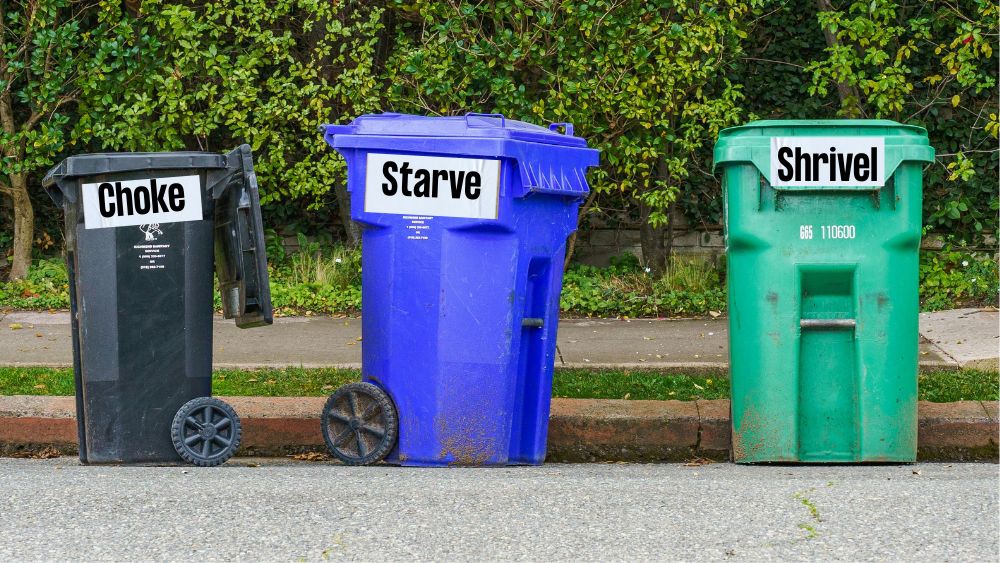
If we keep prioritising emissions other than greenhouse gases, we narrow our choice to shrivelling, though some might choke or starve first.
This article, in terms a small child or Golden Retriever might understand, cuts through the tangled knots and unintended consequences of waste management policy to expose the rubbish problem no one wants to talk about.
Fly-Tipping: nothing to do with insect gratuities
Until British people say ‘fly-tipping’ to a foreigner, most are unaware it’s a local term for a local problem.
When Brits say ‘fly-tipping’ to a tourist or to natives when abroad, they’re met with knitted brows, pursed lips and inclined heads.
Even foreigners who share the same language (Americans, Australians), continent (French, Italians) or tea-drinking island status (Japan, Taiwan) greet any mention of ‘fly-tipping’ with bafflement. Attempts to guess the circumstances under which someone might tip a fly can provoke hilarity.
[Explainer for non-Brits: fly-tipping means ‘the illegal dumping of waste’. If you think we’re pulling your leg, government regulations use the phrase as a legal term, with a maximum penalty of ‘unlimited fines’ and a 5-year prison sentence].
The origin of the phrase involves chucking things out of a moving car window ‘on the fly’, but we’re not mentioning fly-tipping out of etymological (or entomological) interest.
Like metal-detecting, toast racks or ‘punching above our weight’, ‘fly-tipping ’is a term most Brits assume to be universal.
It’s actually a dialect term for a peculiar domestic instance of a universal problem that started with good intentions, and ended in bad practice.
Fly-tipping could be lethal
Fly-tipping turns out to be a little-known case study in our psychological response to climate change.
Unravel this linguistic quirk, and you reveal a universal mess we’d all rather ignore.
First, the unravelling. Search the BBC and other UK news sites for ‘fly-tipping’, and you’ll find page after page of articles that:
- Despair at its rising incidence
- Decry the antisocial immorality of its perpetrators
- Demand more stringent fines, penalties, incarceration etc. to stop it
- Detail the damage it does to local habitats and landscapes
Such responses exemplify how our go-to toolkit for problem-solving, evolved over our 300,000 year existence, is not useful when we’re confronted with a planetary-scale existential threat.
Our instinct is to focus on small, immediate problems that seem soluble. The more obvious the perpetrators, the more we’re absolved of any responsibility to take action.
Best of all are problems that only require us to fulminate from our moral high ground, and throw rotten tomatoes at Those To Blame, instead of composting them.
Much easier to blame evil fly-tippers than ask who’s creating all the rubbish they make so awkwardly visible by the side of the road. Asking why our waste management systems are failing is harder when we suppress our self-righteous instincts, and apply critical thinking instead.
Fly-tipping typifies the human condition. We’d all much rather ignore big problems. We’d prefer to criticise the idiot who painted the lifeboats that colour, while ignoring or shouting down anyone trying to point out the ship is sinking.
Fly-tipping could kill us all, but not for the reasons most people, British or otherwise, understand.
Rubbish Basics
A seven-step history of our rubbish problem:
- When we just made what we needed, we produced no waste.
- When we started making what we wanted, we started producing waste.
- The more we want, the more waste we churn out.
- The more of us there are, the more waste we churn out
- To deal with our waste, we deploy the 3 Bs: Bury, Banish or Burn.
- We could keep making things we need and want, by recycling, but generally don’t.
- Unless we recycle more and/or churn out less waste, we’ll kill ourselves by Choking, Starving or Shriveling.
For more detail on 1-6, see the links at the end of this article.
To find an alternative path to 1-6’s highway to hell, we first need to understand where we are now. This article examines our current suicidal choices for 7.
Why are our current ‘waste management’ options going to Choke, Starve and Shrivel us? It’s because we’re running out of Bs.:
- Bury (= ‘landfill sites’): we’ve run out of holes
- Banish (= ‘exporting for processing’): we’ve run out of ‘away’ to ship our rubbish away, as everyone has too much of their own now.
- Burn (= ‘waste incineration’): has been our go-to carpet to sweep our rubbish under, but the carpet is now too small, the rubbish too big, and the stink too great to ignore any more.
This might be more obvious if we re-labelled our colour-coded ‘recycling’ bins, much of whose content ends up in incinerators.
- Rip off ‘Household Waste’, ‘Plastics’ and ‘Compostable’.
- Stick on: ‘Choke’, ‘Starve’ and ‘Shrivel’
Choking apart
For ‘Choke’, read ‘air pollution’. These are the nasties we usually think about when opposing waste incinerators in our back yard:
- dioxins
- furans
- heavy metals (lead, mercury)
- acid gases
- toxic fly
- bottom ash
- etc.
These are the emissions that cause cancer, respiratory diseases, and developmental retardation. The ones you see resolved in Hollywood movies.
Choking is why no one ever welcomes proposals for new incinerators, no matter how big the investment or how many jobs they may create.
That’s because we all know, or can imagine, what would happen if we tipped out our recycling bins onto a bonfire.
Keep burning waste, and we choke.
Starving point
‘Starve’ is a bit less obvious. Among all the nasties that choke us, are chemicals that poison our local soil and disrupt food systems.
Some of these are the same ‘toxins’ and ‘forever chemicals’ (PFAs) that ‘leach’ from landfill sites. Both make farmland unfarmable.
They include nitrogen oxides (NOx), a ‘group of highly reactive gaseous compounds composed of nitrogen and oxygen, significant air pollutants that pose a serious threat to environmental quality and human health’.
NOx emissions induce respiratory problems in livestock (not to mention humans), acid rain, and ground-level ozone.
Keep pumping it out, and we’ll no longer be able to feed our growing numbers.
Keep burning waste, and we’ll Starve.
Shrivel most uncivil
‘Shrivel’ is what will happen if we keep finding more pressing reasons to delay weaning ourselves from our fossil fuel addiction, and keep burning waste.
If you’re confused as to what waste incineration has to do with climate change, you’ve been successfully greenwashed by the waste incineration industry.
Their misdirection skills in avoiding this obvious problem with their business would impress a conjurer. Their chutzpah in claiming burning plastic is a ‘renewable’ energy resource is admired, and amplified, by demagogues in the pocket of Big Oil.
Plastic is made of oil. Burning oil heats our planet. Therefore, burning plastics heats our planet.
Keep burning waste, and we’ll Shrivel.
Sick Burn
Before asking if there’s anything we can do about this, here’s a fact that’s a relatively minor contributor to the waste incineration’s greenhouse gas emissions, but is so rich in irony, we could recycle it as irony-ore.
This pub quiz gotcha fact helps explain why ‘fly-tipping’ is a uniquely British word.
The science is explained in detail elsewhere, but here’s all irony-fans need to know about this case study in good intentions having unintended consequences, and focusing on lifeboat colour schemes distracting us from ships sinking.
Britain can claim to have been relatively ‘responsible’ about its rubbish. After all, many countries who’ve run out of Bury and Banish options simply Burn their rubbish in vast open pits, sending all those toxins directly into the air to Choke, Starve and Shrivel us.
Britain, by contrast, has an elaborate and quite stringently-enforced set of regulations about burning rubbish. Japan, which burns 70% of its rubbish, has even fancier technology.
But all these regulations are directed towards the Choke and Starve risks, and ignore or barely mention the Shrivel risk.
The awkward fact is that however much of the toxic nasties your hi-tech incinerators, scrubbers, and pelletization equipment might remove from the smoke before it leaves the chimney stacks, it sends exactly the same amount of CO2 up into the air to heat our planet.
But not ‘exactly’, exactly. UK regulations that prioritise Choking and Starving over Shrivelling, actually increase the Shrivel risk.
UK regulations incentivize waste incinerators to use chemical and heat processes, involving ammonia and urea, that reduce the volume of NOx emissions. But these actually increase the volume of CO2 emissions.
Call it the School of Hard NOx.
Why fly-tipping ‘scandals’ miss the point
This NOx irony-ore nugget reveals more than just how contradictory government regulations can be, or how good intentions can have bad consequences.
It’s also symptomatic of a much bigger, much more intractable problem, for which we all need to take responsibility now.
Instead of blaming others for relatively trivial things, we should all confront the big problem and take action ourselves.
The problem is not information, but storytelling. It’s been decades since the problem with global heating and the greenhouse effect was ‘raising awareness’. We’re all perfectly aware, we just feel powerless to do anything about it.
The obstacles to carbon drawdown are well known and becoming more obvious by the day. They are formidable, funded by fossil fuel profits, and delivered by accomplished storytelling manipulators.
They are experts in inducing despair and denial in us. Both suit their purposes just fine, as they both result in inaction.
In waste management, minor but much-heralded, improvements in recycling, mask the very inconvenient truth that the richer we get, the more stuff we buy, and the more waste we create.
Our consumption shows no sign of slowing. Indeed, our governments still frantically promote ‘growth’.
A declining number of governments still bother to make lofty-sounding but unbinding, assurances at annual COP meetings, that ‘emissions reduction is our number one priority’.
The final photo-op completed, our leaders return home to spend the 50 weeks before the next COP doing the opposite.
There turn out to be loads of ‘priorities’ that trump emissions reduction: growth, jobs, savings, strategic interests, national interests, return on investment…
It’s ironic that on the rare occasions our leaders are publicly confronted with this hypocrisy, they often explain that unfortunately they’re obliged to operate in ‘the real world’.
Most of us nod sagely, as if the world of politics were more ‘real’ than the one governed by the laws of atmospheric physics.
We nod along because sweeping stuff under the carpet requires very little of us.
Our mountains of rubbish, growing every day, are the bits they can’t sweep under the carpet. Periodically, particularly huge piles of fly-tipped rubbish churn out headlines like ‘shocking’ mountain of waste.
The language used is usually reserved for organized crime or natural disasters.
But the waste was created not by mobsters or acts of God, but by us.
Good news or bad news?
If our media focused on our species’ survival, rather than inter-species finger-pointing, here are the news headlines for people who care about the rest of their lives, their children/grandchildren, or are fans of human civilization:
- ‘Good news’: the global population is set to peak at 10.3Bn in the mid-2080s, after which per-capita waste will presumably diminish. Unless something catastrophic like an asteroid or virus kills loads of us sooner.
- Less good news: there are already 8.3Bn of us, all producing more waste as we get richer, so it’s not necessarily true that fewer people means less waste. Unless capitalism collapses between now and then.
- Rubbish news: our current approach to ‘waste’ might kill us in three different ways, imitating the impact of an asteroid or virus.
- The least-worst news: tweaks to waste management policy could mitigate all three of our current suicide preferences.
If you’re fine with you, your children/grandchildren Choking, Starving or Shrivelling, or aren’t that into human civilization, at least your choices are now informed.
If you want to do something about it, you could start with telling your legislators you’ll only support them if they ban waste incineration and incentivise reducing waste and promote recycling.
Further reading:
Other See Through Rubbish articles. Each takes a different angle on our perception of the waste issue, with the goal of mapping out how effective climate activists can sort the useful bits from the rubbish, and use these recycled parts to build a sustainable future.
- Why Waste Time In A Time Of Waste?: asks what on earth we’re all waiting for.
- Litter and Rubbish: A More Complicated Climate Challenge Than You Might Think: Rashomon-style litter-ary mini-screenplays on the emotional reality behind throwing stuff ‘away’.
- How To Explain Burning Waste To A Child, Alien or Legislator: reveals, in terms a child can understand, our actual options for dealing with ‘waste’.
- The Big But – climate action, inaction and self-delusion: reveals, also in terms a child can understand, the inertia behind addressing our increasingly urgent waste issue.
Why Do We Let Strangers Set Fire To Our Bins? asks what happens after the bin men take our rubbish ‘away’, who we should be listening to for the sustainable solutions, and how we can act.