
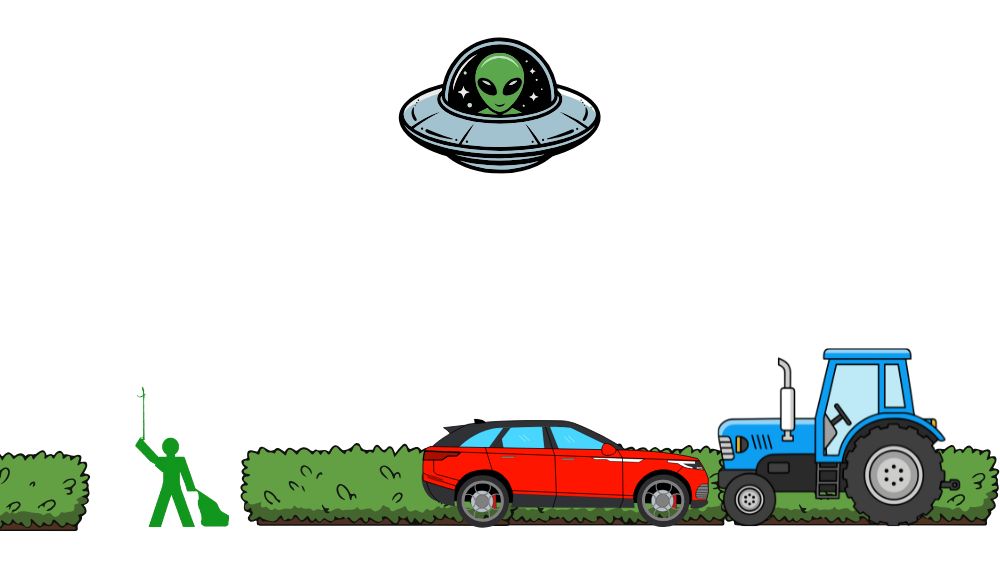
Is climate action on litter a rubbish idea, a waste of time in a time of waste? A circular economy is the only path to a sustainable future, but our attitude to waste is more psychologically complicated than most of us realise.
This is part of a series of See Through Rubbish articles examining the climate impact of rubbish. These litter-ary mini-screenplays focus on the emotional reality behind how we view throwing stuff ‘away’.
Three trash talk perspectives
Here are three interconnected screenplays.
Rashomon-style, each describes the same incident from three different points of view (POV):
- Litter-bug
- Litter-blind
- Litter-picker
Most readers, whatever their political opinions or stance on environmental policy, should at least be able to understand the emotional impulses and responses each scenario describes.
POV 1: Litter-bug
SCENE: Daytime interior, red family estate car driving along country lane, THREE YOUNG CHILDREN in the back seat, DAD driving and MUM in the front passenger seat.
- THREE YOUNG CHILDREN clamour with competing demands for their favourite music to be played.
- Shuffling a deck of CDs featuring different primary-coloured anthropomorphic animals, MUM gives up negotiating. She shoves the first one to hand into the CD player and shouts at the children to shut up and they’ll all get their turn as it’s a long trip.
- Annoying children’s music starts playing. The victorious child shouts for it to be played louder. MUM turns it up, drowning out the continuing objections of the other two.
- MUM slumps in her seat. DAD glances over, worried. They both wince at the music. THREE YOUNG CHILDREN now start fighting over who stole whose French fries.
- The back seat is a mess of fast food packaging, discarded pickles and dropped food.
- DAD shouts from the front, trying to keep order. MUM stares ahead.
- DAD, knuckles white on the steering wheel, struggles to keep his eyes on the narrow lane with its high hedges and sharp corners. He places a tender hand on MUM’s knee, and quietly beseeches her to do something to shut the kids up.
- MUM sighs, takes a deep breath, and twists to face the rear. Through shouting and bribery she gets the children to collect most of the rubbish into a single plastic bag. This reduces the mess, but not the bickering, which grows even louder.
- MUM, plastic bag in her lap, starts to cry silently.
- DAD, glancing at her distress, gently tells her she’ll feel better once the mess is out of the car, as there’s a long journey ahead.
- DAD looks down to find the button to wind down the passenger side window.
- A tractor suddenly appears round a corner, driven by a wide-eyed FARMER, who smashes his horn in alarm.
- DAD slams on the brakes, swerves to the side of the road.
- Parents and children sit in silent shock as the tractor thunders past, missing them by an inch.
- The FARMER’s curses are drowned out by the sound of his horn. In DAD’s driver-side wing mirror we see him shaking his fist as the tractor rumbles out of sight.
- Shaking, her pale face streaked with tears, MUM silently drops the plastic bag out of the car. We hear the noise of DAD winding up her window.
- DAD pats MUM on the knee, gives her a tender look.
- Wordlessly and carefully, DAD drives off. The THREE YOUNG CHILDREN, briefly silenced by shock, quickly resume their shouting and bickering at even louder levels.
- In MUM’s passenger side wing mirror, we see a RAMBLER holding a half-full bin bag in one hand and waving their litter picker in the other.
- MUM is oblivious, staring ahead, lost in her private despair.
POV 2: Litter-blind
SCENE: Daytime exterior. A blue tractor drives across a recently ploughed field, pulling a trailer piled high with manure. Switch to tractor interior POV.
- FARMER sings along to a pop song on the tractor radio, his voice barely audible above the engine noise.
- FARMER approaches an open gate, comes to a complete stop, leans forward, looks in both directions, carefully inches out, turns carefully along the narrow country lane and gathers speed.
- Turning a bend, a red family estate car suddenly appears. FARMER slows slightly. Close-up panicked face as FARMER suddenly realises the driver hasn’t seen or heard him.
- FARMER swerves to the edge of the lane, smashes the horn.
- The tractor misses the car by an inch. As FARMER passes, he sees three shocked children in the rear seat.
- FARMER shouts abuse at the car driver, cursing his recklessness and selfishness, waving his fist through the open window in rebuke.
- In the tractor’s wing mirror, we see a plastic bag dropped from the car’s passenger window into the hedge and a RAMBLER holding a half-full bin bag waving a litter-picker at them.
- FARMER continues to rage at the car driver’s careless driving, still muttering to himself as we see the red car pull away in his rear view mirror.
POV 3: Litter-picker
SCENE: Daytime exterior. A RAMBLER walks by a hedge in a ploughed field.
- RAMBLER, sensibly dressed in a jacket festooned with badges showing various logos featuring trees, globes and charismatic macrofauna, takes a neatly-folded black bin bag from their jacket pocket and shakes it open.
- RAMBLER walks along the edge of a field, bin bag in one hand, litter-picker extendible grabber in the other.
- RAMBLER glances up to see a distant blue tractor trundle across a ploughed field, pulling a loaded trailer bumping along behind.
- RAMBLER, humming a folk tune, methodically picks rubbish from the hedge, transferring various items of litter from hedge to bin bag: crushed drinks cans, crisp packets, plastic bottles, fast-food packaging.
- The RAMBLER’s expression alternates between a frown and pursed lips as each item of litter is spotted and grabbed, and a small smile and nod as it disappears into the expanding bin bag.
- Just as RAMBLER passes an open gate, a red car slams on the brakes, the blue tractor sounds its horn, and misses the stationary car by an inch.
- RAMBLER rushes through the gate.
- As the tractor drives on behind, still sounding its horn, a woman’s hand emerges from the red car’s passenger window, dropping a plastic bag full of rubbish into the hedge.
- The plastic bag immediately opens, spilling fast food packaging into the hedge the RAMBLER has just cleaned up.
- RAMBLER starts shouting and waving their litter-picker at the car as it pulls off, oblivious.
Emotional rubbish
What these three perspectives share are powerful emotions triggered by the same ‘inciting incident’.
The objecting of this inciting incident is what Hitchcock popularised as a ‘McGuffin’ ‘an object or device in a film or a book which serves merely as a trigger for the plot’.
For the Litter-bug parents, the litter-blind farmer and the litter-picker rambler, the McGuffin is the plastic bag of fast food packaging ejected from the car.
The emotions attached to this McGuffin are equally powerful, but completely different from each viewer’s perspective.
Litter-bug emotions
We identify with the beleaguered parents, besieged by their bickering back seat offspring. They’re trying to do the right thing, but under intolerable pressure make bad choices.
There are no exterior establishing shots. Viewers are delivered straight into the claustrophobic noisy car interior, and we stay inside with them the whole time.
For however long their nightmare journey continues, the interior of this car will continue to constitute their universe.
We can completely understand their desire to keep their little world free from rubbish.
Litter-blind emotions
Meeting the farmer via an establishing exterior shot immediately places him in the broader context of his relationship to his workplace, the fields and hedges.
Once in the tractor cabin, his behaviour reveals him to be careful and considerate of others. Sharing his perspective, in the cabin of his massive tractor as he negotiates pulling his fully loaded trailer along narrow country lanes with high hedges, he comes across as a good guy who cares about other people.
His reaction to the near-miss crash with a thoughtless car driver who’s not as attentive as he is (or we’d be) is understandable.
After a near-fatal collision, why should he be distracted by the sight of one more bag of rubbish disappearing into his hedge? It’s just not as urgent or important.
Litter-picker emotions
Even if we don’t share the political affiliations suggested by the Rambler’s collection of right-on badges, or their taste in folk music, we appreciate their litter-picking action.
Seeing rubbish in the countryside grates with us just as much. Thank God there are volunteers like the Rambler who devote their spare time to clearing up after those morons/idiots who treat anything outside their car like a trash can.
We share their frustration and outrage at seeing the hedge they’ve only just cleared of litter polluted again within a minute by some careless, selfish drivers.
A fourth dimension
What are we to make of these three, equally compelling, equally relatable, but competing emotions?
Who’s Right? Who’s Wrong? With social media amplifying our tendency to judge, blame and see things in binary terms, how are we to respond to these three competing claims on our emotional attachments?
Maybe a fourth perspective might help.
POV 4: Scientifically Litter-ate
SCENE: Outer space. A spaceship hovers over the planet Earth. In the cabin, a reassuringly humanoid, but unmistakable non-human ALIEN. Charlie Mingus’s Goodbye Pork Pie Hat plays in the background.
- ALIEN hums along to the music, audible above the alien spaceship’s bleeps and clicks.
- ALIEN’s various eyes scan a huge array of screens, a few show images in green, a few more in grey, but most show images in red.
- A few of ALIEN’s lower tentacles tap away on other screens in a manner that suggests it is taking notes.
- Each screen displays a live-stream of different scenes from Earth, each with a dot on a map to show its location: an oil refinery in Oman (red), a cruise ship in the Caribbean (red), a data centre in Belgium (red), rain forest in Brazil (green), a crowded beach resort in Spain (red), an office block in Sweden (grey), a pig-farm in China (red), a school in Uganda (grey), a refugee camp in Pakistan (grey), recycling plants in Dallas (green), a forest in New Zealand (green) etc.
- Among the indecipherable alien script, each screen has one legible element. A number, changing by the second with the unit ‘CO2 equivalent’, conveniently in English.
- We gradually realise the green screens show the number decreasing. The grey screens show nothing changing. The red screens show the number increasing.
- Something that looks like a phone rings. ALIEN picks up the receiver in one tentacle, and holds it to the largest of its ears.
- A subtitled radio conversation reveals the ALIEN is reassuring its parents that they are indeed studying hard, monitoring the impact of human activities on the Earth’s atmosphere as part of their college anthropology graduation project.
- Cutaway to a central, bigger monitor, also measuring ‘CO2 equivalent’ but with many more zeroes, and the entire planet illuminated. The number is creeping upwards towards a flashing big red cross.
- ALIEN returns the phone-thing to its cradle. It taps a tentacle on a screen, which zooms in on a familiar-looking country lane, seen from above.
- ALIEN tracks the red car. We see the ‘CO2 equivalent’ monitor tick up as it drives along, comes to a brief halt as a blue tractor passes, and continues on its way. The monitor is red. ALIEN makes a note.
- ALIEN now tracks the blue tractor. We see the ‘CO2 equivalent’ monitor tick up as it drives along, comes to a brief halt as it passes the red car, and continues on its way. The monitor is red. ALIEN makes a note.
- ALIEN now tracks the RAMBLER. The ‘CO2 equivalent’ monitor doesn’t move as each item is transferred to the bin bag. Nor does it move when the plastic bag is transferred from the red car to the hedge. The monitor is grey. ALIEN makes a note.
Further reading:
Other See Through Rubbish articles. Each takes a different angle on our perception of the waste issue, with the goal of mapping out how effective climate activists can sort the useful bits from the rubbish, and use these recycled parts to build a sustainable future.
- How To Explain Burning Waste To A Child, Alien or Legislator: reveals, in terms a child can understand, our actual options for dealing with ‘waste’.
- The Big But – climate action, inaction and self-delusion: reveals, also in terms a child can understand, the inertia behind addressing our increasingly urgent waste issue.