
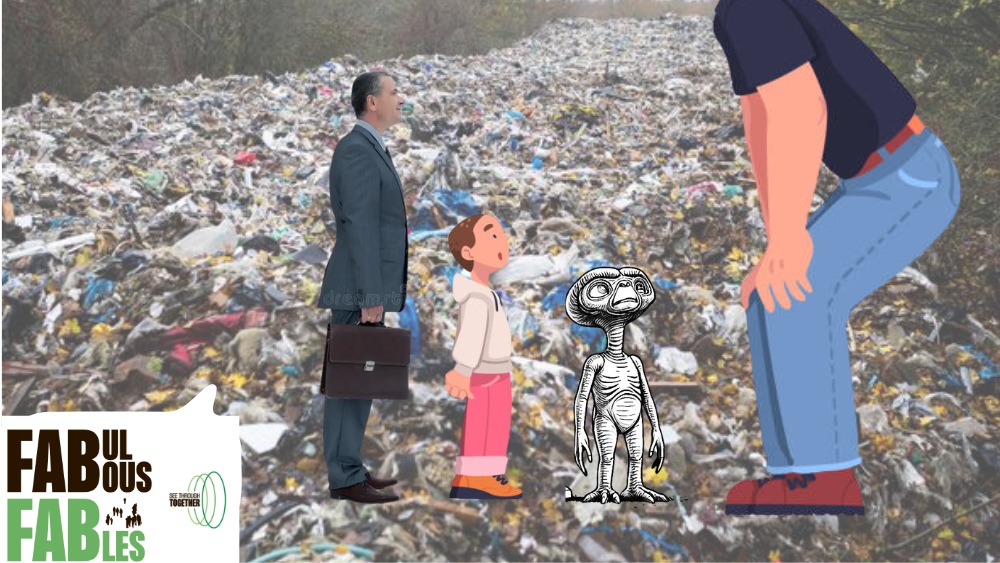
‘Waste-to-Energy’ (WtE) or ‘Energy from Waste’ (EfW) sound way better than ‘burning rubbish’, but they’re designed to conceal the awkward truth that they increase emissions. Incinerating useless stuff to create energy can sound reasonable. Until you try explaining it to a child or visiting alien, or let Big Oil spin their ‘renewable energy’ fable to legislators.
This article tries explaining our profligate attitude to Stuff, as if to a child or passing alien, in the form of a Fabulous Fable mini-history of waste over the past 300,000 years.
Waste: A short tale of Needs, Wants, Enough & Too Much
Chapter 1: Waste-Less
When we were tiny dots on a vast plain, we Needed Stuff.
Stuff was hard to find, harder to make.
We valued what we Needed.
No Wants. No Waste.
Chapter 2: Waste Not
When tiny dots formed groups, we Needed more Stuff.
We found more, made more, started Wanting more.
We valued Stuff we Needed and Wanted.
Waste not. Want not.
Chapter 3: Waste Full
When groups grouped, we dug up black stuff, burnt it for fuel.
We burnt more, found more, made more, Needed a bit more, Wanted much more.
We valued Stuff less, as Needs and Wants blurred.
Waste more. Want more.
Chapter 4: Waste Land
Now one huge group, we burnt, found, made, Wanted and Wasted more.
We buried Waste till the holes filled up. Threw it away, till there was no more ‘away’. Burnt it till we choked.
Not valuing Waste, we drowned in it.
Waste more. Value less.
Chapter 5: Why Waste?
Waste is Need-less.
If we Want less, we Waste less.
No need to dig holes, search for ‘away’, burn, choke or drown.
Want less. Value more.
**
Glossary
For grown-up, humans, or non-legislators who find this children’s story too simple, or too obscure, here’s a short glossary of key terms that might make its purpose* clearer.
We’ve provided two definitions:
A) for grown-ups, including some legislators
B) for children, aliens, and other legislators
Waste (n)
A) unwanted or unusable material, substances, or by-products
B) stuff no one wants
Raw material (n)
A) feedstock, unprocessed material, or primary commodity; basic material used to produce goods, finished goods, energy, or intermediate materials/goods
B) stuff to make things from
Recycle (v)
A) act of converting waste (qv) into new materials and objects
B) using old stuff to make new stuff
Circular economy (n)
A) resource production and consumption that involves sharing, leasing, reusing, repairing, refurbishing, and recycling materials and products, to extend product life cycle for as long as possible; interconnecting principles, such as the ‘5 Rs’ of Refuse, Reduce, Reuse, Repurpose, Recycle designed to promote sustainability and mitigate the worst impacts of human-induced climate change
B) not using more stuff than we have, only using the stuff we need, even if it means not always getting all we want
Recyclable (adj)
A) materials or products that can be used again after they have been treated using special industrial processes
B) how people who burn stuff pretend they don’t, or blame you
Sustainability (n)
A) the ability to continue over a long period of time; matching resource with needs
B) not using more stuff than we have, only using the stuff we need, even if it means not always getting all we want
Community (n)
A) a group of people with shared socially-significant characteristic(s), such as location, norms, culture, religion, values, customs and identity; the result of making us one with everything
COP (n)
A) acronym for Conference Of the Parties, the supreme decision-making body of the signatories to the United Nations Climate Change Convention. All States that are Parties to the Convention are represented at the COP, at which they review the implementation of the Convention and any other legal instruments that the COP adopts and take decisions necessary to promote the effective implementation of the Convention, including institutional and administrative arrangements.
B) a fortnight every year when people in charge say reducing emissions is our top priority, before going home to spend the other 50 weeks prioritising other things.
A rubbish grown-up but
To quote from another Fabulous Fable, ‘The Big But’:
if grown-ups don’t want to hear your tale, they come up with Buts’.
As any child will tell you, grown-ups are really good at coming up with ‘buts’. Here’s a common one on the topic of this article:
BUT doesn’t burning waste create energy that would otherwise come from fossil fuels?
Conflating the first and second part of this question is a common cart-and-horse error. It’s common because it’s propagated by Big Incinerator, and by the politicians their lobbyists have taught to parrot its superficially reasonable logic.
Here’s how to decrypt their rhetorical trick. Think of it as a ‘but crack’.
Part 1 ‘But doesn’t burning waste create energy…?’
Yes, burning waste can be used to generate energy. In the same way that a helicopter can be used to deliver a single potato, a cathedral can be used as a log store, or tax money could be spent on subsidising billionaires.
Just because a small good comes to a very small number of people doesn’t make it a good idea. If generating energy were really the goal, we’d it in the lowest-carbon way, via renewable technology like hydro, solar or wind. Incineration is only exists because it looks like the least-worst solution to our rubbish problem to legislators who don’t believe sustainability is politically attractive.
Part 2 ‘…that would otherwise come from fossil fuels?
Yes, if you assume humanity has no capacity for ever returning to living within its ecological means, as we’ve done for all but the last couple of centuries of our 300,000 year existence? The presumption that we should only consider creating more energy, rather than using less, is the logical fallacy that undermines any demand-side solution to the climate crisis.
What if the tiny amount of energy produced from an unsustainable source (waste) was instead ‘replaced’ by deciding not to use a huge amount of energy for something unimportant or damaging (AI-generated images of puppies in funny hats, the Pope doing the triple-jump, deepfake porn etc.).
A rubbish child or alien’s but
BUT why don’t we make less waste?
* bear in mind the See Through Network’s emissions-reducing Goal of Speeding Up Carbon Drawdown by Helping the Inactive Become Active.
For more about the Network, and how you can help measurably reduce carbon, apply here.