
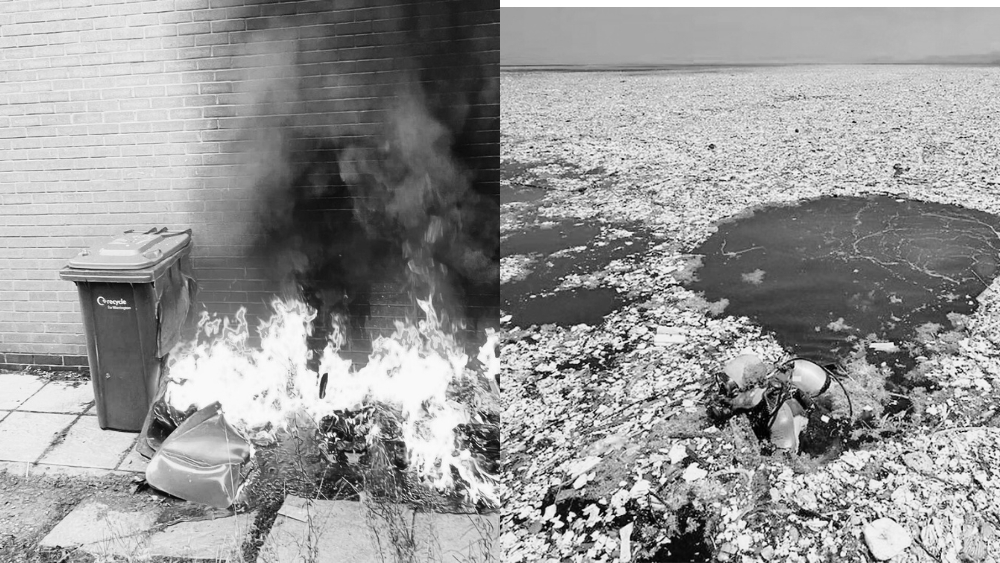
It’s high time to hold our noses, recognise the problem, and take action on the inconvenient reality of our rubbish problem.
This article takes different perspectives on a problem we’d all rather ignore – what happens after the bin men take our rubbish ‘away’, reveals who we should be listening to for the sustainable solutions, and how we can act.
A potted rubbish history
300,000-10,000 years ago
When we were tiny dots on a vast plain, survival was too hard, and resources too precious, for us to waste anything. Rubbish wasn’t an issue, as we didn’t produce any.
10,000-300 years ago
Civilisation brought many upsides, but also a new downside – what to do with the ‘waste’ we now had the luxury of creating.
Our waste problem was still relatively small and manageable. Materials remained hard to acquire and things were still expensive to make. We’d repair and recycle before chucking any ‘waste’ away.
When we did discard trash, there was so much ‘away’, our planet appeared to be an infinitely massive rubbish bin, more than capable of absorbing our waste.
By and large, it was. There were few obvious consequences for chucking trash ‘away’.
300 years ago-now
Industrialisation and globalisation changed everything. More people and more tech meant more stuff. More stuff meant more waste.
As technological advances made our lives easier, and streamlined processes, we valued things less. The result was more and more ‘waste’.
Each advance in living standards eroded the remaining amount of ‘away’. Our volume of trash has long surpassed our environment’s capacity to absorb it.
Planet Trash-can has been overflowing for some time now. Our mess is getting harder to ignore.
We’ve soiled ourselves. The longer we try to style out our ‘little accident’, the worse the stench becomes, and the harder it is for even the most polite, considerate noses to ignore.
Darling, have you put the bins out?
Few of us ever visit the Great Pacific Garbage Patch, because it’s in the middle of the ocean.
Out of sight, out of mind. To call ourselves ostriches sticking our head in the sand is a disservice to ostriches (they’re actually checking on their nests) and a demonstration of our ignorance, anthropocentric arrogance, and preference for a good story over facts.
But once you’ve seen the Great Pacific Garbage Patch, or realised it’s the same size as Mongolia, or Iran, it’s hard to put from your mind.
Once seen, it’s hard to unsee. Think of all those emotive images of albatross stomachs full of plastic junk, seals choked by discarded fishing nets, or turtles suffocated by plastic bags.
But that plastic all comes from us. Connecting such upsetting images with our domestic chores like putting the bins out is not something we choose to think about, or feel responsible for.
But in the real world, ignoring our rubbish problem makes it worse, not better.
As householders, we know the drill:
- Separate bins for different types of waste.
- Put the right trash in the right bins.
- Put the right bins out on the right day.
- Pay your taxes, and ‘the government’ will take our rubbish ‘away’.
- Repeat next bin day.
We’d rather not know what actually happens to our rubbish once the bin lorry disappears down the street.
After going to all that trouble to clean and separate our ‘recyclable’ plastic, we wouldn’t be happy to learn most of it ends up being burnt, but neither are we particularly curious to find out.
Anti-incinerator activists like the UK Without Incineration Network (UKWIN), Zero Waste Europe and Zero Waste International Alliance (ZWIA) provide all the unpleasant facts and figures.
Such activists support local campaigns to stop incinerators being built in particular back yards, often successfully, but have yet to succeed in persuading powers-that-be to simply ban waste incineration.
Our rubbish problem is more complex, once we zoom out from our narrow consumer or taxpayer points of view.
What’s it like for the other players?
Here are four other perspectives on our rubbish problem:
- Powers-that be
- Business
- PRs, Advertisers & Spin Doctors
- Boffins, Aliens & Children
See if you can spot which two are currently resulting in more rubbish, which one reduces rubbish, and which one does both.
And which one chimes with you, and might move you to take action beyond your bin-day chore.
1: Powers That Be: Let It Be
There’s a reason you can’t name a celebrity night-soil collector. Clearing up rubbish has never been a high-status, or much-appreciated job.
The same is true for the powers-that-be charged with dealing with our waste.
For anyone in charge – whether in a household, local council, regional authority, or ministry, and whether in a democracy or autocracy – dealing effectively with waste has always been a chore.
If you think putting out the bins is a thankless task, try dealing with what’s in them. That’s the hard bit.
If you want to be popular, throw a party, but few notice, let alone thank, the anonymous figures in masks and hi-viz jackets who show up in the morning to clear up the mess. Tat and bling trump litter-grabs and binbags.
Leaders are more likely to be popular if they focus on consumption and growth – party time! Do this and your people will like you, but it means you have more stuff, and more waste, they expect you to deal with.
Whether elected representatives seeking re-election, or autocrats securing their power, leaders are left holding the bin bags and wondering what to do with them.
A child can understand their favoured ‘B’ options – bury, banish or burn. But a smart kid might also point out the less favoured ‘R’ options – reduce, re-use, recycle, repair, re-design etc.
If you’re in charge, why make things hard for yourself? If ‘B’s are the norm, why bother with the trouble of switching to ‘R’s? Easier to keep sweeping things under the carpet.
Until you run out of carpet.
Or, until the people who vote you in, or on whose approval you depend, start holding you to account (skip to the end if you’re already in, and want to take action).
Ordinary householders do have leverage. Even leaders who promise their citizens they’ll ‘Drill, Baby, Drill’ baulk at ‘Burn, Baby, Burn’.
2: Business: Where There’s Muck, There’s Brass
There’s always been money for those prepared to get their hands dirty. Not just figuratively, money-laundering, drugs-running, arms-dealing, human-trafficking, extortion etc. – but also the less lucrative literal version of being the people you hand the bin bags to.
This is not a new business, but it has gone by different names. Noddy Boffin, the ‘Golden Dustman’ of Dickens’ final novel Our Mutual Friend (1865) inherited a fortune based on finding value from Victorian-era rubbish.
Victorian-era London already had a considerable rubbish problem. What they called ‘dust heaps’ have bequeathed us words like ‘dustbin’ and ‘dustmen’.
Our trash heaps have ballooned since then, but these days we’ve re-branded the business of dealing with them as ‘waste management’.
Waste management companies are capitalism’s answer to the waste problem. They see themselves as being in the business of making our ‘waste problem’ go ‘away’. But waste management is an odd business in more ways than one.
Waste management companies are conjurers, making things disappear into thin air. Status-wise, they’re akin to Mehatar members of India’s Dalit ‘untouchable’ caste, assigned the role of ‘manual scavengers’. In our daily lives, they’re the anonymous figures in masks and hi-viz jackets quietly sweeping our mess under rugs while we nurse our hangovers.
The scale of our rubbish problem means they’re also now multi-million dollar industrial conglomerates, but the cognitive dissonance with which we view the rubbish problem has made them uniquely odd conglomerates.
Driven by the powers-that-be’s need to fix their growing dirty problem, waste management companies have organised themselves into convenient, one-stop shops.
But ecologically speaking, waste management companies are Pushmi-Pullyus, with different divisions cancelling out each other’s emissions results.
Their incineration divisions create greenhouse gases (along with all those pollutants and particles), while their recycling divisions reduce emissions.
Yet they offer reward – or risk – to the same shareholders.
Are investors actually investing in ‘waste management’, or in rubbish burners and recyclers who, weirdly, share the same offices?
3: PRs, Advertisers and Spin Doctors: Look here, not there!
Within the Madison Avenue hierarchy, French perfume accounts probably carry higher status than waste management clients. Same job, though:
- Tell the stories that make us look good, avoid those that make us look bad.
- Draw attention to the recycling bits, not the burning bits.
- Keep it light – talk about ‘saving the planet’, not polluting it.
- Behold our recycled metal and glass, not our incinerator chimneys.
- Don’t interrogate our badging of burning rubbish as ‘Energy from Waste’ too carefully. Just believe it’s ‘renewable’, even if the plastic we’re incinerating is made of fossil fuels.
- Don’t ask us exactly how much of the waste we burn is plastic, or recyclable material. We know the answers, of course, but would rather not let them be known.
Not an easy job then, if your clients both create and reduce emissions. And you have to dry-clean your clothes after a site visit.
Any chance of a sniff at the Dior perfume account instead?
4: Boffins, Aliens & Children: The grown-up choice, ironically
Scientists, like aliens and children, tend to focus on awkward questions everyone else would rather not ask, let alone answer.
They’re not amenable to ‘Not In My Backyard’ logic, whether the backyard is literal, local, regional or planetary.
For under-rug sweeping to work, you need everyone to buy into ‘out of sight, out of mind’.
Boffins, aliens and kids just don’t get it. They ask questions like:
- And what happens after the bins are taken ‘away’?How many times can you ‘recycle’ plastic?
- What’s plastic made from?
- Why does no one want a waste incinerator in their back yard?
- Why are we letting those strangers set fire to our bins?
- ‘R’ solutions that return us to a sustainable path exist – wh
- What’s the difference between ‘recyclable’ and ‘recycled’?
- y don’t we adopt them?
The last question seems the most perplexing – or the hardest to explain to a child or alien.
Why, when we have ‘R’ solutions and technology to hand (industrial design, recycling tech, sustainable packaging, subsidies, incentives, taxes, regulations etc.), do we persist in putting up with ‘B’ solutions that pollute, destroy, heat and choke us and future generations?
Pick a side, take action
We hope by now it’s clear that:
- We’re consenting to letting our governments, and spin doctors be part of our rubbish problem.
- Businesses are currently both part of the problem, and the solution, depending on their business.
- Scientists can direct us towards paths that lead to sustainability, if we choose them and convince our governments to legislate and enforce them.
Technology has created our trash problem, but it can also solve it. The path to a waste-free circular economy will be very different from the one we followed when we were tiny dots on a vast plain, but it could lead to the same sustainable destination.
It should also be clear that remaining passive householders, dutifully separating our rubbish for the bin collectors to take ‘away’, guarantees that nothing will change.
To take action: visit www.seethroughnetwork.org
Further reading:
Other See Through Rubbish articles. Each takes a different angle on our perception of the waste issue, with the goal of mapping out how effective climate activists can sort the useful bits from the rubbish, and use these recycled parts to build a sustainable future.
- Why Waste Time In A Time Of Waste?: Asks what on earth we’re all waiting for.
- Litter and Rubbish: A More Complicated Climate Challenge Than You Might Think: Rashomon-style litter-ary mini-screenplays on the emotional reality behind throwing stuff ‘away’.
- How To Explain Burning Waste To A Child, Alien or Legislator: reveals, in terms a child can understand, our actual options for dealing with ‘waste’.
- The Big But – climate action, inaction and self-delusion: reveals, also in terms a child can understand, the inertia behind addressing our increasingly urgent waste issue.