
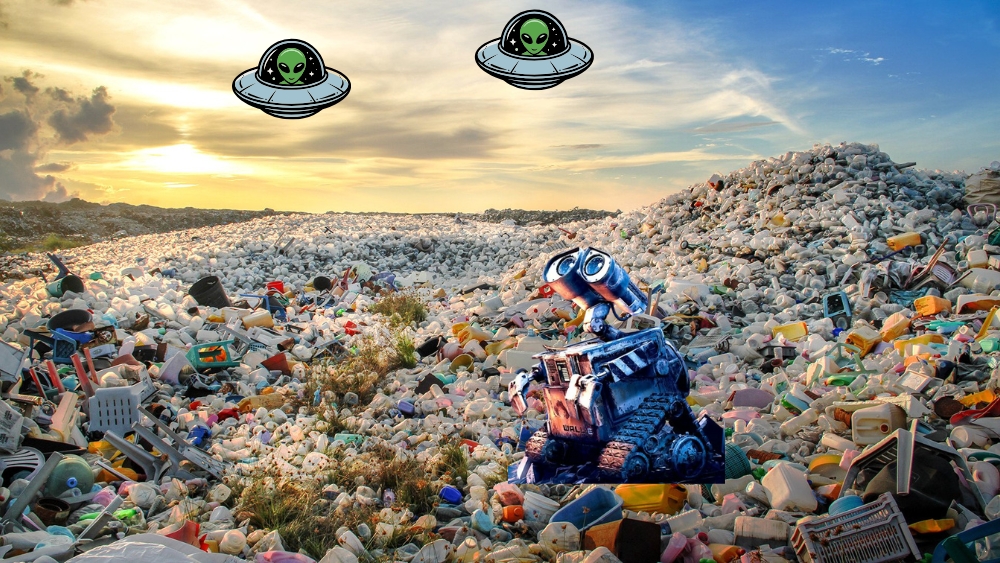
We’re so used to the idea of throwing things ‘away’, we struggle to adapt to the reality that we’ve run out of ‘away’. Trash-can Earth started overflowing a long time ago – why do we still keep chucking our rubbish at it?
This article looks at the evolution of our understanding of our ‘waste problem’. It’s part of a series of rubbish articles examining the issue of waste to help effective climate activists sift useful bits from time-wasters. Let’s recycle these recycled parts to build a sustainable future.
Our Rubbish Problem
There was a lot going on in the 1960s.
In hindsight, we were focused on the wrong things.
Civil rights, proxy wars, nuclear war, anti-colonialism, racism etc. were big problems. Still are.
It’s just that in the decades during which those bandana-wearing hippies became baby boomer pensioners, science has revealed what was invisible at the time.
Humanity’s biggest self-inflicted problem turned out to be our fossil fuel addiction.
Here’s to you, Mrs. Robinson
There were clues, now we know what to look for.
The Graduate (1967) is remembered long after most of its contemporary hits lapsed into obscurity.
Supercharged by its Simon & Garfunkel soundtrack, The Graduate’s zinger-packed screenplay, powerhouse performances and iconic production design have come to define the ‘60s zeitgeist.
Its most famous line immediately became part of modern culture
The father of the eponymous graduate (Dustin Hoffman’s Ben) asks his sensible accountant friend Mr. McGuire to help get his confused son back on track. No more affairs with older women like Mrs. Robinson. Time to sort himself out, get a job, find a career, and get with the corporate programme.
Mr. McGuire’s famous sage advice, delivered at a pool party, was:
There’s a great future in plastics. Think about it. Will you think about it?
At the time, this was celebrated as a potent warning against fake, plastic emotions.
Mr. McGuire’s words remain portentous, but their significance has shifted. Originally metaphorical, they became a prediction.
Over the next few decades, Big Oil’s cunning plan to expand the petro-market from fuel to by-products unfolded:
- Our addiction deepened.
- Big Oil multiplied their sales, profits, dividends and share value.
- Plastics entered our lives, oceans, wildlife and bloodstreams.
Now plastics appear to have ‘won’, the focus shifts to the second part of the quote.
Will we think about it?
Hindsight clues
In the 70’s, Mr. McGuire’s prediction became reality. Plastics – convenient, cheap, sterile, flexible – became embedded in our economies, ubiquitous in our shops, and everlasting in our landfills.
Environmentalists were starting to understand our industrial ‘miracle’ came with ecological costs. Clues, obvious with hindsight, were there, but harder to spot at the time. Harder still, was connecting the dots, in the absence of a full understanding of the greenhouse effect.
If future aliens were to pick over the lifeless remnants of what they might call Planet Trash, the more creative alien novelists – Zig and Zog – might compete to write competing versions of Homo sapiens And The Greenhouse Effect, based on the archaeological remains.
Zig, inspired by Agatha Christie, might write a planetary murder mystery. Here are the clues Zig might weave into the narrative:
- Ecologist Garret Hardin’s warnings like Tragedy of the Commons (1968) and Everybody’s guilty – the ecological dilemma’ (1970). Hardin turned the focus away from technology and politics, and towards our emotional and psychological relationship with our environment. But his focus was on overpopulation, not the Greenhouse Effect. Consequently, his legacy today is as a white supremacist eugenicist rather than as a wise futurologist.
- 1970: Earth Day was established as a secular protest against pollution and environmental degradation. Early protests focused on the human health impacts of leaded gasoline, or habitat degradation of oil spills. It would be decades before these were seen as localised instances of climate change.
- 1972: James Lovelock published the first article that formed the basis of his best-selling 1979 book on his Gaia hypothesis, revealing our planet is not just a rock in space, but a living organism. This overtly connected human activity to environmental damage, but for decades was seen as a touchy-feely hippie bible, rather than a scientific hypothesis being proven by emerging data.
- 1978: Exxon’s in-house scientists calculated the disastrous environmental consequences of keeping on burning carbon and how technology isn’t always our friend. Exxon’s executives declined the chance to turn themselves from an oil company into an energy company, suppressed the report, shut the unit, and kept on drilling.
Our murder mystery suicide note
Zog, picking through our rubbish heaps for source material, might decide humanity’s legacy would work best not as an Agatha Christie puzzle, but as a psychological thriller.
What if humanity were a diarist, proudly recording their achievements in their private notebook for posterity, unaware – until it was too late – that they were actually penning a detailed suicide note?
Zog, getting the hang of it after poring over a trove of airport novels, might get the idea of seeding this idea with cunning misdirections.
Zog’s diarist might, for example, mock the political satire Dr. Strangelove (1964), in which nuclear armageddon is triggered through a series of calamitous, avoidable, mistakes and miscommunications. ‘Never happened!’, he might gleefully inscribe.
Zog could have his hapless protagonist heap similar scorn on other Hollywood end-of-the-world disaster movie staples, like asteroid impacts, alien invasions, or zombie infections, dismissing them all as pseudo-scientific fantasies.
What a plot twist, then, when it turns out that the actual existential threat turned out to be the much less dramatic process – drowning ourselves in plastic.
Imagine the ironies, as the author slowly realises:
- Nearly all plastic is actually buried, incinerated, or ends up in the oceans.
- Burning plastic, marketed as ‘Energy from Waste, is actually just another way of burning fossil fuels.
- ‘Recycling’ plastic is greenwash, promoted by the petro-chemical industry.
- Even in theory, plastic can’t be ‘recycled’ like metal and glass; some types can be ‘downcycled’ into inferior products before they end in landfill or floating in our ocean overspill.
- Downcycling turns out to be just as environmentally damaging as burning plastic.
- The more we burn, the more we heat the planet.
So what ‘works’?
The placards carried by ‘60s hippies, their ‘70s successors, and subsequent generations, all reflect the social and ecological consequences triggered by the Industrial Revolution.
Hindsight reveals they’ve always been interconnected.
So what?
It’s not as if the moment climate scientists flagged the greenhouse effect, we all reverted to sustainable lifestyles. We kept partying; emissions continued to rise. Still are.
Historically, successful ‘environmental activists’ campaigns share certain features, in particular:
- They focus on manageable minutiae like localised pollution, specific chemicals or narrow industrial sectors, rather than systemic issues.
- They’re attached to powerful emotions, often fronted by charismatic macrofauna (elephants, pandas, tigers, whales) and/or celebrity influencers (David Attenborough, Julia Roberts, Leo de Caprio).
This approach has many practical merits, but risks missing the bigger underlying problem. Unless these small victories are strategically connected (by storytellers like the See Through Network) they soon become Pyrrhic.
Listening to the scientists
Even celebrity-driven eco-activism has a bedrock of facts and data, exemplified in Greta Thunberg’s exasperated pleas to ‘just listen to the scientists’.
The problem is that humans are not (yet) robots, easily swayed by data. We’re social apes for whom emotion usually trumps reason. Science without story is sterile. Doesn’t get our juices flowing, unlike the anti-scientists who profit from our inaction.
The history of climate science itself reveals a cautionary tale in the limits of science, the weight of unknown unknowns, and the power of storytelling.
Take the greenhouse effect.
The scientist credited with ‘discovering’ the theory, long before it turned into an existential threat, was Joseph Fourier (1768-1830).
Fourier’s many day jobs included being scientific advisor to Napoleon on his Egyptian campaign, road construction supervisor in Grenoble, pioneering Egyptologist, and author of mathematical papers on heat transfer in solid bodies.
Fourier probably died confident his scientific legacy would be Fourier’s Law of Conduction.
But like his contemporary brilliant Industrial Revolution polymath, born of common stock, James Parkinson, Fourier was wrong.
Two centuries later, the names of Parkinson and Fourier are associated not with what they thought was their life’s work when they died, but with idle musings noted in minor papers that lay ignored until, generations later, future scientists spotted their genius insights.
Imagine if in a hundred year’s time, David Beckham was only known for his contribution to medical ethics.
Posthumously, these long-dead Napoleonic Era polymaths were championed by scientists who weren’t even born when they died, remembered for ideas they’d probably themselves forgotten by the time they were buried, and celebrated for their presentiment of phenomena we’ve only recently developed the technology to measure.
Parkinson was remembered not for his extraordinary revolutionary heroism, pioneering papers on geology and fossils, or open-source invention of a surgical truss to relieve the afflictions of factory workers. We know him for his brief medical classic, Essay on the Shaking Palsy, the eponymous disease only linked to him a century after his death.
Fourier too is now best known for what, at the time, was a casual observation. Today, he’s now been posthumously crowned as the ‘discoverer of the greenhouse effect’.
Such barely credible, but true, plot twists, show that even for scientists, it’s not just about the science.
The plastic plot twist
For Zig and Zog’s alien blockbusters on Planet Trash, when might the moment of this slow-motion accidental suicide come?
(By the way, these histories have not yet been written, and are not inevitable. Humans reading this now who are big fans of human civilization, and not so keen on our current path of collective suicide, are welcome to join the See Through Network.
It would be nice if some of us were around to welcome the aliens and show them around our blue dot hanging in space, rather than having them make do with Wall-E robots picking through the remnants of our civilization.)
It won’t be easy. Even the most acute harbingers of doom have taken a while to piece all the clues together.
Edmund Wilson didn’t articulate his famous quote about humanity’s ‘real problem’ (‘we have paleolithic emotions, medieval institutions, and god-like technology’) until 2009.
Zig and Zog could also recycle other Homo sapiens storytelling tropes they retrieve from Planet Trash.
Sifting through our human archive, they might come across:
- The Cassandra Curse of knowing the future but not being believed
- The Specialization Curse, celebrated as the ‘division of labour’ by Adam Smith as the furnace of capitalism, but also a blind spot when, ‘division of attention’ prevented us from dealing with the disastrous environmental consequences of untrammelled consumer capitalism, disposable products, and throwaway culture.
Zig and Zog might find creative ways of showing how these human flaws obstructed scientists from connecting the dots. It takes a deep understanding of science, storytelling and human nature to connect the dots, weave the narrative threads, and translate their micro-stories into stories powerful enough to move people from inaction to action.
What if storytelling turned out to be the pivotal plot twist in a story about mankind’s fatal preference for a beguiling lie over an inconvenient truth?
That’s a hell of a plot twist – but maybe also too complicated for humans.
Maybe only aliens, with the benefit of hindsight and the evidence of a trashed planet, can see the connections.
Simple, complex, rubbish
As the scale of our self-inflicted environmental catastrophe emerges, hindsight makes it easier to realise the issues scrawled on hippy placards at ‘60s protests right up to today’s online memes about (climate) refugees and (climate) wars, are all second-order issues.
We focus on them because they’re a cleaner, simpler, more manageable story, apparently more amenable to clean, simple solutions.
All the while, in the background, ominous and foreboding, are our overflowing trashcans, literal and metaphorical.
While we shout, bicker, march and Twitterspat, the trashcans keep overflowing at an ever-increasing rate.
We shout and rail at anyone and everything. Anything to avoid addressing the underlying problem of our fossil-fuel addiction.
Like any addict, deep down we all know what we need to do, we just don’t want to quit yet.
There are plenty of cures for our fossil fuel addiction. Popular brands include ‘sustainability’, ‘circular economy’, ‘living with our means’, ‘one planet’, ‘planet before profit’ etc.
Our trash cans, landfills, oceans and other rubbish dumps will be a key indicator we’re on the road to recovery.
When our rubbish bins stop overflowing with plastic, we will have decided it’s time to grow up.
Ironically, this was exactly what Mr. McGuire wanted the young graduate Ben to do.
The party’s over. Time to get real. Straighten out. Get back on track.
There’s no future in plastics. Think about it. Will you think about it?
Further reading:
Other See Through Rubbish articles. Each takes a different angle on our perception of the waste issue, with the goal of mapping out how effective climate activists can sort the useful bits from the rubbish, and use these recycled parts to build a sustainable future.
- How To Explain Burning Waste To A Child, Alien or Legislator: reveals, in terms a child can understand, our actual options for dealing with ‘waste’.
- Litter and Rubbish: A More Complicated Climate Challenge Than You Might Think: Rashomon-style litter-ary mini-screenplays focusing on the emotional reality behind how we view throwing stuff ‘away’.
- The Big But – climate action, inaction and self-delusion: reveals, also in terms a child can understand, the inertia behind addressing our increasingly urgent waste issue.