
Bickering about which of our technologies will kill us first, while doing nothing, guarantees disaster. Seeing our polycrisis as an expression of our common humanity might defer Armageddon, if cool heads collaborate to wrest the story back from our emotions and those profiting from inaction.
This article is part of a series on See Through’s policy of using our God-like technology to prolong our existence, rather than truncate it.
Must activists choose which hand to wring?
Ask Silicon Valley what’s going to kill us all, and the answers will largely involve AI.
Ask the poorest in the Global South, and the answers will likely involve drought, floods, famine, or some other consequence of our fossil fuel addiction.
Listen to both, and you might conclude our burning question is whether we should worry about species suicide by:
A) drowning, burning, shrivelling
B) robots
Choosing A or B is a stupid answer to a stupid question (who created this two-item menu at the End of Days café?).
It’s also a very human answer to a very human question.
Before telling their story, any activist should carefully consider the implication behind this stupid/human question – why do we favour making complex issues binary?
In the playground, pub and dinner parties, we find ‘Would you rather…?’ questions funny, intriguing, and narratively satisfying:
- Would you rather find true love today or win the lottery next year?
- Would you rather be 11 feet tall or 9 inches tall?
- Would you rather wear the same socks for a month or the same underwear for a week?
- Would you rather drown or freeze to death?
Opposing one thing against another, ignoring the spectrum in between them, or other factors, comes naturally to us.
As well as being a practical survival strategy (Fight or Flight, when faced by a sabre-toothed tiger), viewing the world in black-and-white is a useful cognitive tool and an irresistible linguistic snack.
Philosophers, mathematicians, comics, and their audiences, deploy reductio ad absurdum (Latin for “reduction to absurdity”), exposing illogic by juxtaposing the start and end points of an assertion:
- If that’s true, pigs can fly
- (n x u)² = 2(m x u)²
- Never say never
But when the consequences of our actions extend beyond a fight-or-flight decision, or involve multiple factors spread over time and space, binary thinking becomes more of a hindrance than a help.
Complex solutions to complex problems require us to understand this mechanism, how it work.
And how to co-opt it, instead of trying to change human nature.
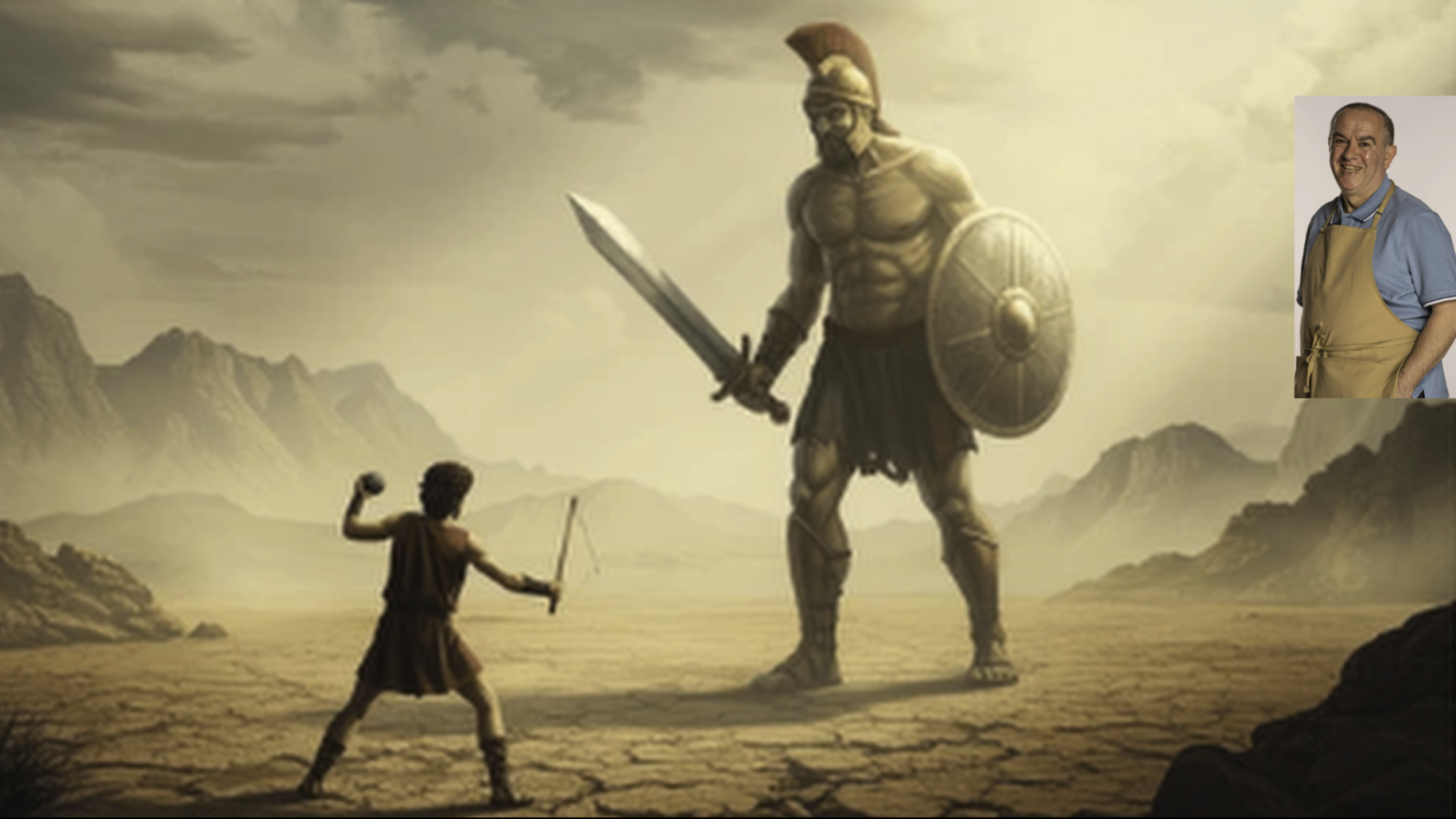
David vs Goliath vs Keith
Framing binary options simplifies storytelling.
There’s a reason why David vs Goliath vs Keith sounds ridiculous. For the same reason, you’ve not seen Alien vs Predator vs Godzilla.
Both are one too many.
Unlike the Rule of Three, a narrative tool which smooths the path from Problem A to Solution Z, three’s a crowd when it comes to A and Z. Consider:
- 1-Thing Titles: Scoop, Deliverance, Genesis. Classic.
- 2-Thing Titles: War & Peace, Romeo & Juliet, Hansel & Gretel. Balanced.
- 3-Thing Titles: The Lion, The Witch & The Wardrobe, and er…there’s a reason why these are much harder to think of.
Two, it turns out, is the magic number for commanding our attention. One thing can enhance or inform the other (The Power & The Glory, Pride & Prejudice), or antonyms can define the space in between them (The Prince & The Pauper, Of Mice & Men).
Tick Tock
If, on reading the title of this article, you started marshalling your defences of Team AI or Team Climate Change as our #1 existential threat, you know how effective this kind of framing can be.
But spare a thought for the Bulletin of the Atomic Scientists.
Since 1947, the Bulletin’s Doomsday Clock has used a clock face to visualise its estimated likelihood of a human-made global catastrophe. The proximity of the minute hand to midnight denotes the imminence of us committing species suicide through our technological ingenuity.
At the Doomsday Clock’s launch, two years after Hiroshima and Nagasaki, and two years before the first Soviet atomic bomb, it was set at seven minutes to midnight.
Since then, annual reviews by the Bulletin’s panel of Nobel Laureates and leading scientists have adjusted the hands backward eight times, and forward 19 times.
In 1947, they were thinking only of imminent nuclear annihilation, but as we’ve developed more ingenious ways of wiping ourselves out, they’ve had to add criteria.
The Bulletin’s list of species-ending technologies has now grown to include climate change, biological threats, and disruptive technologies from AI to cyber warfare:
- The farthest time from midnight was 17 minutes in 1991, at the end of the Cold War.
- The closest is 85 seconds, set in 2026.
Yet as we create more ways of killing ourselves, our interest in the Doomsday Clock has waned.
During the Cold War, the Bulletin’s annual report and adjustment made headlines, provoking sombre governmental comment and public reflection.
Our attention was focused on a single threat, linked to everyday emotions. No distractions. It seems the more complex our world becomes, the harder we find it to locate the sabre-tooted tiger.
But what did you think of the play, Mrs. Lincoln?
Why, then, are we so easily distracted by relatively trivial issues?
Why do we prefer to bicker about prioritising one existential threat over another, resulting in inaction on all of them?
Why, with our suicide arsenal growing so fast, do we pay less attention to the warnings of our wisest and smartest people, not more?
A simple answer to these complex questions: because our storytelling rules are set by our hearts, not our heads.
It’s not just that we ‘can’t handle the truth’. The more truths there are, the less narratively satisfying we find them, and the more space is created for emotions to fill the gaps and deflect us.
This presents a fundamental problem for any storyteller trying to get anyone to focus on any single existential threat.
Even worse, activists focusing on any one element of our polycrisis, frustrated by other activists competing for limited attention, can direct their ire at other activists seeking complementary change, rather than at the status quo obstructing them both.
Today’s activists yearn for simpler times, when we were united by a shared perception of a single dominant threat. Post-WWII, we could focus on Cold War nuclear annihilation.
In popular culture, Hollywood offered us Good cowboys in white hats and Bad cowboys in black hats, and Soviet Bond villains. After the Cold War thawed, scriptwriters conjured up asteroid impacts and alien invasions to bring us together.
Start a story with a moustache-twirling Baddie to threaten us, finish with a just-in-time cavalry Goodie to rescue us, and we all leave happy.
Add an additional threat, or confuse us with multiple different Baddies requiring different Goodies, and we lose focus.
Is it possible to imagine a story that engages us with a wide cast of Baddies of your choice, before offering a universal Goodie to inspire us to action?
Same old story, never fails
The narrative trap created by multiple Baddies makes activist storytelling even harder.
Painting your Baddie and your Goodie using a palette of facts, evidence and reason works for a minority of die-hard science fans. It won’t, however, engage and activate a big audience.
Just ask Greta Thunberg from Team Climate, Geoffrey Hinton from Team AI, or any other polycrisis Don Quixote.
Effective activists should also learn from storytellers less dependent on facts to spin their tales, but more expert at moving people from inaction to action: populists, preachers, kindergarten teachers, online influencers, artists etc.
They all know the shortest route to move large numbers of people from inaction to action is a cracking yarn.
There are many variants, but all good stories start with a worrying Problem, and end up with a satisfyingly redemptive Solution.
Evolution has given us a taste for the same old wine, whatever new bottle it might come in, so just follow the recipe:
- Start by placing your favoured Problem – the worse the better – centre stage.
- Make each development surprising, yet compelling, impelled by attaching powerful emotions along the way.
- End up, apparently inevitably, at your favoured Solution.
You’ve been framed
Con artists call it ‘stupidity’.
Psychologists call it ‘a cognitive bias where people’s decisions change depending on how options or statements are framed, even when they are logically identical’.
Both describe the same human peculiarity, the framing effect.
Artful framing is the secret of all successful storytelling.
Framing is a cheat code to break through the noise of rival storytellers, bellowing their tales around you in the forum. Frame your story better, and you can get the crowd to turn round and shush the others, so they can hear What Happens Next in your tale.
Activists, advocating carbon drawdown, AI regulation, or any other action that challenges vested interests, are competing with expert storytellers paid by very rich people.
Not only do the Three-Headed Beasts of Government, Business and Media provide their beguilers-for-hire with towering platforms and powerful loudspeakers, they often own the forum, too.
Shouting louder is unlikely to work. Telling a better story might.
Here’s our suggestion.
Instead of shouting yourself hoarse explaining your unique Problem, co-opt the Problems advocated by other, louder voices.
With this head start, your challenge becomes nudging their stories off their tracks, and onto the one that leads to your Solution destination.
Even better, use the forums they think they control to reach your audience, and weave in bits of their stories to support your narrative journey.
It’s not about competition, but cunning.
It’s not X, it’s Y
It’s the oldest rhetorical trick in the book, so no surprise that chatbots trained on the Internet deploy it.
Journalists are starting to spot the ‘It’s not X, it’s Y’ structure as a chatbot giveaway, but for as long as we’ve been communicating, humans have been deploying some version of this rhetorical gambit, summarised thus:
If you want someone who’s thinking about A to think about B instead, acknowledge A in a way that clears the path for B.
- A caveman, about to be hit with a rock, grunts ‘Zig sorry for stealing Zog’s fire, but look at sabre-tooth tiger behind Zog!’.
- A toddler, caught with a fist in the cookie jar, pleads ‘It’s not for me, puppy is hungry’.
- A sophisticated leader, asked an awkward question, ju-jitsus it in an elegant pivot, ‘But it’s precisely because prices are rising that we must take this decisive action to deregulate banking’
- An unsophisticated leader, facing domestic scandal, declares ‘This is no time for petty politics, we’re facing an imminent threat from an implacable enemy and you need me to lead this war’.
If you can’t score, move the goalposts.
Consciously and unconsciously, humans do this all the time. Use what your audience is thinking of, to point at something else you want to talk about.
AI, ironically, provides an excellent illustration to this storytelling trick.
AI chatbots, far from being ‘smarter’ than the rest of us imperfect humans, are just very plausible mimics of our language and narrative tropes.
Sophisticated comedians have worked out how to run rings around chatbots, exposing their weaknesses via online reductio ad absurdum.
A sharp human, who understands how LLMs work and is adept at yanking their chains’, can easily – and entertainingly – induce ‘intelligent’ robots into committing crimes and endorsing criminal activity by ‘playing dumb
Keep It Simple, Stupid
Our preference for a single protagonist, or antagonist, over multiple ones, made sense when we were evolving to avoid specific imminent threats, like sabre-toothed tigers. Debate too long, weigh up too many variables, and you’re tiger food.
More complex challenges, especially those distant in time and space, are not necessarily amenable to the same problem-solving.
What we loosely refer to as our ‘intelligence’, has the capacity to upend apparently ‘simple’ answers. Especially when they’re unintuitive.
Galileo was imprisoned as a heretic for mathematically proving Earth revolves around the Sun, because the Vatican concluded ‘common sense’ demonstrated the opposite. Quantum theorists face a daily battle to suppress their ‘common sense’, warning ‘if you think you understand quantum mechanics, you don’t’.
This bias towards simplicity, preferring single-source Problems and Solutions to complex ones, permeates our discourse:
- Mainstream media: ‘good’ journalism only has room for one existential threat. Try fitting two or more into a story, let alone cramming them into a headline. Can’t be done, even in the broadest of broadsheets.
- Social media: eyeball-sucking platforms owned by Silicon Valley Overlords who resist all attempts at regulation, are optimised to drive any discussion into polar opposite camps. We duly oblige.
- Chatbots: beneath their smooth-talking interfaces, omniscient Large Language Model oracles reflect the same binaries
C is unsurprising, as chatbots are trained on A and B.
Because LLMs are designed to sound ‘intelligent’, their responses don’t make this bias as obvious as the caveman’s ‘Look behind you’ trick or the toddler caught with its fist in the cookie jar blaming the dog. They’ve learned from the best.
But precisely because you think it’s intelligent, it’s not.
It’s not competition, it’s co-opting
How can a smart activist, whatever their particular cause, learn from this storytelling story? Here are three tips, with examples.
Avoid getting sucked into a perceived zero-sum competition with fellow-travellers
Fighting to mitigate, avoid or reverse any existential threat is hard enough. Don’t waste your energy and resources battling with other activists seeking compatible change, but who see you as rivals.
Climate is one of 17 UN Sustainable Development Goals – that doesn’t make anyone advocating one of the other 16 your ‘competition’.
Unfortunately, many see fundraising as a zero-sum game, rather than a win-win, usually because they’re competing for a limited pool of funding. One way to avoid this situation is to not have a bank account.
If you do, you’re ineffective at best, and at worst dancing to vested interests’ divide-and-rule tune.
Identify overlap with ‘competing’ activists, not differences
Our polycrisis has a common origin – our self-destructive ingenuity. Or as E.O.Wilson memorably put it, our ‘paleolithic emotions, medieval institutions and godlike technology’.
If you’re among the minority who choose to try to do something about it, rather than ignore or despair, look for Solutions that also leverage risk-taking ingenuity, rather than trying failed strategies again.
For example, if you frame the widening arsenal of suicide weapons Homo sapiens is inventing for itself as our common Problem, your particular Solution needn’t compete with others.
AI doomsters needn’t diminish climate change; climate activists needn’t dismiss AI threats.
If one of our arsenal detonates, no one will care about who was right.
Pick a card, any card, but remember who you’re playing
Plenty of other existential threats are available, all inter-related: oceanic acidification, asteroid impact, pathogens, microplastics, forever chemicals…
If those problems appear dauntingly complex, populists offer a familiar menu of simple solutions to any worries. They usually involve banning foreigners, leftists, rightists, the rich or the poor, and other ineffective actions..
Most of us either don’t have the option of selecting from this doomsday buffet, or choose not to. Paying bills, feeding the family or finding the next meal loom large enough, without worrying about the future of human civilization.
The Inactive are not your opponents. They could be your allies.
Your opponents are those who resist any diminution of our suicide arsenal.
Frame your own problem, but co-opt other stories
Be pragmatic about the shortest route to your Solution.
If you can piggy-back on other people’s problem-framing, piggy back away. Don’t worry about motivations, focus on outcomes.
- If you can ‘trick’ a climate denier into building a zero-carbon house because it saves money, why risk getting in the way by dropping C-Bombs like ‘climate’ or ‘carbon’?
- Explain the technological innovation sparking the Industrial Revolution and Digital Revolution in a way a child could understand, but framed and aimed at adults.
- If science, facts and truth are on your side, create Solutions that promote transparency as a hedge against bad actors.
For more See Through ecosystem Solutions to our polycrisis, visit www.seethroughtogether.org