
People make movements. Companies have staff. Petitions have signatories. Movements have affiliates. Even charities have lists of volunteers or supporters. So why is it so hard for the See Through Network to say how big it is?
This article does its best to follow the Network’s principle of radical transparency in answering what should be a simple question for conventional climate activist organisations.
Metrics that don’t matter
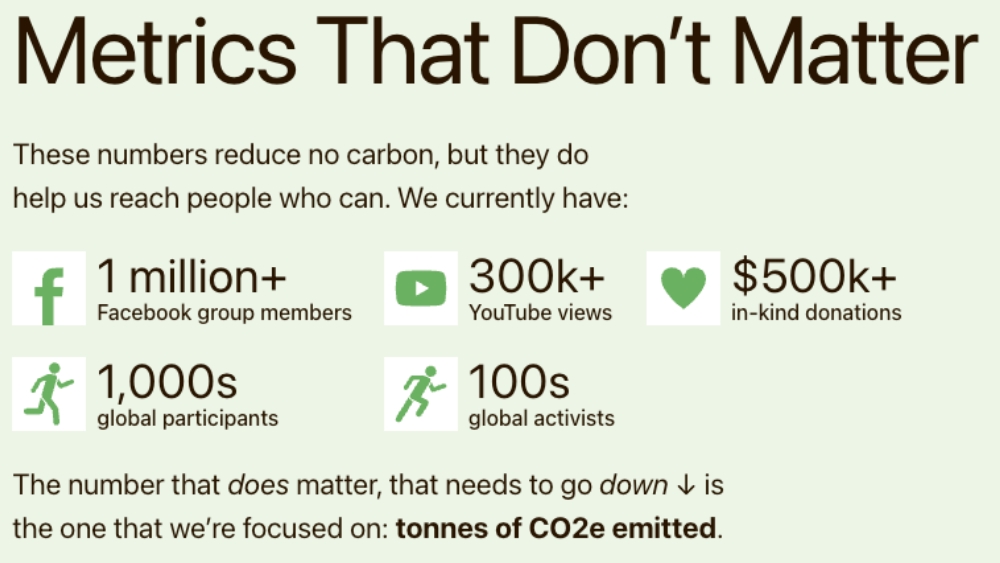
By the end of 2025, visitors to the recently-launched See Through Network website with the patience or curiosity to scroll to the bottom of the home page would have found a short section called Metrics That Don’t Matter.
As you can see, it included five numbers, with four different orders of magnitude:
- Members on the world’s #1 social media platform, in millions.
- Views on the world’s #2 social media platform, in hundreds of thousands.
- A dollar figure for total funding, also in hundreds of thousands.
- Real-world participants in the network’s projects, events & activities, in thousands.
- Activists creating/administering those projects, events & activities, in hundreds.
Each number, on its own, could constitute a reasonable metric for evaluating the ‘size’ of a network. But in combination, these different metrics may appear to be comparing apples and oranges, if not chalk and cheese.
To top it off, these numbers all appear in a section called ‘Metrics That Don’t Matter’, located in the least prominent section of the home page.
The numbers given for ‘global participants’ (‘1,000s’) and ‘global activists ‘(100s) seem strangely vague.
Maybe suspiciously vague.
You can’t click on any of the numbers to verify them (you couldn’t have known the Network’s web team was working on an interactive upgrade and that within weeks you could click away to discover the kind of information contained in this article, but better presented for your convenience).
The final bit of text explicitly states the metric the See Through Network considers does matter, and to which it presumably wants to be held to account:
‘tonnes of CO2e emitted.’
Search the See Through News website for ‘tonnes of CO2e reduced or sequestered’ and you’ll find dozens of articles explaining this is the metric used by climate scientists to evaluate, monitor and model climate change.
It’s the metric attached to all the numbers flung about at COP meetings. It’s what those online carbon footprint calculators use to determine your degree of flight shame, meat guilt or thermostat profligacy.
The problem with money as a climate activism metric
Take the trouble to browse the clunky See Through News website (again, you’re not to know the same web design and IT team is currently working on a much more easily-navigable upgrade).
You’ll find loads of articles about money.
Articles like Carbon: Must Be Funny In A Rich Man’s World go into some detail about the relative merits of using money, or the CO2e metric, in measuring the ‘carbon drawdown’ mentioned in the site’s quirky Goal FAQ.
Most people, however, have never heard of either CO2e or carbon drawdown, though they’re simple enough to explain with an inflatable globe, a bathtub and some ink.
No serious attempt to address our climate crisis can omit one or other of these terms.
If you want a simple greenwash detector, metrics provide an excellent litmus test.
It’s a good rule of thumb that the more any ‘climate solution’ mentions money, the less serious it is about reducing carbon.
Apply this rule, and commercial ‘carbon offsetting’ schemes reveal themselves as greenwash, designed to optimise profit. If they were meaningful actions designed to mitigate the worst effects of human-induced climate change, they’d use CO2e.
If you’re sceptical, imagine dressing in a Santa costume, and asking the child perched on your knee ‘Ho, ho ho! And how good have you been this year?’.
You’d expect them to reply something like ‘Very good! I’ve obeyed my parents/tidied my room/said my prayers/been punctual for school/got straight As’, or to cite other meaningful metrics for ‘goodness’ in this context.
If they replied ‘$56.30’, you’d be surprised, even if that did happen to be the precise purchase price of the ‘present’ you were about to give them to reward their moral rectitude over the past 12 months.
Yet when carbon offsetting merchants crow about the carbon trading industry smashing the trillion-dollar barrier, or the millions of dollars company X or Y has invested in their products, rather than only talking about the number of tonnes of CO2e reduced or sequestered, no one says ‘You’re a weird kid’.
So, if money is the wrong yardstick for emissions reduction, how else could a reasonable person like yourself assess the success or failure of the See Through Network, whose Goal is Speeding Up Carbon Drawdown by Helping the Inactive Become Active?
‘How many people are there in your network?’
appears to be a simple and clear question.
But before examining See Through Network’s ‘metrics that don’t matter’ numbers – that grab bag of chalky apples and cheesy oranges, for what they might reveal about its size, seriousness or impact – we should flag a word problem.
The problem with ‘Network’ as a climate activism brand name
The word ‘network’ is already an obstacle to clarity.
‘Network’ is a common word, but one which covers a lot of ground. The benefits and drawbacks of describing yourself as a ‘network’ may require some explanation.
Pros
- Mislabelling Avoidance: The See Through Network has found calling itself a ‘network’ to be an efficient time-saver – more accurately, an effective way of avoiding wasting time correcting See Through virgins’ misapprehensions.
Not calling itself a ‘business’, ‘standard’, ‘charity’, or anything else it isn’t, saves the Network time in retracing its steps and levering people who’ve got stuck in cognitive ruts. These ruts have been created by other climate action organisations that do fall into those categories, so are hard to avoid.
- Collaborative Connotations: ‘network’ invokes a wide spectrum of connotations. All share wholesome and positive notions of commonality, community and self-sustainability, which is why it’s so widely used:
- Silicon Valley Overlords choose to brand their advertising businesses as ‘social networks’. Internally, they use terms like ‘eyeball aggregators’ or ‘data-collection bait’.
- The magic phrase venture capitalist fund managers expect to hear in every tech-bro’s pitch is the ‘network effect’. They’ll all invoke the phrase, though Muggles might say something like ‘word of mouth’ or ‘viral marketing’. Genuine ‘network effect’ is hard to predict, but would guarantee exponential scaling growth at zero marginal marketing cost.
- Engineers, plumbers and electricians see ‘networks’ as the system of arteries, veins and capillaries that enable our power grids, sewage systems and broadband. These all make our lives better, so that’s a positive.
- Ambitious professionals attend ‘networking’ events to promote themselves, advance their careers, and accelerate their professional development. As no one wants to demote themselves, reverse their careers or retard their professional development, this too is a positive usage.
- Ordinary people depend on their ‘family networks’ or ‘neighbourhood networks’ for support when they need help in a crisis, or are vulnerable.
Again, all good stuff.
Cons
- Suspicion: the tech bro embrace of the word ‘network’ has made it a bit whiffy. It’s become a red flag to anyone aware that our digital-era wolves use the term as sheepskins to conceal their rapacious, lupine, data-hoovering advertising cartels. Anyone encountering an unfamiliar entity describing itself as a ‘network’ is entitled to be wary.
- Technocratic: we tend to use the word ‘network’ when describing mechanistic, abstract, technical systems. It’s a bit cold and distancing.
From a branding perspective, ‘network’ is something of a ‘Marmite’ word, i.e. ‘you either love it or hate it’, though it might be more accurate to say that ‘most people quite like it’.
What else could the See Through Network have called itself that would work better?
‘Network’ alternatives as a climate activism brand name
Here are a few synonyms, or meaning-adjacent words, to ‘network’, and why they were rejected:
- ‘Community’: unambiguously good (which social ape doesn’t want to be part of a community?). Consequently overused to the point of vapidity (‘the darts community’, ‘the bubble tea community’, ‘the scissor-using community’ etc.).
- ‘Collective’: nicely descriptive, but comes with unnecessary communist/socialist baggage.
- ‘Collaboration’: also a good fit with the Network’s collegial (there’s another one!) approach, but carries toxic association with wartime treason, c.f. ‘alliance’.
- ‘Ecosystem’: the word the See Through Network chose to describe See Through Carbon (‘an accurate, free, open-source, transparent carbon reporting ecosystem‘). The article Ecosystem Solution explains what it is. Its companion article Ecosystem vs Species explains why it’s a good term for See Through Carbon.
But not for the See Through Network, with its broader audience of Unwilling Inactivists.
Only a tiny minority understand ‘ecosystem’s specific tech-sector meaning. The vast majority are unaware of the word’s specific technical usage in the context of a ‘carbon reporting ecosystem’. To most ears, ‘ecosystem’ is a weird metaphor, not a helpful description.
So much for the rejects, and so much for the words.
Let’s return to the numbers.
More chalky apples and cheesy oranges
Every month, the See Through Network monitors its global influence by adding up various social media metrics. Here’s the Dec 1st 2025 overview:
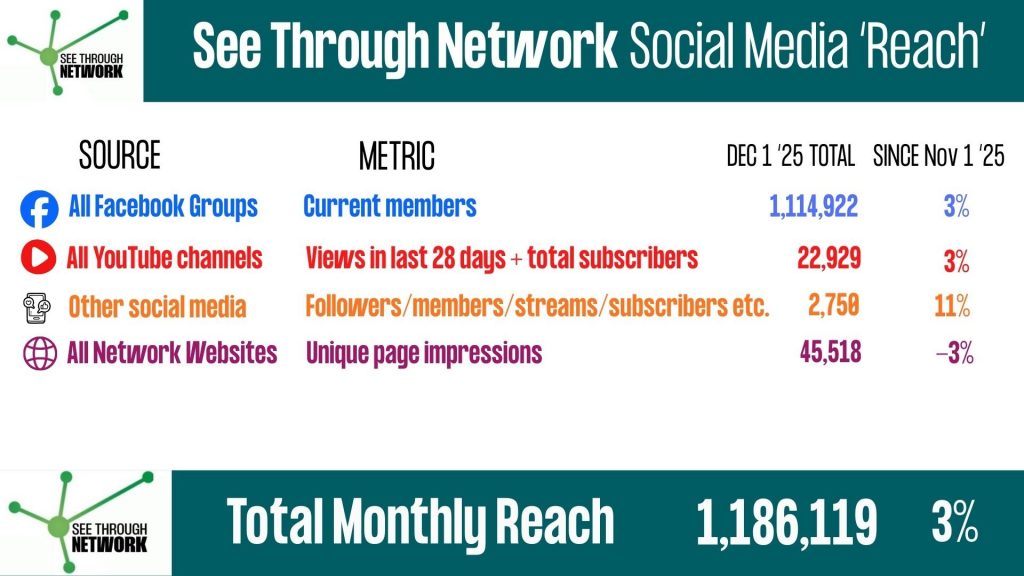
As detailed, this summary combines a mish-mash of metrics, updated monthly.
What’s the exchange rate between one YouTube view and one community Facebook Group membership? Is it, as this summary implies, a one-to-one ratio? Should the same tariff apply to a single podcast stream, website visit or LinkedIn follow?
Seen this way, these numbers are not just apples and oranges, but an entire fruit bowl, cheese board, and box of coloured chalk.
Still, even if the absolute number requires considerable context, at least the Network has been measuring the same items, in the same fruit bowl, since April 2022. This may be some kind of guide to the Network’s size, or at least rate of growth.
After an initial period of double-digit monthly growth, the monthly growth rate for 2023-2025 has settled down to a consistent 5-7%, or around 100% per year.
As it compares like with like, the monthly growth figure should provide a meaningful measure of the Network’s growing influence on ordinary people around the world – for what that’s worth.
But whatever its merits, the Network’s own four-step Engagement Journey makes clear this ‘reach’ figure only measures the first step in meaningful climate action, so we don’t recommend it as a guide.
Hence ’metrics that don’t matter’.
How about measuring how many supporters the See Through Network has?
The problem with ‘supporters’ as a climate activism metric
The Network’s Transparent Trojan Horseplay storytelling strategy means the majority of all those YouTube viewers and Facebook group members probably have no idea of the Network’s carbon-reducing Goal.
The Network’s subtle storytelling and branding strategy is designed not to ‘drop the climate C-bomb’ too early. This makes the ‘million plus’ reach figure a poor answer to the question ‘how big is the See Through Network’?
This may be surprising if you’re accustomed to using ‘supporters’ as a meaningful metric of a climate organisation’s appeal.
British media, after all, report the growing membership of The Green Party as a meaningful measure of ‘growing Green Party support’. The media also regard the reported number of people paying for Greenpeace membership as a useful measure of support for that organisation’s activities.
There are two problems with this way of assessing a climate organisation’s ‘real’ size.
- Money as a proxy of ‘support’
The vast majority of such ‘supporters’ are only ‘supporting’ them financially. Setting up a monthly direct debit is a not meaningless act, but nor does it directly advance the organisation’s environmental goals. It could just be ‘virtue-signalling’.
If money is a means, not an end, how useful can it be as a proxy metric for ‘support’?
We don’t apply the same logic to all relationships measured in financial transactions.
- You can be an Arsenal Football Club ‘supporter’ without ever paying them a penny.
- People who expect a return on their investment in Nvidia stock are called ‘investors’ or ‘shareholders’, not ‘supporters’.
- The Coca-Cola Corporation might call people who buy their fizzy pop ‘loyal customers’, but even they would think calling them ‘Coke supporters’ would be pushing it a bit far.
- Non-financial proxies of ‘support’
Without the need for a bank account, the See Through Network has no ‘membership list’ to serve as the conventional answer to the question ‘how many supporters do you have?’.
If not money, how else can we measure support?
The fact that there’s no obvious answer to this question reveals just how gaslit we all are by Money. We struggle to come up with alternative metrics for success or failure.
The problem with ‘volunteers’ as a climate activism metric
Most people, on realising the See Through Network has no need for a membership list, as no one gets paid, reach for the next most obvious metric. Perfectly reasonably, they ask:
‘So how many volunteers do you have, then?
A useful answer requires a shared understanding of what constitutes a ‘volunteer’. The usual definition is:
‘Someone who works unpaid’
This is not, however, a useful distinction for the See Through Network. No one gets paid. Everyone is motivated by the shared Goal of measurable carbon reduction.
Next step is usually to focus on the word ‘work’. Far from helping, this triggers a fresh set of questions about what defines ‘work’.
A strict definition might be:
‘Someone who engages in See Through activities full time, i.e. during normal office hours, as if they were being paid’.
This sounds precise, but would it generate a useful answer?
Say the answer was ‘none’, or ‘one’, or ‘four’, of ‘fifteen’. How wiser would you be?
If the See Through Network had four people fitting this narrow description, would that make it four times ‘bigger’ than if there were one?
Or just less than a quarter more impressive than if the answer were fifteen?
The problem with ‘activists’ as a climate activism metric
You might be getting exasperated by the See Through Network answering apparently simple questions with convoluted questions of its own.
Do you detect a whiff of sophistry? Does it strike you as suspiciously evasive? If the absence of straight answers makes you doubt the Network’s claims of ‘radical transparency’, a final throw of the dice might be to ask:
‘So how many activists do you have, then?
This, surely, must finally be getting to the heart of the question.
Forget money, ‘supporters’ or ‘volunteers’, how many real activists participate in actual See Through Network projects?
Regrettably, a meaningful answer still requires some further definition. Otherwise, how could anyone tell whether an answer of ‘500’ would be ten times more impressive than an answer of ‘50’?
Should the Network count any of the following as ‘activists’:
- The 40-odd expert advisors listed on See Through Carbon’s ‘Who We Are’ page?
- The dozens more world-class expert advisors who haven’t yet got round to submitting their photos and mini-bios, or whose contracts prevent them from doing so?
- The dozens of Facebook Moderators who’ve been spending anything from a few minutes to hours per day since 2021 building up trust in See Through News’ hundreds of community Notice Board groups around the world?
- The 30 Ugandan early-career professionals who presented to, and attended this online discussion arranged by the Network’s Uganda Country Coordinator and Project Manager, to decide which of the 10 Network outreach/education projects might best be adapted to local conditions?
- The 150 10-15-year old students and teachers from HIV orphanage schools in the Nairobi slum of Mathare, who devoted a week in 2023 to being remotely mentored by See Through News professionals (do we count them too?) to make videos for the Global Reporter Intensive Training (GRIT) scheme?
- The dozens of professional filmmakers, audio engineers and musicians who’ve created all the original content for the See Through Together, See Through News and See Through Carbon YouTube channels since 2021?
- The hundreds of children who’ve submitted entries to the See Through News Superhero and Supervillain Drawing Competition since 2021?
- The dozens of amateur crew members and interviewers who’ve been involved in filming The Think Game and The Learn Game since 2021
- The dozens of ‘players’ who’ve consented to have their participation in The Think Game and The Learn Game filmed and uploaded to social media, and have shared it with their family and friends since 2021?
- The dozens of local residents who participated in 1 Sunday Morning, 4 Films: doing good in Finchley over two months in 2022?
- The eight volunteers from Canada, Nigeria, England, Scotland, India and Uganda whose detailed recruitment journeys were featured in Could You Volunteer To Measurably Reduce Carbon in 2025?
The real answer, at last
We could go on, but hope we’ve made our point.
We could waste time…
- Creating a taxonomy of ‘activist’, categorised by a rolling average of x hours a week over such-and-such a period
- Following up and entering every single one of the people mentioned in the list above into a public database
- Doing the same for all the other projects since 2021 that we couldn’t be bothered to include in the list above.
- Coding an interactive user interface that would permit you to slice and dice this data according to your own definitions of ‘supporter’, ‘volunteer’, ‘activist’ etc.
…knowing that none of this will convince a sceptic who’d rather keep asking unanswerable questions in order to justify their climate Inaction.
We’d much rather get on with what we’ve all signed up to do, i.e.:
‘Speeding Up Carbon Drawdown by Helping the Inactive Become Active’.
The only question the See Through Network is interested in is:
Are you going to join us?