
A radical alternative to fundraising – make everyone a volunteer and only use other people’s money as an accelerant. Mutual trust and radical transparency frees activists to focus on their mission, instead of fundraising.
This article outlines a novel model for activists to keep their eyes on their prize, without paying the price themselves.
You Can’t See Clearly Now The Goggles Are On
Before we reveal our radical solution to charity fundraising, it’s only fair to warn you we’re first going to ask what will sound like four Stupid Questions.
They only sound stupid to people wearing Money Goggles, but we nearly all have Money Goggles strapped on at birth.
Money Goggles distort the real world to make it appear the world is driven by profit, not principle.
Most of us die wearing our Money Goggles, never realising how much they distort our vision.
That’s why our four questions are going to sound so stupid.
How to tell if you’re wearing Money Goggles
If you’re wondering how to identify the Money-Goggled, it almost certainly means yours are still on, but quick diagnostics are easily available.
The Money-Goggled say things like this, often preceded by ‘in the real world’:
- money talks
- money makes the world go round
- time is money
The Money-Goggled find these phrases so self-evident they utter them as if they were laws of nature, like:
- the sun rises in the East
- winter is coming
- what goes up must come down
Yet the Money-Goggled assert money truisms as facts, when a moment’s reflection reveals them to be fiction.
Yes, they’re metaphors, but they’re usually deployed as trite truisms, rather than cautionary cliches. We’ve stopped thinking about what we’re saying. That’s what Money Goggles do.
If a Money Goggle-free child, time-travelling cave man or alien were to point out that money can’t talk or rotate a planet, and that time precedes money by, well, a long time, we would see them as the obtuse ones. That’s what Money Goggles do.
The ‘real world’ so often cited by the Money-Goggled is, of course, an illusion. It must be, as money is nothing more than a promise.
Diffracted by Money Goggle lenses, however, something we made up 5,000 years ago appears real.
Doing good without money: not a dream
This article requires you to rip off your Money Goggles. Only then, whether as activist or donor, will our radical solution make sense.
If, by the end of this article, you manage to remove your Money Goggles, you’ll find it odd to pursue a non-profit based mission any other way. But those Goggles are expertly designed, so most of you won’t be able to get them off.
Even so, you might be able to catch a brief glimpse of a world that doesn’t depend on money.
This alternative fundraising model is not, by the way, a dream. It has been working since 2021, growing year by year. Whether you consider it ‘proven’ is a matter of degree, depending on your degree of faith in the Ten Requirements.
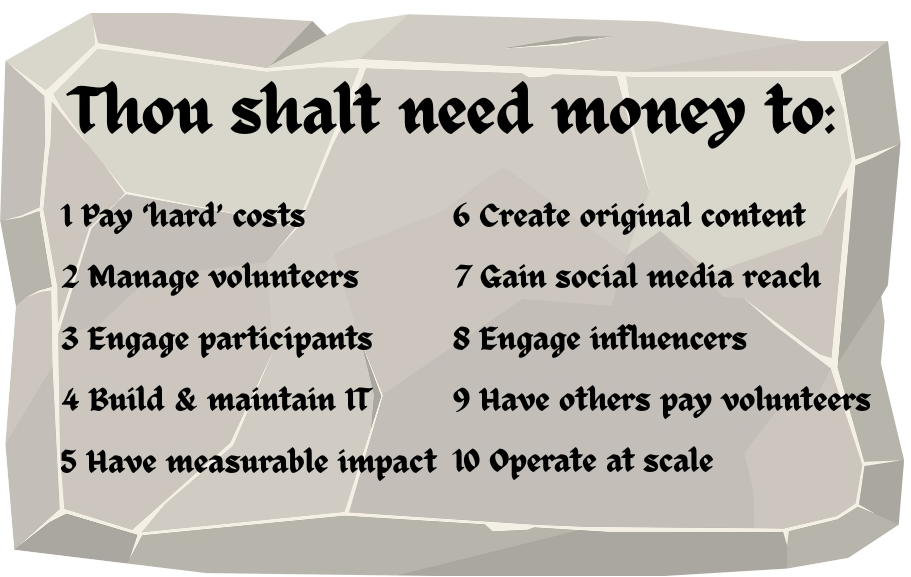
The ecosystem that pioneered this model has definitely ticked off Requirements 1-8, can claim to have already done 9, and 10 is in the eye of the beholder.
To be clear, the four Stupid Questions are not abstract theories forming the design of a castle in the sky, but retro-engineered from this ecosystem’s real-world experience.
The ecosystem’s trick, if you want to call it that, is to only work with people who’ve managed to remove their Money Goggles.
This can be a painful process. In many cases, it seems that the more money you have, the more painful the removal.
But find other people who have removed their Money Goggles, and it should work fine. The only price you pay is removing your goggles.
If you suspect this is all an elaborate setup for a scam to get you to pay for our ‘how to raise money without money’ secret sauce:
- Your suspicion confirms you still have your Money Goggles on
- You can relax. Scammers require bank accounts. This ecosystem model only works without one.
The rewards, however, are considerable. You can advance your Mission without the need for a bank account, with the occasional judicious application of other peoples’ money directly from their bank accounts to speed things up.
All you’ll need are a handful of fellow Money Goggle-free people with Excess money, and bingo! Our modest proposal for paying volunteers with other peoples’ money will work like a dream.
If this all sounds like a pipe dream, or you’ve wondering what ‘Excess money’ is, that’s another sign your Money Goggles remain firmly attached.
Removal can be a painful process, so we’ll take it step by step, via our Four Stupid Questions.
Stupid Question 1: ‘What is ‘excess’ money?
A key Money Goggle feature is displaying a price on everything.
If money is the only metric displayed, it makes it much harder to tell when ‘need’ ends, and ‘want’ begins, but we’ll come to that in Stupid Question 2.
The Charity Fundraising Market Platform Report monitors and values the global supply of Excess Money (which it defines as ‘philanthropic donations’). The 2026 report summary:
The charity fundraising platform market size has grown rapidly in recent years. It will grow from $7.7 billion in 2025 to $8.75 billion in 2026 at a compound annual growth rate (CAGR) of 13.6%. The growth in the historic period can be attributed to growth of online donation culture, expansion of nonprofit digital presence, rising use of social media for campaigns, increased trust in digital payment systems, availability of cloud-based fundraising tools.
Every added zero makes Money Goggles fuzzier. Few of us really understand what a billion means, so here’s a more accessible summary of their summary:
- Global Excess Money 2025: GDP of Fiji
- Global Excess Money 2026: 6.5% of a peak Elon Musk.
Money Goggles render Excess money almost invisible by conflating ‘needs’ and ‘wants’, and blurring any line separating the two.
Which brings us to our second stupid question.
Stupid Question 2: What’s the difference between ‘need’ and ‘want’?
Defining Excess money as ‘money you don’t need’ simply restates the problem.
This is because Money Goggles focus on money over everything else. In this case ‘money’ is the wrong focus. We all think we know what money is, but it’s our vision of ‘need’ that’s particularly blurred and opaque.
Excess money is what remains in your bank account once you’ve paid for everything you ‘need’.
If you don’t ‘need’ it, by definition it becomes available for what you ‘want’. ‘Wants’ are, well, whatever floats your particular boat. Examples of common ‘wants’ include:
- a nice holiday
- a gold toilet
- advancing your passion project’s Mission
The tighter the Money Goggles are strapped on, the more blurred this line between needs and wants becomes.
This is why Elon Musk, and any other billionaire, keeps making money. Without recognising the point at which you have ‘enough’ money, Money Goggles will always obscure the ‘excess money’ line separating needs from wants.
Billionaire Money Goggles are super-strength. They need to compensate for a variety of astigmatisms that afflict the super-wealthy:
- an aversion to follow the same tax rules as the rest of us
- an obsession with demanding tax breaks for any discretionary spending
- an insecurity that compels them to call their discretionary spending ‘philanthropy’
The world’s billionaires can fit into six aircraft, and are probably hopeless cases for our alternative model.
That still leaves 8.5Bn of us. We can minutely calibrate our own degree of money-blindness by answering this bonus Stupid Question:
‘How much money would be enough for you?’
Try it. You may be surprised at how low the number is.
Most of us struggle to get past low tens of millions before any claim that it’s a ‘need’ starts sounding a bit ridiculous.
Our Money Goggle lenses may be too weak, or the straps too loose, to be able spend any more.
Or they fit just fine, but we lack the imagination to envisage what we could possibly ‘need’, once we have multiple fancy homes, a garage full of fast cars, a fleet of private jets, a gold toilet, and all the other need/want items that appear on our wishlists ahead of ‘philanthropic’ donations.
Only a tiny number of very special people are blessed with the superpower of seeing living in more than one home, driving more than one car, or defecating onto precious metal, as a ‘need’ that takes precedence over any charitable mission.
About the same number that would fit into six aircraft.
Stupid Question 3: Can you describe ‘charity’ without using the word ‘money’?
Whatever your answer to Stupid Question 3 may be, it almost certainly illustrates the ‘real’ problem with charity fundraising.
Money is supposed to be a means, but nearly always becomes the end.
Not always, and not for everyone, but consider these two statements:
- Volunteers can focus on The Mission: the lower down the charity hierarchy, the greater the proportion of your waking, working hours volunteers spend on doing the thing the charity was set up to do. Even so, loads of volunteer time and energy goes into raising money.
- Execs must focus on The Money: the higher up the charity hierarchy you ascend, the more of your waking, working hours are devoted to raising money to fund The Mission. If fish rot from the head, this is bad news for the Mission.
Do these statements sound like truisms? In that case, your Money Goggles are firmly strapped on.
If they merely sound like annoying ways of stating the bleeding obvious, your Goggles may be a bit loose. It might be worth considering our 4th and final stupid question, before dismissing our radical solution as a pipe dream.
If Stupid Questions 1-3 have got you thinking along different lines, your Goggles are almost off.
You should definitely have a crack at Stupid Question 4.
Stupid Question 4: Why is it harder to be a fundraiser than a benefactor?
How many of the people running, volunteering for, or funding NGOs, social enterprises or charities are aware that ‘charity’ originally meant ‘costly’?
Before it became synonymous with ‘benevolence’ and ‘altruism‘, ‘charity’ was closer to its Latin root carus, meaning ‘dear, expensive or costly’.
Carus itself came from the Proto-Indo-European root ‘ka-’, meaning ‘desire’. ‘Charity’ has always been about needs and wants, it seems.
In a perfect market economy, where supply and demand are evenly matched, there should be no power imbalance between charity fundraisers and philanthropists.
Matching charity ‘needs’ with donor ‘wants’ would be as routine and straightforward as finding a plumber to fix your toilet, golden or porcelain.
So if charities need excess money, and people with excess money want to spend it meaningfully, why is the power dynamic between beggars and begged so asymmetric?
Market forces can explain this imbalance in four steps:
- The world is imperfect.
- Demand for fixing imperfections is infinite.
- Money is finite.
- Excess money is a subset of all money.
But we all know charities’ real problem isn’t a question of economic theory, but of human psychology.
If you have enough excess money to buy four drinks, you can afford to find the answers.
After a gala charity fundraiser, find one of each of the following four attendees. Offer to buy them a drink, and listen carefully.
- Charity Volunteer: I’ll tell you what annoys me. We Volunteers do all the work, and all those Administrators get paid to sit around in their office all day doing nothing. You have no idea how hard it is for me to find the time to volunteer.
- Charity Administrator: I’ll tell you what annoys me. We Admins work like slaves for a pittance, and those Volunteers just swan in and out doing nothing. Employees do what you ask, Volunteers don’t. You have no idea how hard it is for me to get money from the Fundraisers.
- Charity Fundraiser: I’ll tell you what annoys me. We Fundraisers rush around begging Donors who care more about tax breaks and photo-opportunities than our Mission. You have no idea how hard it is for me to get Donors to sign the cheques.
- Charity Donor: I’ll tell you what annoys me. Charity Fundraisers think I’m made of money. They swarm over me like flies on a honey pot, all convinced their Mission is the only one that matters. You have no idea how hard it is for me to deal with all those Fundraisers.
There’s the human condition for you. We aspire to join forces for Missions that promote joy, peace, security and harmony, yet are caught in a vicious cycle of power imbalances, resentment and misery.
Volunteers and staff, staff and fundraisers, fundraisers and donors, all locked into a binary world of beggars and benefactors.
But only if everyone is wearing Money Goggles.
If only there were an alternative that:
- Required no bank account
- Promised no tax breaks
- Demanded mutual trust between Donor and Recipient
- Was radically transparent
- Treated money warily, as an occasional temporary accelerant
- Only used money under very limited circumstances
- Existed
Turns out, there has been such an alternative, since 2021.
For more, visit www.seethroughtogether.org