
As the alternative is a brisk species suicide, any orderly transition to a sustainable future requires rules. From Manchester City to OpenAI, Ukraine, Iran and the EU, the ultra-rich no longer bother bending rules, but ignore them altogether, largely by avoiding transparency.
This article links the intractability of our climate crisis to the growing dominance of billionaires, posits that any solution requires rules that don’t fetishise money, and suggests transparency is a good place to start.
Suicide by cop: 1 dead
Some suicidal individuals outsource their execution to the police.
This tragic phenomenon is so common it has a name.
‘Suicide by cop’ may strike the cynical as a victim-blaming cop-out. We can’t know for sure, as ‘successful’ suicides by cop leave no protagonists to ask. Still, it’s plausible to imagine a desperate person provoking a cop to kill them as a less worse alternative to dying at their own hand.
Plausible enough, anyway, for a Harvard Medical School study to have published a paper titled Suicide by cop (1998). Its authors reckoned suicide by cop accounted for at least one in ten police shooting deaths in Los Angeles between 1987 and 1997.
Every suicide by cop is a tragedy for all connected. The victim, of course, but that was their choice.
The police, witnesses, families and communities all live with the trauma until they join the victim in the graveyard.
Suicide by cause: many dead
Some suicides are motivated not by individual existential despair, but by a desire to sacrifice their most precious asset – an individual life – for a ‘greater good’.
In these suicide by cause cases, the perpetrators must all have a ‘good’ reason powerful enough to risk ending their lives.
Our degree of empathy with the person choosing to kill themselves depends entirely on our own opinion of their motives, and whether their dramatic means justify their stated ends.
One person’s ‘terrorist suicide bomber’ is another’s ‘martyr’. Friends garland a soldier who sacrifices their life to save others as ‘heroic’. Enemies brand the same person as ‘brainwashed’.
Try substituting ‘hate’ for ‘love’ in the Biblical quote ‘Greater love hath no man than this, that a man lay down his life for his friends’, and it works both ways.
Some may cheer at planes full of innocent passengers being sacrificed for an idea. Others may be appalled.
What all suicides by cause have in common is the epic, ultimate, extreme scale of the sacrifice. Whatever the perpetrator’s motivation – despair, a glorious afterlife, altruism, stupidity or programming – individual suicides arouse powerful responses in the rest of us.
Even if we have no personal involvement in the cause, we’re fascinated, moved and gripped by their extreme jeopardy. The more involuntary collateral deaths, the stronger our response.
- 1 dead: Suicide by cop victims are so commonplace they barely make the local news.
- 2 dead: Any suicide that kills another person, like a cop, a bystander, garners much wider coverage.
- Dozens dead: School shooters who survive suicide by cop tell us this gruesome ranking is a major competitive motivation. People who drive cars into Christmas markets may have a similar metric for ‘success’.
- Hundreds dead: an airplane deliberately flown into the ground, or a bomb in a crowded market or packed public space is a global story.
- Thousands dead: fly an airplane into a tall building full of workers so it collapses, and it’s a historical pivot that moves events decades later.
Note that in this macabre emotional tariff, a plot to kill hundreds that’s averted can gain more coverage than a ‘successful’ suicide by cause that only kills a handful.
These emotional outcomes are what drive plot organisers, news editors to determine story prominence, and us as news consumers.
If you’re finding all emotional accounting grisly and distasteful, it gets even more bizarre.
Why, when the potential number of victims is 8.5 billion, including us and everyone we know, do we all shrug our shoulders?
Species Suicide
Human-induced climate change is suicide at a species level.
This makes us both victims and perpetrators.
This confusion, along with climate change’s slow-motion and geographically uneven impact,may account for the trouble we have processing our suicide, or even recognising it’s taking place at all.
How else to account for our indifference, when the upper limit of potential victims is the entire human race?
Compare the prominence and frequency of the following two types of news stories you’ve seen:
- Individual Suicide, e.g.:
- school shootings
- terrorist attacks actual and thwarted
- rescuing drowning children at the seaside
- saving comrades and civilians on the battlefield
- Species Suicide, e.g.:
- a Climate Impact Lab report forecasting an additional half million deaths from the current El Nino, a weather event exacerbated by carbon emissions.
- an IPCC report projecting the human cost of Business As Usual at half a billion additional climate refugees if we allow 2 degrees of warming (probably already baked in).
- The Swiss insurance company Zurich article There could be 1.2 billion climate refugees by 2050. Here’s what you need to know
Now compare your own emotional response to A) and B).
We can’t handle the truth
Why we care so much more about individual death than mass death is well understood.
When Stalin is quoted as saying ‘A single death is a tragedy; a million deaths is a statistic’ it’s usually designed to shock, but actually states the obvious.
This contradiction is not just well known to behavioural psychologists. It’s instinctively understood by:
- newspaper editors who publish headlines like ‘Brits Narrowly Miss Crash Killing Hundreds’
- charities who know an image of a single hollow-eyed child elicits much bigger donations than an image of hundreds of starving people, and way more than statistics documenting millions of starving people.
Psychologist Robin Dunbar’s study concluded that humans are only really evolved to live in communities of around 150. Our brains – specifically our emotions – have not evolved to process numbers beyond that.
This notion is so well accepted it’s become an eponym. ‘Dunbar’s Number’ has long been used by businesses, the military, schools and other institutions, optimising their operations on the basis that 150 is the maximum number of stable human relationships our brains can handle.
Stalin noted its bizarre outcome. He could murder millions precisely because it was unimaginable.
Even more illogically, the degree of our emotional response is inversely proportional to the number of victims. We’ll weep at a single ‘tragic’ death, but when a TV report about the imminent death of millions appears, it’s a good time to put the kettle on, or swipe away to a cat video, if we have the option.
Weirder still, we remain indifferent when those potential victims include us, our family, our community, and everyone we know or have ever met.
Other studies have put the number a bit higher, or a bit lower than Robin Dunbar, but not by much.
We certainly can’t process 8,500,000,000.
Beyond our Dunbar number, diminishing returns rapidly set in. The emotional bang for the buck plummets. Add another zero and it’s a realm inhabited only by boffins, statisticians, ‘number-crunchers’.
And billionaires.
What is a billionaire?
Can you picture a gigatonne?
This video clip, using multiples of US Nimitz class aircraft carriers as a visualization tool, shows how hard most of us find this task.
Few of us could say with confidence how many zeroes a giga-anything has (it’s 9, if that helps).
Every added order of magnitude renders our ‘common sense’ more useless.
This incapacity, aided by the fact that switching a single initial letter denotes the same as adding three terminal zeros, is why we underestimate the power of billionaires so disastrously. Consider:
- A million seconds is around 11.5 days – a nice holiday.
- A billion seconds is around 32 years – around 50% of an average Russian male’s life, or around 40% that of an average Japanese man.
- A trillion seconds is around 32,000 years – wind back this far and Earth was in an Ice Age, now-extinct beasts roamed freely, and we probably lived alongside Neanderthals.
Now consider the equivalent in dollar terms:
- A millionaire (6 zeros) is most homeowners in nice parts of a big Western city. The world has around 58 million, or the population of Kenya.
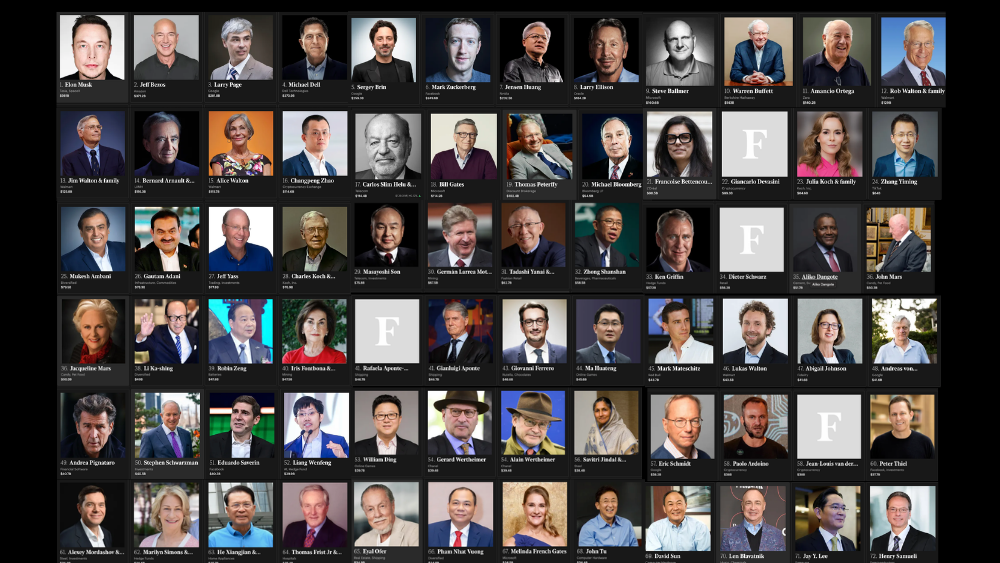
- A billionaire (9 zeros) belongs to a club of around 3,000 out of 8.5 billion humans. If you could convince them to abandon their private jets, you could fit the world’s billionaires into the Economy class seats of six jumbo jets.
- A trillionaire (12 zeros) has so far only existed once, for a few days, but we’re on track to produce more. There are a couple of dozen who’ve got to 11 zeros. A website tracks their net worth in real time, for those who think it important.
Are billionaires intrinsically bad for the climate?
Billionaires are not necessarily an obstacle to carbon drawdown or a sustainable future. But nearly all of them are.
It’s certainly true that the more billionaires there are, the worse the problem gets, as fewer people prise more of the levers of Government, Business and Media power away from the rest of us.
In the 200 years since we started our slow-motion species suicide by burning fossil fuels which heated our planet, peak equality of wealth distribution occurred in the late 1970s.
Since around 1980, when income equality went into reverse, wealth resumed its concentration into billionaires’ hands.
This wealth gap U-turn coincided with the point at which scientists first alerted us that the local pollution problems we knew were associated with burning hydrocarbons, were dwarfed by their planetary climate impact.
In the half century since, our species can claim a few pollution victories. Some of the wealthier places have mitigated a few of the worst and most obvious pollution impacts of burning fossil fuels, though often by exporting the smog and soot to poorer places.
We even managed to take urgent collective action to fix one of the first atmospheric impacts, when we repaired the holes in our polar ozone layers.
Good news for those of us who breathe the most smog or live closest to the poles.
But what have we – and the growing numbers of billionaires – done about the greenhouse gases that could kill us all?
Nothing effective. Emissions have rocketed, and continue to rise.
More billionaires, more emissions.
The billionaires assure us this is pure coincidence.
They go further. They dangle silver-bullet tech solutions like AI, mini-nuclear reactors, scalable carbon capture. As all require vast amounts of money, this casts them as our sole saviours.
Billionaires don’t suggest any reduction of demand. This would mean no growth. Their asset value depends on the presumption of infinite growth.
Billionaire chutzpah doesn’t stop there. They sell their Large Language Models, anti-aging research, crypto schemes and space ships as acts of altruism, rather than very expensive job-destroyers, immortality fantasies, money-laundering wheezes and planetary escape pods for their families.
Meanwhile, they quietly use their unimaginable wealth to buy up whatever real world assets can be bought, from art that once hung in public galleries to land and water. This is a zero-sum game.
Removing great art from public view to a private room in a billionaire’s home is depressing, but not life-threatening. Every acre bought by a billionaire, on the other hand, is an acre less for non-billionaires to control.
Billionaire landowners are not motivated by carbon drawdown for its own sake. Making money is a hard habit to break, and they’re used to getting us to praise them for making profit.
Hence their ‘philanthropic’ donations to climate causes, in lieu of paying tax like the rest of us, but only if their accountants pass it as ‘tax-efficient’.
Hence billionaires demanding credit for planting trees on their expanding estates, but only if we reduce their tax bills enough through subsidy schemes.
For a while, Silicon Valley Overlord billionaires used their power, money and influence to get states and countries to vie, with subsidies and tax breaks, for the privilege of hosting their data centres.
We didn’t object to them owning and monetising our data while accelerating climate change, so long as the data factories were somewhere else.
But this tsunami of money has hit an interesting obstacle, that may prove immovable and impervious to the application of more money.
Ordinary people started objecting to their construction in our back yards.
This is an interesting, and rare, example, of the limits of billionaire power.
We’ll return to it later, in the Hope Bit.
How billionaires evade rules
It’s one rule for the rich, another for the rest of us.
This refrain has grown truer over the past 50 years.
Facts, evidence and common sense suggest billionaires are – currently – a much bigger part of many social problems – not just climate ones – than their solutions.
They know that globalisation has made a billionaire ban highly unlikely. Tax me here, and I’ll move my money there. There will always be regimes happy to host their wealth.
Billionaires are the beneficiaries of a global economic system that rewards concentration of capital with more capital. The more wealth they accumulate, the less they need to do in order to make yet more money. Like mediaeval aristocrats, they can just collect the rent, but with more zeros.
This has worked well for billionaires since Peak Equality reversed half a century ago. Money worship got a further boost with the end of the Cold War, when capitalist governments no longer had to make precautionary concessions to labour unions, workers and ordinary people, to prevent them being seduced by the Reds.
Every ‘deregulation’ and ‘bonfire of red tape’ may have unshackled entrepreneurs, as advertised. But it also removed more and more constraints on billionaires playing by the same rules as the rest of us.
Then the Internet created new entrants to the billionaire class, who owned the new media which reflected their own commercial interests. Their billions then allowed them to hoover up the old media too.
Owning all the megaphones makes it much easier for supervillain billionaires to cosplay as Robin Hoods, revolutionaries and superheroes.
The problem with unregulated billionaires
If you think of the global economy as a housing market, the current rules:
- favour the landlord over the tenant
- make buying more properties easier the more you own
- impose fewer restrictions on landlords raising the rent
Not a problem if we had an infinite expanse of land, and an infinite store of building materials.
But we don’t.
The amount of land (planet Earth) and the building materials to build new houses (Earth, again), are both finite. As we approach these physical limits, accelerated by growing population and wealth, supply and demand dictates that housing will get more and more expensive.
Once we hit those physical limits, no amount of money will be able to buy anything. The system will collapse. Money will reveal itself to be what it’s always been, a promise. Until a promise is broken, there’s always hope.
But once the promise is broken, the entire system based on money collapses overnight. Survivors may have to rewind to how life was a trillion seconds ago.
But there’s a lot of money to be made in the meantime. Billionaires continue to cultivate an environment that:
- fetishizes money and uses it as the primary metric for evaluating anything
- diminishes any rules that constrain their wealth acquisition
- greases their path to becoming trillionaires, so long as the rest of us follow the rules they’re allowed to break
This has created the vicious cycle that is probably the biggest obstacle to rapid carbon drawdown:
- The less we regulate billionaires, the more money they make.
- The more money billionaires make, the more they ignore rules.
- The more rules billionaires ignore, the weaker our ability to regulate them.
Unregulated billionaires
Unregulated, billionaire impunity grows with every added zero to their net worth.
The results are becoming hard to cover up, and difficult to ignore.
Football rule-breaking
Allow Midas-rich petro-states to own football clubs, and they break 114 rules designed to keep a level playing field to get sportswashing bang for their buck.
Political institution-breaking
Pack the cabinet of the world’s richest country with billionaires, and they demolish the ‘red tape’ of institutions preventing them from getting even richer quicker, in the name of ‘efficiency’.
Tech ‘disruption’
Move fast and break things is the motto of psychopaths, toddlers and the world’s biggest social media Overlord.
Trust billionaires to self–regulate, and they’ll turn a non-profit into a start-up, suck up all the capital they can to build data centres that will suck up all the energy and water they can get away with.
Military might-is-right
Billionaire oligarchs with global assets and boltholes feel insulated enough from the consequences of war to start them without seeking the authorisation, permission or co-operation of international bodies.
From Ukraine to Iran, seeking coalitions of the willing via the UN is out of fashion. Consensus is for losers, when you’re a billionaire.
Carbon reporting
When governments and regulators attempt to compel big businesses to even report their carbon footprints accurately, let alone reduce them, billionaires’ responses are always foot-dragging, dodging, and dilution, rather than compliance.
Let’s not even talk about corporate greenwashing like carbon credits and trading. Just look at the hockey stick curve since the first carbon credit was issued in 1988, and realise the y-axis could be both the rise in emissions in gigatonnes of atmospheric CO2, and the value of the carbon trading industry in dollars.
The latter was supposed to bend the curve of the former, but has done nothing beyond putting more capitalists on the billionaire pathway. At this rate, we’ll need another jumbo jet to fit them in.
Is capitalism hopeless?
Does our growth-obsessed, money-fetishising, capitalist civilization mean any attempt at resistance is hopeless?
The answer is entirely up to you. Here are the options.
Yes
We should all stop worrying, enjoy what we can while we can, buy tinned food and weapons, or pre-emptively return to small agricultural communities?
If you think so, you’ve already answered your own question about hope.
No
We should stop being doomsters, enjoy the warmer temperatures, and trust the billionaires to come up with an escape route?
If you think this, you’ve also already answered your own question about hope.
Maybe
The chances of regulated capitalism providing a viable pathway to a sustainable future are not zero.
Why just wait until the capitalist system collapses under its own weight? Why presume it’s inevitable that the myth of infinite growth on a finite planet will persist until it succumbs to physics?
Earth systems are complex. Humans have the capacity to foresee consequences and adapt their behaviour.
The possibility of our descendants living in a civilization that resembles what we know today, rather than that of a trillion seconds ago, is more than 0%.
Remember the local protests against data centres? If we all applied the same logic to other billionaire-enriching enterprises, the result might be something approaching a regulated capitalism solution.
But consider why local people knew about the damage to their communities. The billionaires did everything they could to hide the true environmental costs, but were obliged to disclose them when activists forced courts and councils to apply planning rules.
Rules plus transparency is billionaire Kryptonite.
Where to start? Transparency
These are all big questions, much bigger than most of us are prepared to even contemplate, let alone act on.
That’s why it’s easier to shrug our shoulders, keep doomscrolling, or make a smart remark that mocks the futile efforts of the naive, while justifying our inaction to ourselves.
But if you’re looking for one thing you can do that doesn’t require you to stop flying, eat meat or take public transport, why not try Transparency?
Bad billionaires do all they can to hide what they do. One thing they’re prepared to spend an awful lot of money on is concealing their actions.
They pay people to:
- hide what they do
- distract us by looking at someone else
- stop anyone exposing what they do from raising the alarm
The wealthier you are, the more you spend on lawyers, accountants, journalists, politicians, NGOs etc. to keep yourself and the consequences of your actions opaque.
Money can buy you a lot of opacity, but we all have the ability to challenge it, one way or another, e.g.:
- Whistle-blowing
- Supporting and celebrating whistleblowers
- Asking more questions
- Applying the same laws to everyone
- Demanding full disclosure
- Insisting transparency should be the default, not the exception.
Sunlight is the best disinfectant.
We know this is the right thing to do because we urge our children to be honest, tell the truth, and not lie.
So why not billionaires?
**
The See Through ecosystem operates a policy of radical transparency, internally and externally, as part of its Goal of Speeding Up Carbon Drawdown by Helping the Inactive Become Active.