
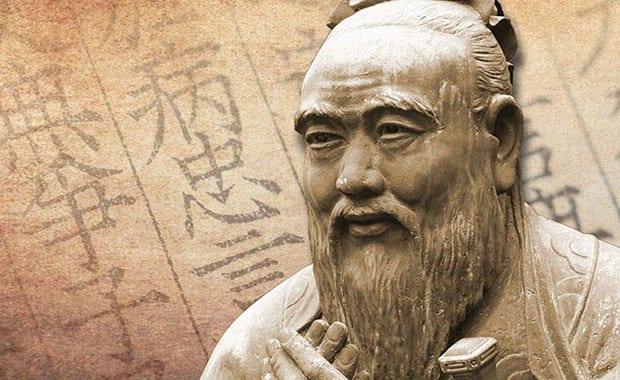
Human nature hasn’t changed much since a gentleman scholar sought stability amidst chaos in China 2,500 years ago. How might his insights help climate activists today?
By Robert ‘SternWriter’ Stern
Founder, See Through Ecosystem
Confucius and me
I’m no Confucian expert, but when I studied Chinese at university forty years ago, I scratched the surface of The Analects of Confucius as part of my classical Chinese course.
Four decades wiser, I’m now a climate activist strategising the shortest path to emissions reduction.
Weirdly, my undergraduate understanding of Confucius keeps bubbling up.
In Confucius He Say: Time To Tackle Our Climate Crisis, I mapped a famous Analects passage, about how our thinking should mature with age, onto my own succession of careers.
By my age, 60, Confucius felt his ‘ear was attuned’. The meaning of this gnomic phrase (耳顺: er shun) has provoked much scholarly debate, but is generally understood to mean Confucius had ‘learned to listen to many different views without becoming agitated’. In today’s world on online pile-ons and social media rage, this is surely a good thing.
The previous article was my attempt to explain my own journey from know-nothing student to founding the See Through Ecosystem (Goal: ‘Speeding Up Carbon Drawdown by Helping the Inactive Become Active’).
This article, however, applies The Analects not to me, but to the climate crisis.
As I struggle to find innovative and effective ways to nudge us away from our fossil fuel addicion, I’ve been surprised to find myself asking:
- What can this scholar-sage of the Spring and Autumn period (c. 770-481 BCE) teach us about sustainability?
- What might this itinerant philosopher-for-hire, born in China half a millennium before Christ, have to offer in restoring our collective sanity in the 21st century?
- How might Confucius’ insights into human folly two and half millennia ago serve as a guide towards a sustainable future?
What follows is my attempt to jiggle the messy, polluted, chaotic slop of today’s world through a Confucian sieve, sifting for effective climate action.
Confucian virtues, Take 1
As a student labouring through The Analects, Mathews Chinese-English dictionary of classical Chinese at my elbow, decoding its literal meaning was enough of a struggle.
When it came to applying the actual philosophy Master Kong (c. 551-479 BCE), Latinised at ‘Confucius’, to the 1980s, I had little bandwidth, or inclination, to think much about his contemporary relevance.
Unlike Confucius, I didn’t see classical texts as a timeless repository of wisdom, to be judiciously deployed in the real world.
For a callow youth who knew little of life, and less of the Chinese language, The Analects was more of a cryptic crossword puzzle.
I had to turn to Mathew’s for virtually every character, as even the familiar modern Chinese ones often had different meanings when Confucius’ disciples compiled their Master’s bon mots.
All this meant that when I sat back to consider the meaning of what I’d deciphered, my understanding was pretty superficial.
Confucius would have expected this. My previous article was based on his most biographical, and famous, ‘Ages of Man’ saying. Master Kong, in his dotage, reflects on his own moral and intellectual development, describing key milestones at age 15, 30, 40, 50, 60 and 70.
At my stage of life, Confucius had only just ‘set my heart of learning’. It took Confucius decades of experience to put his learning into practice, but I still had to write essays on the bloke’s ‘Five Constants’:
- 仁 (Ren: Benevolence)
- 義 (Yi: Righteousness)
- 信 (Xin: Sincercity)
- 智 (Zhi: Knowledge)
- 禮 (Li: Ritual)
The first four made sense. Benevolence, Righteousness, Sincerity and Knowledge could easily be mapped onto the value system I’d been raised in.
Even if my exact understanding o these terms differed from Confucius’, I was all for them. Put another way, I was against malevolence, sin, lying and ignorance.
‘Ritual’, however, always struck me as the weakest card in the Confucian deck. As a naturally subversive youth, raised agnostic, ‘ritual’ just didn’t ring my bell.
I was against etiquette, and for informality. To my ears, ‘sincerity’ and ‘ritual’ were contradictory.
Essays submitted, and exams passed, I never expected to cross paths with Confucius and his Five Constants again.
Yet he’s turned out to be a persistent bugger.
Confucius’ longevity
There’s a reason why we’re still talking about Confucius 2,500 years after he died.
Like the Bible, the Ramayana, Works of Shakespeare, and other written legacies that transcend their time and culture, The Analects exposes profound, enduring truths about human nature and relationships.
Like those other works, Confucianism survives because new generations use them as a lens to view our changing reality.
Across East Asia, from Mongolia to Japan to Indonesia, governments and citizens have long adopted ‘Confucian values’ as part of their culture.
Within China, Confucianism (it’s known there as ‘Ruism’) has had a rollercoaster ride.
From his contemporary Moists to Maoists during the Cultural Revolution, attempts have been made to challenge or erase its influence.
But like a recessive gene, Confucian values keep returning. Governments claim them, as credibility tokens. Citizens aspire to them, as cultural touchstones. For better or worse, people re-invent The Analects to be whatever suits them.
The rest of the world may not be able to recite the Five Constants, or the Four Virtues, or know their Yi Ching from the Book of Rites, but most have heard of Confucius.
Anyone with more than a passing interest in East Asia soon becomes aware of his shadow. From Bangkok to Jakarta, via Tokyo, indigenous local ‘values’ are attributed to him.
Now the entire planet is roped together on our march towards the environmental abyss, we should probably learn a bit more about the core values of 30% of the world’s population.
Especially as this includes Confucius’ country of birth, source of 30% of global emissions.
Confucius’ Crisis
For those whose knowledge of Confucius is limited to the set-up for ‘Confucius say crowded elevator always smell different to midget’-style jokes, here’s a mini-bio.
Like his contemporary Mohammed, or Jesus Christ, born half a millennium later, separating the biographic from the hagiographic, is tricky. But Chinese bureaucracy means Confucius’ life was better documented than those other towering influencers:
- Confucius (Kong Qiu), born around 551 BCE, of minor nobility lineage in northeast China, just as the Eastern Zhou dynasty was collapsing into warlordism.
- Orphaned early and raised in poverty, young Confucius’ passion and aptitude for study earns him steady promotion as a civil servant under his native state of Lu.
- As Lu succumbs to warlordism, Confucius becomes an itinerant freelance consultant to states competing to reassert central authority and restore stability.
- At 68, he returns to his home town of Qufu, Shandong Province, spending his remaining years educating disciples, editing classic texts, and continuing his vain efforts to advise leaders on bringing peace through good governance.
By his own standards, Confucius was a noble failure. He strove, and failed, to avert chaos and promote stability.
It got worse. As he died, China descended into the Warring States period (c. 475-221 BC), but his legacy was secured by his disciples who compiled The Analects. Beyond the grave, dynasties benefitted from Confucius’ wisdom and experience of human nature.
Like Christian or Muslim kings wielding the Bible and Qur’an, Chinese Emperors used The Analects as heavenly mandates to justify their status.
Far more than Christian and Muslim kings, Chinese Emperors and their civil servants consulted The Analects as a practical guide to good governance. For millennia, it was less heavenly imprimatur, more instruction manual to stay on the throne.
By the 1980s, for this student of his philosophy, The Analects was less an instruction manual, more an exam requirement.
But now I’m looking for ideas to avert a global climate crisis, it’s looking more like an instruction manual.
Confucius’ Solutions
Confucianism has been variously described as a philosophy, a moral code, a theory of government, and a way of life.
Human nature hasn’t changed much in the last few millennia, so what was wise then is probably still wise.
The Analects are particularly robust and universal because Confucius tends to keep God out of it.
The notion of 天 (tiān: ‘heaven’) runs through The Analects, but it’s a vague ultimate force, not a supernatural legislator.
Confucian solutions are thus very much up to man, conducted by man, and man’s responsibility. This makes them accessible to anyone at any time, including now.
The Analects are not immutable commandments dictated by a supreme being, but a posthumous collation of Confucian zingers recorded by his disciples, mostly defining core concepts, like the Five Constants and Four Virtues.
Time, distance, and the compressed nature of classical Chinese leave plenty of room for interpretation, but The Analects’ overt purpose is to provide a set of values that if implemented, would benefit both state and individual. If governors and the governed follow the manual, peace, harmony and stability will ensue.
Today, with rising political volatility and a gathering climate crisis, peace, harmony and stability sound pretty good to me.
I won’t list and explain all the Confucian doctrines.
For climate activists, I’ve selected two key Confucian values that keep repeating on me, as I digest what I’ve learned over my life about why we behave the way we do: Ritual and Knowledge.
Confucian Ritual (禮: li)
‘Ritual’, I realise, is a hard sell these days.
My university lecturers warned that Confucius’ concept of ‘Li’ is not well served by this translation, yet ‘Ritual’ remains the default catch-all for this most challenging of the Five Constants.
In modern parlance, ‘Ritual’ is usually pejorative, or dismissive: empty ritual, mere ritual, unthinking ritual.
This may reveal more about society’s promotion of the individual over the collective. As I’ll come to, this is rather the point.
The original meaning of the Chinese character 禮 was a ceremonial vessel, but even in Confucius’ time ‘Li’ had developed a broader meaning.
Consulting the well-thumbed dictionary that got me through my classical Chinese course, Mathew’s lists ‘Li’’s core definitions as:
- propriety
- good manners
- politeness
- ceremony
- worship
- the external exemplification of eternal principles
- the feeling of respect and reverence
The ensuing list of compound words containing the character ‘li’ include:
- etiquette
- courtesy
- modesty
- decorum
To the modern ear, these are more obviously good things.
Assemble the warm feelings you get from these words, and Confucius’ ranking of ‘Ritual’ as a key virtue looks more reasonable.
Before updating this cardinal Confucian virtue to the present day, here’s the other one I keep thinking about when considering effective climate action.
Confucian Knowledge (智: zhi)
Today, ‘Knowledge’ looks like a more obvious, unambiguous virtue. Mathew’s lists ‘Zhi’’s core definitions as:
- wisdom
- knowledge
- cleverness
- prudence
Even two and half thousand years on, most of us would still give these qualities the thumbs up.
The problem is, the most powerful people in the world reckon they can prosper by hoarding Knowledge for themselves, and encouraging folly, ignorance, stupidity and recklessness in the rest of us.
In 500 BC China, the nature and provenance of ‘Knowledge’ was quite specific, and text-based.
For Confucius, ‘Zhi’ were eternal truths to guide our behaviour found in ancient texts. The Confucian scholar-gentleman’s duty was not to manipulate Knowledge for personal profit, but to revere it, handle it with care, and deploy it for the benefit of society.
That’s why Confucius dedicated himself to writing, editing and proselytising the Five Classics (五經; wǔjīng). For him, all humanity needed to know was contained in:
- The Book of Changes (AKA I Ching)
- The Book of Rites
- The Book of Songs
- The Book of Documents
- The Spring and Autumn Annals
The respect Confucius had for these texts was not the same as the reverence Abrahamic religions express for the Qur’an, Bible and Talmud.
‘Zhi’ is secular ‘Knowledge’, derived from human experience. It’s why Confucianism is regarded as a philosophy, not a religion.
These classics, and other Confucian texts, are not transcriptions of the revealed word of God(s). They are encyclopaedias of the collective wisdom of our elders, accessible only to the literate, designed to avert chaos.
This is why The Analects places such a high value on 學 (‘Xue: to study) as a key moral virtue.
To this day, Chinese parents read their children the text I studied in my basic classical Chinese class and Chinese kindergarten kids can still reel off.
The ‘Three Character Classic’ (三字经 : sanzijing) is a kind of Confucianism for Kids, composed of 356 rhyming three-syllable couplets.
Five lines in, it mentions Mencius’ mother ‘breaking her loom’. When this Confucian paragon discovered little Mencius was skipping school, she broke her loom in front of him, to teach her errant boy the dire consequences of breaking the fabric of knowledge, each thread woven by studying.
If Mencius’ mum smashed a loom over one boy’s truancy, how would she react to today’s Age of Misinformation?
Study is the gateway to Knowledge. Facts matter, opinions don’t.
So how can Confucian notions of Ritual and Knowledge help fix the climate crisis?
‘Ritual’ today, for climate activists
- For political instability 2,500 years ago, think of climate instability today.
- For rival warlords in a collapsing dynasty, think of rival superpowers in a collapsing world order.
‘Ritual’, like carbon drawdown, requires rules, and strict, impartial enforcement of those rules. Rules are the antidote to chaos.
Just when we most need a collective, coordinated, global response to rising carbon emissions, might-is-right mavericks are on the rise. They profit from division, chaos and fetishise ‘disruption’.
The more power and wealth is concentrated, the more incumbent plutocrats and billionaires profit from systematically dismantling rules-based systems.
Confucius was battling to hold a disintegrating society together, suppress the outbreak of war, rein in spreading chaos. Reading today’s headlines, I feel your pain, brother Kong.
I no longer think of ‘Ritual’ as empty and meaningless, but as the ‘rule of law’ and ‘rules-based systems’.
We’d all benefit from a bit more of this kind of Ritual.
Discipline is necessary for our species’ survival. It’s our roadmap for an orderly return to sustainability.
‘Knowledge’ today, for climate activists
‘Knowledge’ is not quite the same as it was in Confucius’ time.
It’s no longer contained in texts and only accessible to the literate. 75% of us have a smartphone and access to the wisdom of the Internet.
Mencius’ mother’s urge to ‘study’ is still good advice. Education will improve your career, and society, we’re told. Knowledge is power.
But ignorance is bliss for those seeking to manipulate. In an Age of Misinformation, we need to define ‘Knowledge’ more precisely.
Our Silicon Valley Overlords and merchants of misinformation know better than to diss Knowledge. They talk of the ‘knowledge economy’, ‘knowledge workers’, and ‘knowledge management’.
But these phrases, coined in a pre-AI age, are starting to sound like a con. Now AI robots threaten the human monopoly on ‘knowledge’, we should ask what kind of knowledge we’re talking about.
Like a light beam shining through a prism, the digital revolution is revealing ‘knowledge’ to be composed of quite separate elements. Subdivisions of the Knowledge Economy include:
- intuition
- wisdom
- experience
- information
- data
- inference
- deduction
2,500 years ago, ‘Knowledge’ moved slowly. Like the sun and the stars, for practical purposes it was fine to regard Knowledge as static.
Now Knowledge is constantly shape-shifting, faster and faster, making it vulnerable to mistrust. We’re now used to new knowledge demolishing old knowledge:
- Science and technology constantly drives religious doctrine into retreat. From astronomy to geology, doctrine cedes territory to the scientific method.
- Since Darwin, our anthropocentric view of our species has been eroded. Learning that traits we once thought uniquely human – language, emotion, compassion, altruism, manipulation, toolmaking – are common among animals, and we only differ in degree and sophistication, is discombobulating.
- Men of learning, once confident of the indivisible building blocks of matter, are obliged to revise these immutable truths with each discovery of a new sub-atomic particle.
- Climate science is revealing the depths of our ignorance in assuming the planet is an infinitely capacious waste-bin, rather than a delicate self-balancing biosystem.
These concepts would have been baffling to Confucius, for whom ‘knowledge’ was unchanging, encapsulated in classic texts.
But rather than focus on this oversight – forgivable 2,500 years ago – I find myself reflecting on the aspect of Confucian wisdom that hasn’t changed – the human factor.
For Confucius, Knowledge was not an end in itself, but a means to promote good governance and individual morality.
I agree. Climate science matters, but is meaningless unless it helps the climate inactive become active, and promotes sustainability.
Confucianism, like religion, is in the eye of the beholder. Revolutionary governments have banned it as blind obedience via rote learning; authoritarian governments have used it to justify autocracy.
Both strike me as self-serving, because they only focus on the collective application of Confucian values in government. They conveniently ignore The Analects as a manifesto for individual self-improvement, and a moral code.
I read his devotion to Knowledge via ‘Xue’, study, as an exhortation to individual growth and responsibility, an encouragement of critical thinking, and a respect for experts.
My climate activist summary:
- Take action
- Nail the lies
- Follow the science
Confucian virtues, Take 2
- How have the 40 years since I first encountered Confucius informed my appreciation of his philosophy?
- How might those lessons be applied to our climate emergency?
When I first laboured over The Analects as an undergraduate in the mid-1980s, it was frankly a bit of a slog.
Deciphering the literal meaning of its elaborate traditional Chinese characters, and punctuation-free grammar, was challenging enough. The effort didn’t leave much brain space for real-world application.
My youth, and 1980s Britain, didn’t equip me to appreciate what I was struggling to simply comprehend.
As a 20-year-old who’d grown up during the Cold War. I’d normalized the mutually assured destruction rationale of nuclear weapons, then considered to be humanity’s greatest existential threat.
However bizarre its logic, at least MAD has its rules. American and Soviet leaders appeared to be respecting the rules. That’s Ritual.
In 1986, with Chernobyl’s radiation cloud drifting across Europe, I was part of a delegation of Young European Sinologists invited on a two-week soft-power junket to China.
The visit culminated in a photo-opportunity with the Vice-Premier. I wore a ‘No Nukes’ badge, in what I now think of a ‘ritual’ statement of principle. Our government handlers were more baffled than offended by my little ritual. China had bigger issues back then. Still does.
Like all but the most perceptive climate scientists, in the ‘80s I was yet to understand the greenhouse gas implications of our fossil fuel addiction. Nuclear war aside, my main existential concerns back then were Amazonian deforestation and the ozone layer.
I assumed that the solutions to both would involve international agreements and enforcement. I now think of such things as ‘Ritual’.
My faith in rules-based protocols wasn’t entirely naive. True, international agreements have failed to prevent the Amazon shrinking by the areas of France and Germany combined in the last 40 years, but without them it would have been much worse.
The Montreal Protocol, signed in 1987, seemed to be a more unambiguous victory for rules/ritual. Concerted international action in the face of a global existential threat appeared to have fixed the ozone hole.
Our HCFC solution may have had damaging greenhouse gas consequences, but that’s not the point.
‘Ritual’, in the guise of rules-based bodies, fixed a planetary-scale problem quickly and efficiently.
Ritual, Knowledge, the climate and me
Remember Confucius’ Five Constants – Benevolence, Righteousness, Sincerity, Knowledge and Ritual?
The biggest obstacle to carbon drawdown is the malevolent, sinful, lying and ignorant minority who promote profit over planet.
I now see ‘Ritual’ not as ‘empty gesture’, but as ‘rules-based systems’, the rule of law, and focusing on the message rather than the messenger.
My new appreciation of Ritual is an articulation of an objective value system that puts principles above hegemons, and the interests of our species above those of individuals.
I now understand why Confucius could see ‘sincerity’ and ‘ritual’ ‘as being complementary, not contradictory.
Translate ‘Xin’ as ‘transparency’, and I’m all in. Transparency would go a long way to leaving my twenty-something daughters a sustainable future, rather than a wasteland.
I now reckon Confucius would also have scorned the notion of ‘empty ritual’, for the same reasons I find performative green grandstanding ineffective and self-indulgent.
Ritual must have a purpose. For Confucius, it was a means to promote stability. For me, sustainability.
This kind of Ritual, like the ‘daily rituals’ that punctuate our non-Confucian lives, is reliable, solid and reassuring.
It’s also progressive, appealing, aspirational, giving form and structure to our efforts to be Benevolent and Righteous.
I now appreciate the breadth of what Confucius meant by knowledge’. ‘Zhi’ can embrace:
- Hard, objective scientific knowledge, in the form of facts, evidence and data.
- Squishy subjective knowledge, in the form of storytelling and behavioural psychology
- The wisdom and understanding combining both types to benefit us all
So, forty years after I started to besmirch my pristine Mathew’s Chinese-English dictionary, I’m finally getting it.
Just as Analect 2.4 predicted, ‘At the age of 60, my ear became attuned’.
***
All these concepts – marrying hard science with sophisticated storytelling, as a means to a greater good – are embedded in the See Through Goal of Speeding Up Carbon Drawdown by Helping the Inactive Become Active.
To discover practical ways in which the See Through Ecosystem is applying Confucian wisdom to the climate crisis, visit www.seethroughtogether.org