
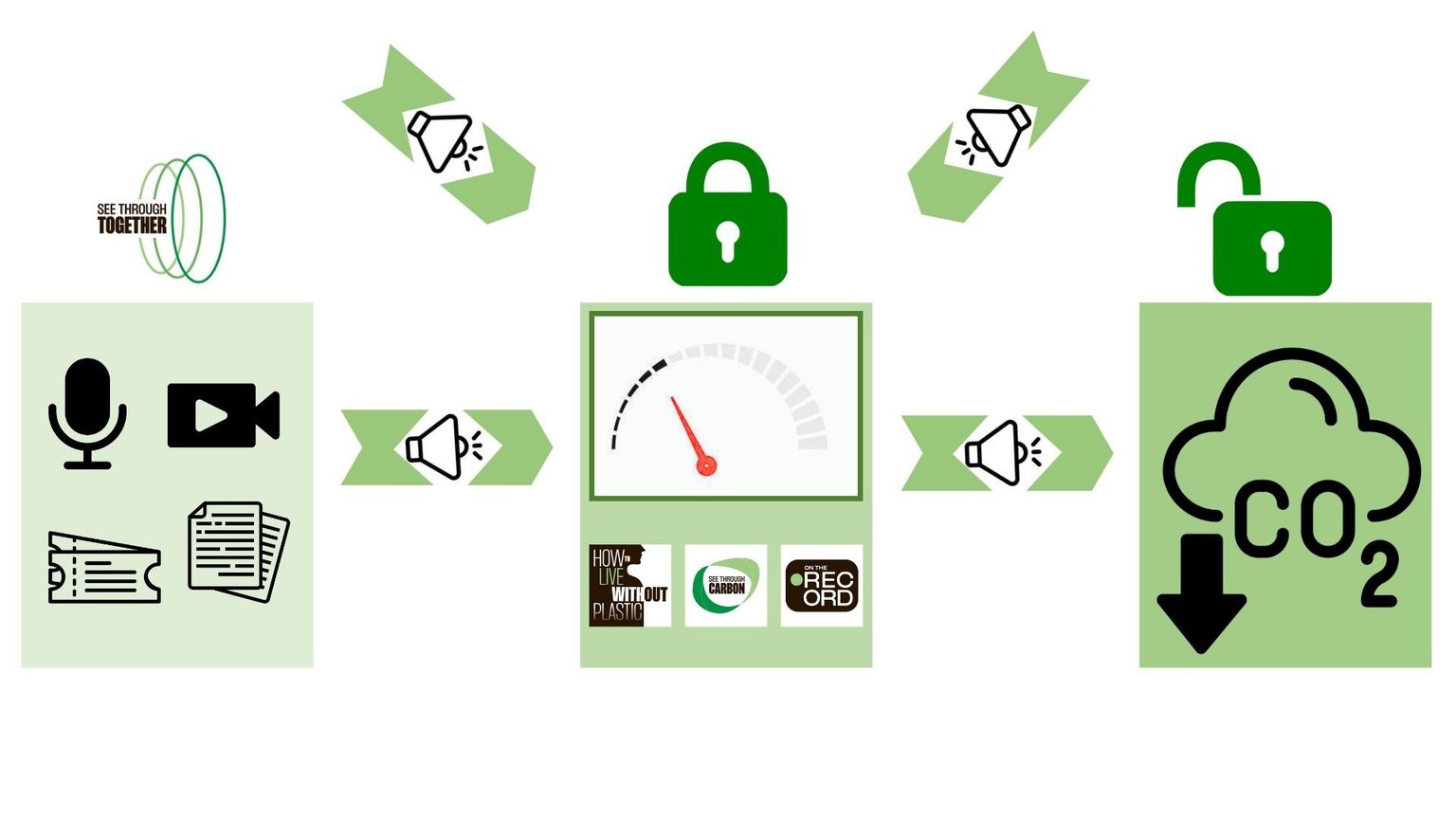
How original text, video and audio content can substitute CO2e-reducing actions for money
This article sketches out how text, video and audio content can adapt money-driven crowdfunding models to speed up carbon drawdown.
Content charity mugging
If you listen to podcasts, browse content aggregators like Substack, or doomscroll videos on YouTube, Facebook or Instagram, you’ll know about content charity mugging.
It’s the Money Bit, as boring as it is annoying. The bits you either tune out to, or skip past until the free bit starts again – if the platform permits it.
We’re not talking about the ads that generate profit for the content aggregators. They won’t let you skip past those, as that’s how they make their money. We mean the cringey bits where hosts who’ve just been speaking with authority, credibility and gravitas suddenly go beyond a politely request to Like and Subscribe, and start pitching you tat, baffling products, or begging you to subscribe to their crowdfunding or Patreon accounts.
The Money Bits is the moment when you feel like, after bumping into a nice person, and taking a nice walk on a nice day, having a nice chat, they suddenly ask you for money.
Or you’re strolling along the high street with a good friend, only to be interrupted by a charity mugger shaking their collection tin in your face, guilt-tripping you with pictures of starving children, sad patients in wheelchairs, war zone orphans, or emaciated donkeys.
Why they do it is painfully obvious, – it’s to get paid.
But how much do you know about the calculations involved?
Why do they constantly urge you to Click The Link In The Show Notes?
And why is The Link In The Show Notes so hard to find?
The Podcast Business Model
The Money Bits tell you, often at length, exactly what you’ll find when you click the link in the show notes.
You’ll land in the middle of a merch shop. If you’re not being proffered logo-festooned baseball hats, it will be a menu of Bronze, Silver and Gold club membership options, with escalating tiers of privileged access to this or that Exclusive Content.
- How often have you clicked on the link in the show notes?
- Have you ever wondered how many of your fellow-listeners choose to leave the warm embrace of whatever social media platform you’re on and risk the unknown shoals beyond The Link?
- What kind of person resists your favourite platform’s siren call to scroll on to the next tempting high-calorie morsel, ready and waiting in your personalised feed?
- Does anyone actually bother to find the link in the show notes?
- And why is it so hard to find the show notes, let alone locate any clickable links?
You now know the questions that keep anyone make a living from podcasts awake at night.
Commercial podcasters depend on charity mugging; our Silicon Valley Overlords who run the content shops like YouTube, Spotify, Substack or Apple Podcasts depend on mugs.
Mugs like the author of this article. Mugs who create original content, enabling the Overlords to devour your data, and get advertisers to pay for bespoke access to your ears and eyes. That’s why the next high-calorie morsel in your feed is somehow exactly what you want.
But the Silicon Valley Overlords really hate it when you click away.
The moment you land on another website, you’ve become someone else’s customer. That’s why they make it so hard to find a link (if they permit you a clickable one at all). That’s why they ask you if you’re absolutely sure you want to click away. That’s why they darkly warn they can’t guarantee the security of third party websites.
The podcast industry term for the percentage of people they can convince to click away is the ‘clickthrough rate’, or ‘CTR’.
Have a guess what the podcast industry average is.
You’re not the only one
The average podcast click through rate is around 0.13%
That means that, on average, out of a thousand listeners, around thirteen will actually click on the link in the show notes.
If you think those odds, while lower than you guess, must still be worthwhile or no one would make podcasts, think again.
There are around five million podcasts, with an average number of listens per episode of 27.
Which is to say, if you apply the average clickthrough rate to the average number of podcast episode listens, the total number of people is 0.0351, or about the weight of your liver.
It gets worse.
Always be closing
For podcasters trying to make a living from podcasts, persuading you to land on their website earns them zero.
It’s the next step – what marketing people call the Call To Action or ‘CTA’ – that finally makes them money. When you click the link, they still have to close the deal. Only when money exchanges hands, and your shopping basket becomes an order, can they sleep at night.
If only 13 out of every 1000 of listeners even enters the shop, imagine how much lower the percentage of shop browsers that end up actually buying something is.
Of course, it’s not random browsing. Podcast listeners know exactly what to expect when they click the link in the show notes and enter the shop. In case you tune out or skip past the Money Bits, that’s what the annoying charity muggers are pitching to you.
Now you understand the podcast business model.
What if you don’t have a bank account?
Of course, not all podcasts are meant to make money. Many are for internal corporate communications, AKA the boss’s vanity podcast.
Charities and NGOs also have podcasts, some of them excellent. They see them as important ‘awareness raising’ tools, as much as elaborate audio begging bowls. Even if only 13 people enter the shop, they can console themselves that the awareness of the other 987 has been raised – assuming they’ve beaten the podcast industry average by 37 times, to reach 1,000 listeners.
The handful of superpower podcasts that get the millions of listeners, the ignored CEO vanity podcasts and the selfless NGO awareness-raisers, however, all have one thing in common.
The entities making them all have bank accounts.
So how might an entity without a bank account go about making podcasts?
Do the same metrics, key marketing indicators and rules of thumb still apply?
See Through Together is about to find out.
Non-money Calls To Action
What Call To Action (CTA in the marketing biz) might an entity that doesn’t have a bank account have?
And how can See Through Together advance its Goal of Speeding Up Carbon Drawdown by Helping the Inactive Become Active?
However enthusiastic See Through Together’s readers, viewers and listeners may be, if they can’t buy a See Through T-shirt (!) or mug, pay for See Through Club Golden Tier membership for exclusive content on a See Through Patreon account, choose perks from a See Through Kickstarter crowdfunding page, or donate to a See Through JustGiving appeal, what’s the point?
At time of writing, any Unwilling Inactivist who’s consumed from See Through Together’s buffet of dozens of projects and content in article, event, video and audio form, and has been successfully Tempted, Intrigued and Engaged to land at www.seethroughtogether.org, has been presented with two CTAs:
- Subscribe to the See Through Newsletter
- Join the team via our How To Help form
There’s little evidence either has been successful. This is unsurprising. 1 is trivially commonplace and often ignored, 2 is a huge leap of commitment.
Now, however, with a major IT overhaul underway, new possibilities are imminent. The spanking new See Through websites will be able to:
- Offer novel, original and engaging Calls To Action that don’t involve money.
- Express potential and, in time, actual contributions & outcomes in verifiable tonnes of CO2e
- Customize landing pages for particular projects
- Measure the effectiveness of each project not just in CTR, but in its contribution to a CTA, expressed in both numbers of actions and, in time, real-world emissions impact.
The new IT infrastructure will also allow See Through to fully integrate three additional Calls To Action, currently in siloed development.
- See Through Carbon: for businesses, in Pilot stage
- How To Live Without Plastic: for individuals, prototype tested and ready to rumble
- On The Record: for individuals, entities and legislators, part-coded, in development
See Through Together’s content buffet exists is to provide appetising enough morsels to lead people along a cookie trail terminating in a See Through Call To Action. If this CTA can measurably reduce carbon emissions, it will advance the See Through ecosystem’s carbon drawdown Goal.
But all those Patreon, Kickstarter, JustGiving etc. crowdfunding models are geared up to measure contributions in cash.
How will an ecosystem with no bank account charge for its Calls To Action?
If time is money, and money makes the world go round, why can’t time reduce carbon?
In the absence of money, the cost of each Action is around an hour of your time. Maybe minutes, if you own a very small small business, live with an old person and have fast broadband, or are a fast reader.
Think of it as an unconventional fundraising goal.
Instead of reaching a crowdfunding threshold, membership target, or raising enough money to pay the bill for repairing the community centre roof, See Through just needs to get x number of people to move the dial by y percent, to reduce z tonnes of greenhouse gases.
But what leverage does See Through Together have, beyond an appeal to people contributing their time, energy and talent pro bono, which all the professionals making See Through Together’s text, video and audio content are already doing anyway?
What’s the secret to scaling this money-free model?
The secret
First, the secret is that there is no secret.
The See Through ecosystem practices radical transparency. Everything it does is public, transparent and open source by default.
That’s why we’re telling you exactly how we’re intending to do it, in this article, before we do it.
But for want of a better word, here’s our secret plan…
Guinea pig
The See Through Prod-cast The Truth Lies In Bedtime Stories seems like an ideal guinea pig to test this methodology:
- The Truth Lies appears to be comfortably the most effective See Through Together Playlist at getting curious Unwilling Inactivists to click on an external link.
- The format already lends itself to ‘selling’ premium content as a ‘reward’ or ‘perk’ for responding to a Call To Action.
The standard Truth Lies series tells a story that is ‘entirely true, largely’ in 10 Episodes, with a single narrator using a bedtime-story tone, augmented by original musical compositions and professional sound design.
Truth Lies topics are diverse, unexpected, and entirely true, largely. For example:
- The Story of Ganbaatar: the only deep-sea navigator in Mongolia. Set in the world’s most remote landlocked country.
- Marcus and Jemima: how I deal with people at parties who assume I have children. Told by a childless man who many believe is father to as many as thirteen children.
- The Quiet Revolutionary: the heroic role played in a Plot to Assassinate the King by someone you’ve all heard of. Set mainly in 1794 London, terrified that revolution might cross The Channel.
But all Truth Lies stories share a common format. Usually 10 Episodes (sometimes 7), all but the last Episode ends on a cliff-hanger, and teases the next. The final Episode reveals the denouement/narrative climax, delivering the storytelling hit.
The denouement is delivered in a way that, in a subtly different way in each series, challenges the listener to question why they prefer beguiling lies to inconvenient truths.
Incidentally, all See Through content is assigned a C-Bomb rating of 1 to 4. The Truth Lies is C-Bomb 1, meaning it never mentions the climate crisis, Big Oil misinformation, or corporate greenwash directly. Instead, Truth Lies narrators allude to it so obliquely, many listeners don’t even make the connection.
Why would professional writers, filmmakers and podcasters work pro bono to craft content for a climate action network that sometimes doesn’t even mention the climate?
See Through’s ‘Transparent Trojan Horseplay‘ methodology explains why.
It’s based on behavioural psychology and storytelling techniques that are the everyday tools of professional creatives and advertisers.
What makes See Through Together uniquely placed to conduct this experiment is that it has no bank account.
Free/’Paid’ Model
The Truth Lies format naturally lends itself to the Kickstarter/Patreon crowdfunding model of providing some content for free (e.g. Eps 1-9), but withholding related content to ‘sell’ (Ep 10).
Denying the listener the most narratively satisfying part of the story should provide maximum leverage for convincing more than 0% of listeners to ‘pay’ for the final unravelling of the complex plot.
Listeners prepared to ‘pay’ to hear the final episode can only ‘buy’ the link to the content by taking a See Through CTA, i.e. with an hour or so of their time it takes to contribute to:
- See Through Carbon (by filling in a form to get a free, accurate, transparent carbon footprint of your business) or
- How To Live Without Plastic (by recording an interview with an old person and sending us the video to add to the open source database).
In taking this action, they have completed See Thorugh’s Engagement Journey, and moved from Inactive to Active, thus fulfilling both the technical and storytelling elements of the See Through Goal of Speeding Up Carbon Drawdown by Helping the Inactive.
A major advantage of not having a bank account, is that ‘raising awareness’, ‘educating’ and ‘informing’ people about, say, the climate crisis, becomes much less important.
Being relieved of the need to advertise one’s ‘greenness’, in order to rattle the collecting tin, facilitates Transparent Trojan Horseplay. If you don’t wang on about the climate all the time, many fewer people will stop listening when they hear a green trigger word.
That’s why it’s called See Through. It describes its radical transparency, but also tells you nothing about our climate-related goal, so as not to alarm you and pre-emptively close your ears. You can’t move someone to action if they have their fingers in their ears, or are rapidly retreating, telling you they recycle, often litter-pick and one way or another are ‘doing their bit’.
Spared the need to fundraise, not having a bank account frees climate activists to access a vast new target audience of Unwilling Inactivists.
Unwilling Inactivists are people who accept the science and reality of human-induced climate change, feel powerless to do anything about it, and would really rather not be harangued by yet another climate activist telling them not to fly, eat meat or use plastic bags.
In other words, almost everyone.
Even better, it doesn’t even matter whether the people targetted by such content care, are concerned about, or even have their awareness raised about human-induced climate change.
Motivation vs Action
The Truth Lies C-Bomb rating of 1 means the podcast Episodes never mention or reference climate, carbon, sustainability or any other ‘green’ trigger words. STT’s Goal is only briefly mentioned right at the end, when most listeners have skipped ahead.
This means anyone clicking on the link in the show notes is unlikely to have any idea of STT’s carbon drawdown Goal. Unlike the commercial podcast listeners, who’ve heard the Money Bit charity mugging script a thousand times, they have no idea what kind of emporium awaits.
Will this deter listeners, and send the scuttling back to the warm embrace of the Silicon Valley Overlords? Or might it further intrigue them?
Your guess is literally as good as ours, until the new IT system is up and running. But once it is, woolly speculation can be replaced by hard data, and opinion will yield to fact.
The answers will be revealed by the conversion rate, i.e. the drop-off between total listeners and link clickers, and between link clickers and Call To Action respondents.
For a Truth Lies In Bedtime Stories fan who really wants to know how the story ends, however, responding to a See Through Call To Action requires no motivation other than wanting to hear What Happens Next.
It has to be a hell of a yarn, of course.
- Will Teetering: how a Hawaiian beach bum held my career in the balance cut the mustard?
- Might Life On The Edge: the moment I realised Mrs. Wang was mostly guessing what her husband said do the trick?
- Could The Penny Drops: how it took me 20 years to realise one of my three Japanese friends was a yakuza pull it off?
If these entirely true, largely, yarns excel themselves, they might even deliver the ultimate proof of concept – getting a climate denier to take an emissions-reducing Call To Action.
Or as a stretch goal, getting a climate denier to encourage their climate-denying friends to ‘game’ the system by taking emissions-reducing actions in order to pass See Through’s crowdfunding target required to to deliver Episode 10, and reveal the end of the story.
If a story is good enough, and told well enough, could a climate-denier’s obsession to find out What Happens Next trump their wilful ignorance?
If you’re worried about disappointing the 99.87% of listeners who are left on tenterhooks because they didn’t click on the link in the show notes, you have yet to fully appreciate the liberty bestowed by not having to consider money.
See Through’s zero-revenue, no-bank-account ecosystem structure means the cost of annoying the Inactive is zero.
3 steps to drawdown
Here’s how it could work, in three steps.
Step 1: Click-Through Rate
See Through Together podcasts, videos, events and articles etc. on external social media sites include a tagged link to their page on the STT website.
See Through can monitor the appeal of the content externally (numbers of views, streams, reads, participants etc.) and the clickthrough rate (i.e. the percentage of content consumers we can Tempt click on our link and leave their social media site).
Benchmarking: for context, the industry average clickthrough rate to external sites is 0.13% for podcast episodes 0.3-2% for YouTube videos, and 2-3% for Substack articles.
Step 2: Call To Action
Visitors driven by See Through storytelling content land on a bespoke page at www.seethroughtogether.org. Page visitors are tracked (anonymised and non-invasively) to measure the percentage who take one of See Through’s Calls to Action. Successful completion criteria would be:
- How To Live Without Plastic: registering an account and send a video (around an hour of their time) OR using the HTLWP database (duration up to them)
- See Through Carbon: completing a data submission (around an hour)
- On The Record: registering as a Citizen, Entity or Legislator (seconds to minutes)
Benchmarking: no standard tool exists, so See Through has designed its own, the See Through Action Evaluation Tool (STAET).
Step 3: Greenhouse gas reduction
See Through Calls To Action have built-in metrics to claim verifiable masses of emissions:
- How To Live Without Plastic: data derived from the database drives an innovation or initiative that turns out to have a measurable carbon drawdown impact.
- See Through Carbon: any emissions reduction following the baseline (adjusted for growth/shrinkage of the business measured by revenue/employees) can be claimed as attributable to STC.
- On The Record: any legal clause passed into law carries a carbon savings tag, which can be credited to See Through’s subtle, Transparent Trojan Horseplay form of activism.
Future data
See Through’s upgraded IT infrastructure will permit automated, dynamic, real-time monitoring of all these numbers for all content – at platform, playlist, series and even episode level.
In time, See Through Together’s team of content creators (and the public, when the new website makes all this transparent) will be able to monitor, track and connect:
- Social Media Analytics: the number of views/listens/reads etc. reporting by the social media platforms that host the content.
- Click Through Rates: the percentage of viewers/listeners/readers tempted to click away from their social media platform and land on the STT or STC website.
- Call To Action engagement: the number of entries in the STC, HTLWP, and OTR databases.
- CO2e drawdown: tonnes of greenhouse gas emissions reduced or sequestered by See Through Calls to Action.
This will become the key management tool to:
- Engage and motivate Unwilling Inactivists by demonstrating the real-world outcome of their actions at a granular level
- Allocate resources to the content that reduces the most carbon, irrespective of their social media analytic numbers.
- Identify weak points to fix what needs fixing, and leave alone what doesn’t.
- Improve every link of the chain between content and drawdown via A/B testing
Current data
STT has been manually tracking 1 and 2 above for several months via content-specific bit.ly codes in the video descriptions prominently displayed in every YouTube videos Description, and every podcast Description/Show Notes.
Detailed analysis is in the Views have risen since then, but there’s enough solid data to draw interesting, and in many cases counter-intuitive, preliminary conclusions.
Here’s the summary table from a recent monitoring.
Because the manual process is cumbersome and time-consuming, and the methodology patchy, the numbers don’t exactly match. Still, as many Playlists now have tens or hundreds of thousands of views, the data is already robust enough to replace hunches, opinions and guesswork with data.
| Playlist [Genre, C-Bomb rating] | Total STT Views @ Aug 10 ‘26 | Total clicks to STT website@ Aug 20 ‘26 | Click-through % to STT website @ Jun ‘26 |
|---|---|---|---|
| Ben Law’s Woodland Year [Craft, 3] | 187,534 | 123 | 0.12% |
| Room From A View [DIY, 1] | 136,413 | 103 | 0.16% |
| The 3 Rs: reading & riting [Education, 2] | 31,644 | 16 | 0.14% |
| Gimme Shelter [Construction, 4] | 24,007 | 19 | 0.11% |
| Concert in the Key of C [Music, 1] | 16,379 | 61 | 0.48% |
| Thinking Outside The Bogs [Humour, 1] | 10,013 | 31 | 0.33% |
| 25 Words That Rhyme With Orange [Poetry/Animation, 1-4] | 4,196 | 19 | 0.62% |
| Truth Lies in Bedtime Stories Prod-cast [Trueish Stories, 1] | 1,452 | 85 | 26.92% |
If the data above are even approximately accurate, they suggest:
- See Through Together content is generally in the industry average CTR zone, with three notable exceptions, and one massive outlier.
- There appears to be no correlation between C-Bomb ratings and enthusiasm to click away.
- Initial efforts should focus on The Truth Lies In Bedtime Stories
Benchmarks
Standard fundraising industry ‘conversion rates’ may not be a good predictor, as they all involve money.
But for the sake of estimating, a conversion rate of 50% (i.e. if half the people who clicked on the link to the fundraising page ended up paying money) would be considered outstanding.
The podcast industry average CTR is 0.13%, i.e. 13 out of every thousand listeners end up clicking on a link in the show notes.
If we apply a modest conversion rate of of 20-40%, that would mean only 3-5 out of every thousand listeners would end up taking a carbon-reducing CTA.
Four out of a thousand. Quite a low benchmark, then.
Worth a try?
***
If you want to be part of this adventure, or support it, here’s how (spoiler – you can use money, so long as you don’t attempt to fill the pockets of the pocketless).