
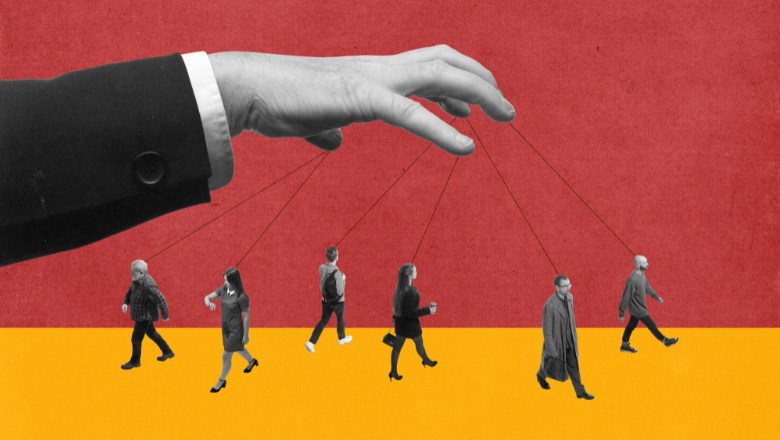
Radical transparency could fix many problems, but when everyone has their own truth and no one trusts anything, how can you prove you’re transparent?
This article examines why the challenges of proving you’re not greenwashing go well beyond climate science.
Three Obstacles To Carbon Drawdown
Climate is complicated. So are the challenges facing activists striving to nudge humanity towards a sustainable future.
Effective climate activists, who choose to influence the world as it is rather than as they wish it to be, need to come up with complex solutions. But to be effective requires simple messaging.
This dilemma is many-headed, but its messaging challenges fall into three basic types: the science, the storytelling, and the media environment we’ve allowed our Silicon Valley Overlords to create.
Explaining The Science
Once considered the primary job of a climate campaigner, explaining climate science is no longer the hard bit.
Primary school kids can explain the Greenhouse Effect. There are now climate sections on news websites. Translating hockey stick charts, PPM, AMOC, CO2e and other climate jargon is no longer the main obstacle.
This is partly because climate scientists have become much better at doing this themselves. Their eloquence now matches their authority.
The problem is that understanding the science was never enough. Even worse, appealing to facts and evidence is becoming increasingly ineffective. As the Greenhouse Effect has transitioned from theory to reality, ‘raising awareness’ is only an issue for the elective deaf.
If Willing Inactivists choose to la-la-la in response to rising global temperatures, shouting science louder won’t work.
If more unpredictable and extreme weather conditions, leading to increasingly destructive floods, crop failures and wildfires, are still treated as bad luck, or bad weather, what role can reason play in changing the minds of the wilfully ignorant?.
Climate activists shouldn’t waste too much time in stating the obvious. One of the actions that make Ineffective Activists ineffective is wasting their energy engaging either with those who will never agree with them, or those who already do.
Demonising the enemy and preaching to the choir might make you feel a bit better, but it doesn’t reduce any carbon and can only deliver false hope.
Science forms the bedrock of climate action, but that doesn’t mean activists should always lead with it.
Storytelling
Supplementing solid science with silver-tongued storytelling is a smarter approach.
The PR shills hired by Big Oil have been showing the way for decades. Learn from the best, and adapt their proven psychological techniques to reduce carbon, rather than increase it.
Those who profit from climate inaction have much deeper pockets, but suffer from the disadvantage of having to constantly lie. Impecunious climate activists can’t match Big Oil’s media budgets, but they can spin yarns from gold-standard truth, not fool’s gold lies.
Hide the climate greens beneath a mountain of narratively-satisfying red meat, and sustainability becomes more appetising.
The retreat of Reason
When it comes to climate change, the March of Reason can no longer be counted on as an ally.
Time will tell whether it’s just taking a breather, going in circles, or retreating. In the meantime, our climate crisis is getting more urgent.
Some are yet to accept this unfortunate truth. Enlightenment assumptions that mankind is now on an irreversible ascent from superstition and myth towards science and fact have long proven naive. Social media has made them delusional.
It’s understandable, though. When the Berlin Wall fell, people whose lives were immersed in the Cold War allowed themselves to theorize about The End Of History, with equally unhelpful consequences.
Mis-state the problem, and you’ll arrive at the wrong solutions. For both geopolitics and climate activism, optimism and pessimism are meaningless if you don’t understand the underlying forces at play.
The key drivers are intrinsic to our species, and thus immune to specific events, regimes, or scientific breakthroughs.
Human nature is the immutable reality shaping all our ill-conceived trade-offs and contrived binaries.
It’s Not About AI vs Climate, It ’s About Stupid Storytelling exposes this misconception. Emotional Man has proved to be far more resilient and vigorous than Rational Man expects.
Scientific advances, from gene editing to AI, march on faster than ever, and are likely to continue their dizzying progress.
But they’re just the last part of E.O. Wilson’s famous observation that mankind’s curse is our ‘palaeolithic emotions, mediaeval institutions and God-like technology’. Why Waste Time In A Time Of Waste? explains the dangers in over-reliance on The Science.
So much for the problem, what about the solutions?
Having understood the true nature of our climate crisis, what’s a determined climate activist to do?
Muddying the transparency waters
Transparency’s The Answer: Now What Was The Question? argues the case for transparency.
If in doubt, have it out.
But as with any single solution to a complex problem, transparency alone isn’t enough.
The problem is not just about what comes out of your mouth. It’s also about what goes into other people’s ears.
Citizens, and the legislators who represent them, are slowly waking up to the consequences of the social media experiment we’ve permitted our Silicon Valley Overlords to perform over the past generation.
This experiment has:
- Created unimaginable wealth for a tiny number of companies that didn’t exist a generation ago.
- Concentrated more power in fewer hands than ever before.
- Driven social, psychological and mental health impacts we’re only just beginning to measure.
- Has been allowed to happen almost entirely without regulation.
This Digital Revolution, ironically, started out selling itself as a positive force, smashing technical and financial barriers that had made information inaccessible, education privileged, and technology unaffordable, for all but an elite.
Now they’re created a new Digital elite, it’s becoming clear that while some of these positive promises have been realised, the people in charge of these companies are not remotely serious or sincere about promoting transparency and truth per se.
Increasingly, they’re trashing the very notion of objective truth to increase their profits.
Blink and you’ve missed it
The Digital Revolution has been so rapid, it’s worth taking a step back to see how rapidly the world has changed.
The 10 biggest companies in 1996 were:
- Mitsubishi Corp (general trading, Japan)
- Mitsui (general trading, Japan)
- Itochu (general trading, Japan)
- General Motors (automotive, USA)
- Sumitomo (general trading, Japan)
- Marubeni (general trading, Japan)
- Ford Motor (automotive, USA)
- Toyota Motor (automotive, Japan)
- Exxon Corp (Oil, USA)
- Shell (Oil, UK/Netherlands)
Three decades ago, when the climate consequences were starting to become apparent, our world was driven by globalisation, industry and fossil fuels.
The 2026 top 10 companies are:
- Nvidia (data tech, USA)
- Apple (data tech, USA)
- Alphabet (data tech, USA)
- Microsoft (data tech, USA)
- Amazon (data tech, USA)
- Saudi Aramco (oil, Saudi Arabia)
- Meta (data tech, USA)
- TSMC (data tech, Taiwan)
- Broadcom (data tech, USA)
- Tesla (automotive & energy, USA)
What does this top 10 list tell us about power, transparency, and wealth, as the climate crisis deepens?
Don’t trust wealth
The Digital Revolution’s big beasts all share economic interests that conflict with transparency-based climate solutions.
Power
75% of our 8Bn human population have an Internet-connected smartphone.
Only the world’s poorest, and most marginalised, are still beyond the direct influence of social media, AI, cloud computing etc.
Profit
The data trade, AKA Attention Economy, is wealthy beyond all previous concentrations of wealth.
The cartel who control the platforms that monetise our eyeballs – Meta, Alphabet, Apple, Amazon, Microsoft – form 5 of the top 6. Their market cap exceeds the GDP of all but the top 10 or so nation states.
Pollution
These mega-eyeball-merchants are dishonest about their carbon emissions. Their future growth is intertwined with the interests of Big Oil and energy-guzzling chip-makers, who make up the rest of the list.
Apart from their literal pollution, their increasing control over new media, amplified by their buying up of surviving old media brands, has supercharged their pollution of public discourse on anything that threatens their profits.
Private
The eyeball trade cartel thrives on opacity. They secretly lobby to free themselves from regulation, while imposing rules to quash upstart competition they can’t buy up. The more they control, the less we know about what they’d rather we don’t know.
The podcast AI’s Dirty Secret was one of the first to expose the unsustainable carbon footprint threat of the hyperscalers’ projected energy-and-water-guzzling data centres, but this may not even be their biggest threat to carbon drawdown.
The hyperscalers’ preference for privacy and opacity over accountability and transparency is making this worse. As Big Data’s money, influence and power grow, so does its preference for smoke-filled rooms, dark corridors, and freedom from any form of constraint or regulation.
Lack of transparency is a big enough threat, but it’s not as big as social media’s assault on truth itself.
New media, new whine, in bottles old and new
The dangerous social, and now political, consequences of Big Data’s accelerating dominance is nowhere more apparent than in how the handful of attention economy plutocrats are grabbing control of the narrative.
When they started out, social media platforms cast themselves as plucky, voice-of-the-people alternatives to Old Media, controlled by a geriatric Deep State elite.
They successfully conned Old Media into giving their content away for free, even though they had inserted themselves as the middle men to whom the advertisers paid the dollars.
The Silicon Valley Overlord may even have believed in their democratic mission at first, but no one does now.
- First they repeatedly decimated independent media titles, profiting as a ‘platform’ from content provided by ‘publishers’ hobbled with the ‘costs’ of complying with regulatory restraints.
- Then they started developing robots to churn out their own ‘content’, driven by clicks rather than truth or ethics.
- And finally, just to make sure, the tech bros started buying up the remaining rump old media that retained truth-seeking credibility (they call it ‘brand value’), in order to further supercharge their own growth and eliminate more pesky truth-tellers out of their control.
Our new, multitasking, media moguls
We usually think of our eyeball kleptocrats as men of business, but consider their new side-hustle as media moguls.
Mark Zuckerberg/Meta
Zuckerberg conceived The Facebook as an app to rate hot chicks on the Harvard campus.
Wisely, he’s avoided pretending he’s driven by anything other than profiting from our baser motives. In this sense at least, he’s relatively transparent.
Larry Page & Sergei Brin/Alphabet
Earnest Stanford PhD dropouts Page and Brin, by contrast, launched Google with the motto ‘Don’t Be Evil’.
They modelled their search engine on journalistic ideals, and presented it as promoting ‘unbiased and objective’ results, instead of ‘advertising’.
By 2018 this became too embarrassing even for the shameless. ‘Don’t Be Evil’ was quietly dropped, along with heroic narratives about being driven by democracy and empowering the human spirit.
The moment the bean-counters took control, and IPO off–ramps turned vested hope into cold hard cash, delivering objective truth to the masses became optional. Now it seems to be an active obstacle.
Jeff Bezos/Amazon
After demolishing local bookshops, Amazon’s boss spent his loose change buying old media crown jewel The Washington Post. If anyone believed Bezos’ blandishments about supporting democracy and holding power to account before regulators approved the sale, they were soon disappointed.
As soon as ‘wokery’, and other libertarian translations of ‘speaking truth to power’ threatened the Post owner’s net worth, Bezos sacrificed freedom of speech and holding power to account on the altar of shareholder value. When you profit by controlling the narrative, sacked hacks and trashed ethics are cheap at the price.
From a priceless cornerstone of democracy, Bezos turned the venerable Post, iconic Watergate truth-teller, into a priceful appendage of kleptocracy.
Tim Cook/Apple
Apple likes to advertise itself as the Silicon Valley giant that’s on your side when it comes to data privacy. Cook has repeatedly demonstrated the limits of this commitment.
Having risen to the top largely by moving hardware production to China, Cook soon found this came at a cost when it came to data storage, particularly of data belonging to those Beijing wanted to surveil.
Faced with a choice between being a guardian of liberty, and losing shareholder value, Cook has consistently chosen the latter, nuts squeezed in a vice of his own design.
Elon Musk/X
Musk was already boss of Tesla, The Boring Corporation and Space X, but he wanted his loudspeaker too. So he bought new media starlet Twitter off the shelf.
Musk renamed Twitter with the letter used to denote mathematical inexactitude or pornography. ‘X’ is now engineered to reflect its owner’s self-serving libertarian extremism.
Twitter’s time as a platform for lively but courteous, moderated debate, is a distant dream. X now makes money through division, hate and bile, relying on robot moderators and content generators to amplify the boss’s white supremacy and boost his bid to become the world’s first trillionaire.
X could adapt the New York Times’ famous strapline, and promote its content as ‘all the news that’s shit to click’.
Black, white and grey
X is the most obviously hateful and damaging cesspit of misinformation, disinformation, fake news, deepfake videos and AI slop, but not the only one.
Increasingly, black-is-white nonsense is being generated by multi-billionaires to:
- Make money through engagement, at the cost of truth
- Weaken challenges to their growing grip of power and control over governments that are supposed to control them.
- Curry favour with the powerful
- Pander to their personal pecadillos
All these involve muddying the waters, flooding the zone, spreading conspiracy theories and content we’d like to be true, rather than what can be proved to be true. This creates a confusion among both legislators and citizens about what’s true and what’s not, reducing the ‘risk’ of regulation.
In doing so, they’re eroding the grey area of nuance, required for any intelligent debate.
But worse, they’re reducing our capacity to distinguish true black from fake black, real white from false white.
This insidious process is devalueing the very meaning of ‘transparency’.
The limits of transparency
In a world where black can be spun as white, transparency risks becoming meaningless.
If there’s no such thing as objective truth, transparency can be twisted into whatever tribal badge you favour.
Like beauty, transparency becomes something mediated by the eye of the beholder.
- My transparency is evidence of my sincerity.
- Your ‘transparency’ is a cynical attempt to dress up your lupine evil plans in ovine clothing.
Social media algorithms are optimised to create black-and-white binaries, not nuanced, fact-based debate, because most of us prefer a good punch-up to a civilised conversation, at least when we’re online.
The good news is that In real life, the reverse is true. The bad news is that in real life, more people are spending more time online.
The angrier we get, the more engaged we become, the more eyeball-time we donate to our Silicon Valley Overlords.
The more we bicker, the richer they get. This will continue until or unless governments start restraining them through regulation that anticipates, rather than reacts.
En masse, it seems we’re incapable of not having our basest instincts monetised online:
- We’re encouraged to believe in our ‘own truths’.
- We find it flattering to ‘do our own research’ and be fed disinformation that perfectly aligns with our prejudices.
- We prefer to be outraged at outrageous content, rather than assess them as lies, and ask who’s lying to us and why.
When evidence, facts and truth become indistinguishable from opinion, prejudice and wishful thinking, transparency goes the same way.
The See Through Solution to transparency
To avoid money’s distraction and contamination, climate activist ecosystem See Through Together has decided to not have a bank account.
What’s your reaction to this? Do you find the notion appealing, logical, or at least worthy of consideration?
Or does the very notion of not having a bank account prompt reflexive reasons why it’s impossible (summarised in The Ten Requirements)?
What See Through has learned is that it’s this initial emotional response, not facts, arguments or data, that determines whether people hearing about it for the first time are inclined to take action.
See Through’s Goal is Speeding Up Carbon Drawdown by Helping the Inactive Become Active.
The ecosystem’s raison d’être is to help people currently doing nothing to measurably reduce carbon.This means it pays exquisite attention to the psychological reality behind these kinds of initial responses.
If only a tiny minority are ever going to be moved to take action, why waste time and energy trying to engage the vast majority, who won’t?
See Through practices radical transparency, making all its data public and its methodology, projects, and IP open-source.
But whatever lengths it goes to to prove it are futile, because being more transparent to people who are sceptical about your goal is futile.
The more you protest your innocence, the guiltier you look. The more you mention your lack of money, the more suspicious you sound to deaf ears.
There’s no point in wasting time trying to convince the unconvincible. Better to focus on the ones whose ears are still open.
**
Join or support the See Through Network here.