
Business has elaborate metrics to assess customer response and employee productivity. How should NGOs measure the effectiveness of their actions and activists – and what difference does it make if you operate zero-budget?
This article shares insight the See Through Network has experienced as a result of not having a bank account, in an ‘activism’ taxonomy that might be useful elsewhere.
The Only Way Is Metrics
If you can’t measure it, you can’t manage it…
This adage applies to businesses striving to make money, and to activist organisations trying to create social change alike.
Both start with a Call To Action (CTA).
Both stand as close as they can to their targets, and bellow out their CTAs with all their might.
Both need measuring sticks. How else to know if they’re bellowing into a deserted maelstrom, detecting faint responses, or hallucinating positive responses from the cacophony?
Businesses vs Activists
They’re not entirely the same, of course. Indeed, business and activists are often shouting contradictory CTAs:
- Vested Interests: Burn our fuel! Use our plastics! Fly with us! Eat more meat!
- Tree-Huggers: Switch to renewables! Use bags for life! Take the train! Eat more hummus!
Business CTAs
Ultimately, businesses succeed or fail through the binary metric of whether they make or lose money. Along the way, their investors put a lot of store by metrics to measure responses to their businesses propositions.
To fine-tune the process (and give themselves a better chance of finding ways to stay out of the red), business management consultants have come up with thousands of different metrics for managers to manage, audit, monitor, project and report.
Activist CTAs
If your purpose is anything other than delivering profit/shareholder value, you might be able to use or adapt some business measuring sticks, but you’ll also need some bespoke ones designed for your non-profit-driven mission.
Charities, NGOs, social enterprises, CICs etc. (for brevity, we’ll label them all ‘NGOs’ henceforth) have plenty of such measuring sticks available. Activist organisations, like businesses, have a broad ecosystem of specialist consultants to advise on which sticks to apply, and how to apply them.
One key metric shared by businesses and most NGOs, however, is Money.
Businesses may be focused on profit and share price, and charities on fundraising and tax breaks, but both balance sheets use the same unit – dollars and cents, or local equivalents.
So what sticks should an activist organisation with no bank account use?
Activity Criteria
Here’s a suggested set of criteria to apply to establish a ratings system for degrees of ‘impact’, ‘activism’, or ‘efficacy’ that apply to both businesses and NGOs.
- Online/Real-World: does their response to your CTA happen virtually, or in person? Real-world is more meaningful, if only because it’s more of a commitment to show up at a particular time and place than click on something at home in your underpants.
- Frequency: more means more. Sustained action is better than sporadic, which is better than one-off, which is better than nothing.
- Time/Money: The currency of the Attention Economy is your time (AKA ‘eyeballs’). The currency of the ‘real’ economy (though money is, ironically, imaginary) is money.
But what if your organization operates without money?
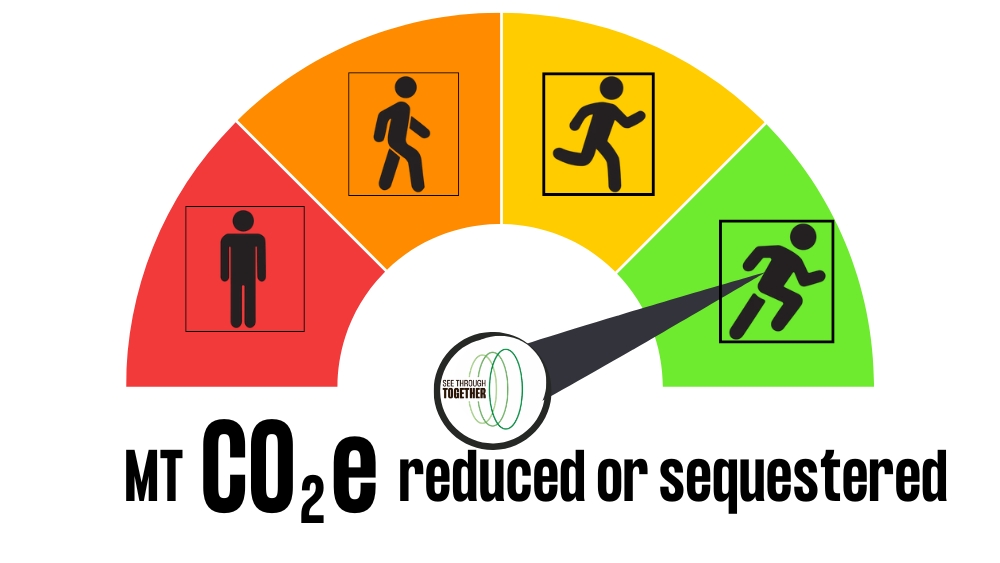
If your balance sheet is calculated in, for example, metric tonnes of carbon dioxide equivalent reduced or sequestered, does that change anything?
Break it down
Let’s apply these criteria to three broad areas that all entities, whether driven by profit motive or social issues, have in common:
- Users
- Contributors
- Colleagues
We’ll add some sub-categories, and apply some labels.
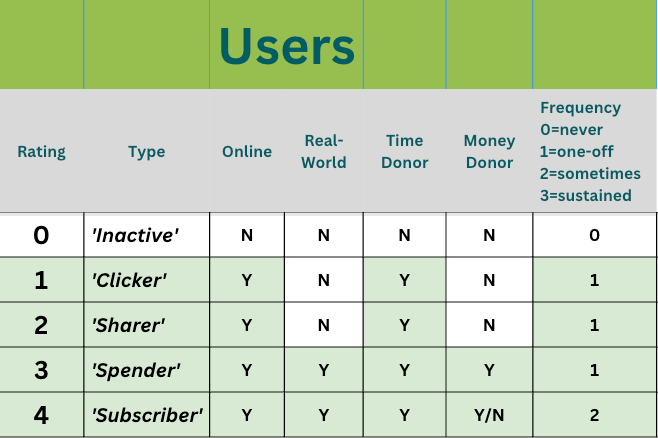
Here’s our proposed 0 -10 ratings system. See if the 11 categories pass your common sense sniff test.
Are they different from what you’d predict for businesses or NGOs with bank accounts?
Users
Users are the strangers that entities seek to influence, AKA ‘humans’ or ‘individuals’, or ‘us’. Users are the fleshy and bony bits attached to the ears and eyeballs you hope will hear and see – and respond to – your Call To Action.
Businesses call Users their ‘customers’ or ‘clients’. The better the business, the more granular and targeted their ‘target customer’ taxonomy.
Different businesses have different ways of slicing, dicing and otherwise categorising the 8.3 billion of us.
- If you’re selling fizzy sugar water, shampoo or social media data, you might aspire to reach all 8.3Bn.
- If you sell Fabergé eggs, private islands or aircraft carriers, your potential customer base is more limited.
NGOs call Users ‘the public’ or ‘our target audience’. Again, these might be very different depending on your particular mission:
- If you’re raising awareness of a medical condition, or eliminate war or poverty, you might aspire to reach all 8.3Bn
- If you’re lobbying to tighten government regulation on waste incinerators, or loosen regulation on cryptocurrency, you may only need to target a few hundred, or handful, of lever-holders.
Apply the activity criteria described above, and the See Through Network generates a 0-4 ratings table that looks something like this.
Is this what you expected?
Here are some examples and notes for each type, differentiated where applicable for:
- Businesses
- NGOs with bank accounts
- The (zero-budget) See Through Network
0, ‘Inactive’
‘Inactive’ are the Users who either fail to hear your CTA, or hear but don’t respond.
- Business example: someone whose awareness of your existence is undetectable.
- NGO example: ditto
- See Through example: ditto
Notes:
- Even for Facebook, Coca Cola, or Head & Shoulders, the Inactive = ‘most people’.
- Having a clear vision of your particular target audience is therefore critical, if only to inoculate yourself against a feeling of overwhelming failure.
1, ‘Clicker’
- Business example: a stranger who Views or Likes content advertising your product online, providing evidence of impact to shareholders.
- NGO example: a stranger who Views or Likes one of your social media posts, providing evidence of ‘impact’ for stakeholders.
- See Through example: ditto, except the View or Like is not the end of the journey, but a first step in a chain ending in metric tonnes of carbon dioxide equivalent being reduced or sequestered (‘MT CO2e’).
Notes:
- Views, Streams and Likes are valuable assets that can be traded for hard currency.
- The Attention: Money tariff is not as transparent as the US$:€ exchange rate, but it exists. Some people do make a living from YouTube.
- Some NGOs can claim their online campaigns were successful if they get loads of Views and Likes, as long as their metric for online petitions, email campaigns, is something akin to ‘raising awareness’.
2, ‘Sharer’
- Business example: a stranger who shares your expensive ad starring a celebrity, or an ad by a celebrity influencer you’ve paid. Sharing provides further evidence of impact to shareholders.
- NGO example: a stranger who forwards your petition to their friends, or shares one of your posts urging them to heed your Call To Action. Sharing provides further evidence of impact to stakeholders.
- See Through example: ditto, except the Share demonstrates the efficacy of that particular step of the engagement journey ending in metric tonnes of carbon dioxide equivalent being reduced or sequestered (‘MT CO2e’).
Notes:
- A Share is better than a ‘Like’, because it might turbocharge your content to ‘go viral’.
- A Share is roughly equivalent to a ‘Comment’.
- Weirdly, a negative Comment can be more valuable than no Comment, such is the value placed on bipolar engagement, AKA online ding-dongs.
- Like Likes, the Share multiplier effect is only as meaningful as the impact the business/NGO ascribes to online ‘engagement’ for their Goal.
3, ‘Spender’
- Business example: a stranger becomes a customer, by making a one-off payment for anything that ends up, in part or in full, in your bank account, e.g. a micropayment for goods or services.
- NGO example: a stranger becomes a supporter/donor, by making a one-off payment for anything that ends up, in part or in full, in your bank account, e.g. chucks coins in a collection bucket.
- See Through example: a stranger makes a one-off donation in kind, e.g. an unsolicited voucher for half a million dollar’s worth of data centre computing.
Notes:
- In both businesses and NGOs, the more senior the role, the more time and energy is devoted to generating income/investment/funding, or other forms of Money.
- For top echelons, the vast majority of their time and effort is devoted to Money, rather than the product (for businesses) or mission (for NGOs).
4, ‘Subscriber’
- Business example: a customer makes a regular payment that can reasonably be projected as future income, e.g. buys electricity, insurance, an annual software licence, or magazine subscription. More subscribers = more money = more success.
- NGO example: a supporter becomes a ‘member’, making a regular payment that can reasonably be projected as future income, e.g. joins a political party, pressure group, Morris-dancing group or table-tennis club. More subscribers = more money = more success.
- See Through example: a supporter makes a regular or permanent donation-in-kind, like stumping up web hosting costs or granting free access to commercial database. Or they might participate in a Call To Action, like signing up their business for the See Through Carbon pilot. Or, for individuals, register for On The Record. Whichever, all See Through CTA’s are ultimately measured in MT CO2e. More subscribers = less greenhouse gas emissions.
Contributors
‘Contributors’ are people or entities with whom you have an ongoing relationship that’s more intimate than a User stranger, but less intimate than a Colleague (see below).
For businesses, Contributors could include your:
- upstream supply chain
- downstream distributors
- influencers you hire to promote your products in some way, whether celebrities on TikTok or lobbyists in smoke-filled rooms and corridors of power
For NGOs, these may be
- Affiliated bodies with overlapping missions with whom you can pool or barter resources
- Volunteers with varying degrees of commitment and expertise who are essential to your business
Unpaid Contributors are common to both the worlds of business and NGOs:
- Unpaid interns are critical to the business models of many fashion brands, media production companies, or other glamour-adjacent businesses where demand greatly exceeds supply of paid positions
- Unpaid volunteers are often indispensable to the operations of many charities, trusts and NGOs, from festival litter-pickers to Trustees or Governers
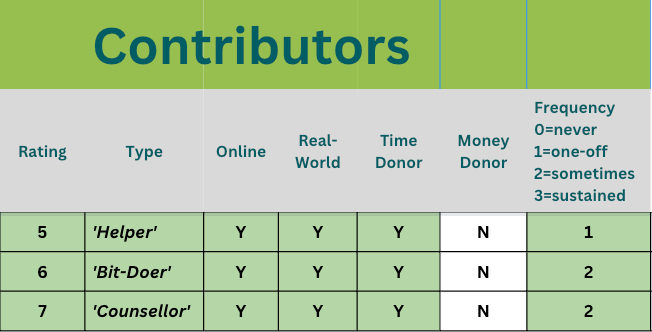
Here’s what a more granular taxonomy for Contributors might look like.
5, ‘Helper’
‘Helpers’ are supporters who do more than passively respond to specified CTA, but actively help to facilitate those actions themselves, with varying degrees of frequency.
- Business example: Businesses tend not to have ‘Helpers’.
- NGO example: Occasional tin-rattlers, village hall-painters, envelope-lickers, door-knockers who might turn up for specific events on an ad-hoc basis.
- See Through example: production crew in one-off events like Concert in the Key of C, volunteers to be filmed playing The Think Game or The Learn Game, interview subjects for How To Live Without Plastic, or children drawing entries for the Superhero & Supervillain Drawing Competition.
Notes:
- Businesses can easily enumerate their employees, via their payroll, and can differentiate between part-time and full-time staff, but there’s no obvious parallel for ‘contributor’ status.
- NGOs can do the same for their paid employees, and often keep volunteer registers for various insurance, health-and-safety and other compliance reasons for paying events.
- With neither the burden to keep track of payroll, nor the need to comply with commercial regulation, the See Through Network finds it hard to count exactly how many ‘members’ it has.
6, ‘Bit-Doer’
‘Bit-doer’s’, go a bit further than ‘Helpers’ to do their bit. The work may be similar, but the frequency is somewhere between one-off and sustained.
- Business example: again, not many. Festival volunteers, possibly?
- NGO example: participants in the Big Plastic Count, where households record their plastic consumption for a week.
- See Through example: participants in multi-day community projects like 1 Sunday Morning, 4 Films, Nairobi HIV orphans participating in the Global Reporter Intensive Training (GRIT) programme, or locals filming and editing The Vox Pox Project.
Notes:
- In general, Contributor categories only apply to NGOs, as most people,not unreasonably, expect to get paid if they’re helping a business make money.
- Social media giants like Facebook and Reddit have nonetheless succeeded in outsourcing quality control (AKA ‘moderation’) to unpaid amateurs. They are prepared to do what, for example, Wikipedia editors do for an NGO, for a business with a turnover of US$200Bn.
7, ‘Counsellor’
‘Counsellors’ contribute with a similar ‘sometimes’ frequency, but their contributions are more advisory or strategic:
- Business example: Non-Executive directors attending quarterly board meetings are close, but not cigar. They get paid, and not just in cigars.
- NGO example: Charity Trustees of School Governors would fit this bill.
- See Through example: The See Through Network has a global network of Advisors, experts in a wide range of disciplines, from the Global North and South, who can be called upon ad-hoc, or for ongoing meetings.
Notes:
- The question of whether a ‘senior’ advisor dispensing occasional pearls of wisdom deserves a higher rating than a ‘do-er’ executing their advice on the ground is not as obvious as we’re encouraged to think.
- During Covid, for example, we found out that ‘essential’ workers turned out to be relatively low-paid nurses, bus drivers, warehouse operatives, supermarket shelf-stackers, etc.. The world continued to turn with all the hedge fund managers, investment bankers, senior management, and other ‘bullshit jobs’, staying at home.
- It is nonetheless true that a 15-minute chat with someone who’s been there and done that can save weeks of wasted effort for the less experienced or expert.
Colleagues
‘Colleagues’ are people you work with, full-time or part-time, with regular, or significant sporadic, roles.
For businesses, Colleagues are ‘staff’ or ‘employees’. They appear on the payroll, with attendant statutory employment rights and status.
For NGOs/charities, Colleagues also fulfil mission-critical roles, full-time or part-time. Sometimes they’re paid, sometimes not.
If in doubt, pronouns are usually a good guide. If they say ‘we’, ‘our’ and ‘us’, they’re inside the tent. Cakes on birthdays, too, unless you work remotely.
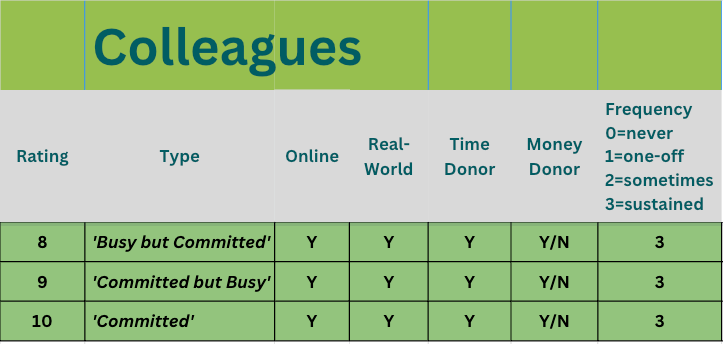
Here’s the See Through sub-taxonomy for Colleagues:
8, ‘Busy but Committed’
‘Busy but Committed’ Colleagues work for, say, 1-4 days a month in total.
- Business example: Contractors on contracts committing them a few days a month.
- NGO example: Volunteers or contractors who work a few days a month.
- See Through example: colleagues who perform specific roles on ongoing programmes, like the production crew who make See Through Together content like Ben Law’s Woodland Year or Room From A View, moderators for 1-5 of the See Through News-administered global network of Facebook community groups with total memberships up to 100,000.
Notes:
- There can often be overlap, or migration to and from, Contributor status, depending on the momentum behind any given project at a particular time.
9, ‘Committed but Busy’
‘Committed but Busy’ Colleagues work at least one day a week, maybe up to 15 days a month, on an ongoing basis, in service of the Goal.
- Business example: part-time staff.
- NGO example: part-time staff, and regular volunteers.
- See Through example: editors working on Ben Law’s Woodland Year or Room From A View, Back & Forth , or podcasts like The Truth Lies In Bedtime Stories, with regular new episodes.
Notes:
- While the main metric may be time – i.e. number of days – there’s often a correlation between the strategic input of the Committed but Busy and the amount of work they do.
10, ‘Committed’
‘Committed’ are those who work full-time.
- Business example: full-time employees.
- NGO example: full-time paid staff or volunteers.
- See Through example: See Through Network founder and Gift Horse Stable Master Robert ‘SternWriter’ Stern
Notes:
- An occupational hazard for the unpaid Committed is to be told they’re ‘privileged’ or ‘retired’, usually by people who have more money than them.
Other See Through Taxonomies
For systems thinking fans still hungry for more, here are few more of the taxonomies underlying the See Through Network’s approach to speeding up carbon drawdown by helping the inactive become active:
- Our 10-word Goal defines the Network’s desired destination and describes the broad process.
- Our 4-category Target Audience taxonomy defines our target audience (Unwilling Inactivists) & aspiration (Effective Activists)
- Our 4-step Engagement Journey describes the process by which an Unwilling Inactivist becomes an Effective Activist
- Our 4-step C-Bomb Taxonomy categorises the engagement bait by how explicitly the climate Goal message is expressed
If you’re a User who’d like to help, click on all the links in the article, like and comment, share them widely, and subscribe to the See Through Newsletter.
If you’re interested in becoming a Contributor or Colleague, you’re more than welcome. Complete this form and we’ll be in touch.