
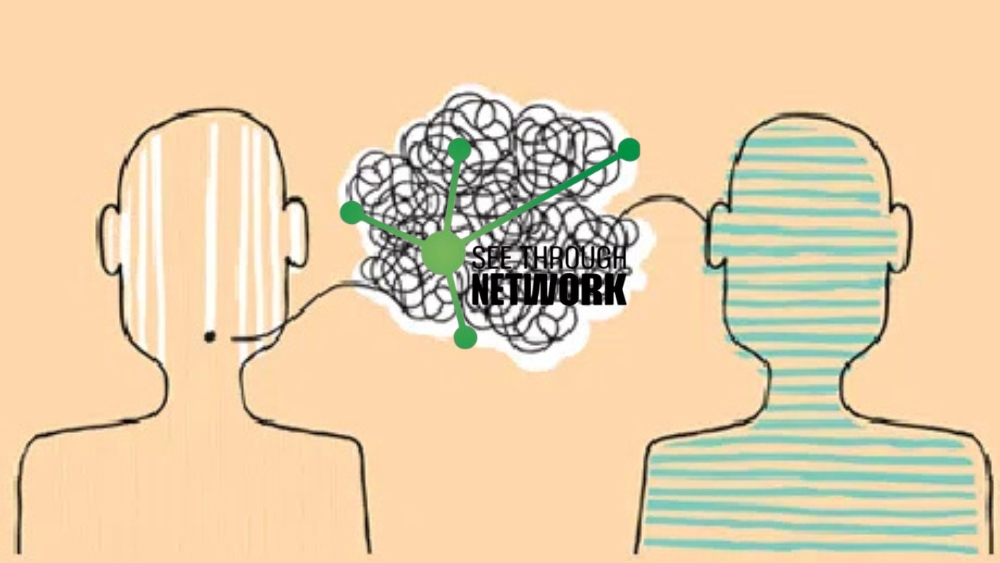
See Through Network’s guide to low-friction conversations with strangers when it’s your turn to say what they ‘do’.
This article is a See Through Network climate activist’s guide on how to respond when strangers ask ‘And what exactly is it that you do do?’.
Climate anti-climaxes
Climate activism, like everything, has become a culture war victim.
In a world of binary tribal affiliation, supercharged by social media, climate activists face the challenge of strangers demanding to know ‘Are you one of us, or one of them?’, without first defining a common definition of ‘us’ and ‘them’.
Sharing a planet may be the one thing we all have in common, but if a stranger suspects you of ‘saving the planet’, most conversations tend to come to an abrupt halt, or veer in a confrontational direction.
Self-identifying as a ‘climate activist’ to a stranger rarely prompts a warm embrace and tearful thanks for your selfless heroism.
Strangers are more likely to respond as if you’d just broken wind.
At best, you’ve shown poor taste in bringing up something unpleasant and leaving a bad smell.
At worst, you’ve committed an aggressive, hostile, threatening act of provocation.
It’s not easy, being Green
Timing is everything.
Display your ‘green’ status up front, deploying words like ‘green’, ‘climate’, ‘sustainable’, ‘environmental’ or ‘eco’, and you trigger three types of outcome:
- Pull: fellow travellers who share your tribal affiliations will embrace you.
- Push: those who don’t will abuse you, biff you on the nose, or even arrest you.
- Indifference: the vast majority will hold you at arm’s length, and disengage asap.
The Pull crowd already agrees with you. The Push lot never will. The Indifferent majority try to slope off – if that’s the first thing they get to know about you – but may be amenable to the right kind of storytelling.
This dilemma is familiar to anyone with non-mainstream views or natures: Marxists, gays, racists, Catholics, Shi’ia, atheists. Do you quell your true nature, or flaunt it?
What about climate activists?
What’s an effective climate activist to do when meeting strangers?
What’s your goal?
First, establish what you want from encounters with strangers.
Is your primary purpose, on meeting someone for the first time, to:
- Survive: avoid risk by concealing your status/identity until it’s safe?
- Perform: signal your status, whatever the consequences?
- Recruit: plot a mutually beneficial path they may be able to join you on?
Note that 1 and 3 are not mutually exclusive, but 3 is unlikely to work if you start with 2.
Before explaining why, let’s first consider what’s going on when one human meets another for the first time, both superficially and emotionally.
Why we don’t instantly kill all strangers
Ever since we were tiny dots on a vast plain, we’ve needed a plan for when we bump into a fellow tiny dot we’d not yet met.
For our fellow social apes who stayed on all fours in the forests, stranger encounters protocols feature things like eye contact, body posture, smell, and intensity of vocalisation.
Once humans started walking upright and developing language, other options came into play.
The first tiny dots were probably naked, carrying everything they owned, and not thinking too far past the next meal. Encountering a stranger was a risk, but could also be rewarding.
Then – as now – strangers could choose to club and rob each other. Rarely, this happens, but mostly not. The risks of violence are high, and the rewards uncertain or limited.
You can safely presume any stranger you meet is, by and large, making the same risk/reward calculations as you.
- ‘Nice spear.’, they may be thinking, ‘I wouldn’t mind having that for myself’.
- At the same time, they may be thinking ‘Nice spear. If we hunted together, we might both end up better off.’
The result of this evolutionary game theory is that – unlike online trolls – in most real-life encounters we tend to seek commonalities and avoid conflict.
Our first instinct is not war-war, but jaw-jaw.
Which is why, from the time we were tiny dots of a vast plain, we’ve learned the value of investing in some initial conversation before deploying our clubs.
A pleasant chat might lead to a more profitable outcome: useful information, tradeable goods, potential hunting or mating partners.
Or recruiting fellow climate activists…
From strangers to acquaintances, without blood
These days, we’re more likely to be two tiny dots crammed into a vast city.
We’re probably wearing clothes, and at a water-cooler rather than a water hole. Or in a park, on a bus or at a party.
Our basic strategy choices – Perform/Survive/Recruit – however, remain the same.
Human rituals are as elaborate and predictable as the mating rituals of a bower bird or puffer fish. Instead of twigs or shells, human tokens of exchanges are ‘conversations’.
Conversations between strangers follow a consistent pattern. First, they cautiously stake out the most obvious commonalities. Then they progress, via an elaborate dance with many hidden rules and unspoken urges, dynamically responding to the other person’s cues and clues, into an unspoken negotiation.
This negotiation is conducted through escalating exchanges of ever more personal information. Each new nugget we offer carries risks and rewards.
As we move from the general to the specific, opportunities for both collaboration and conflict increase. Not everyone goes at the same pace:
- Extroverts dare to go further, faster in their conversations.
- Introverts are more cautious, imparting personal information only when it feels safe.
If two strangers don’t share, or adapt to, a shared tempo, this makes conversations ‘awkward’, but they still follow remarkably similar patterns.
The same conversational alchemy takes place millions of times a second, when strangers meet at the water cooler, on the bus, in the park or at parties.
So what’s actually happening, when our magical exchange of words transforms the raw material of total strangers into the base metal of acquaintances, carrying the promise of future gold?
Here’s the template, with examples from vast plains and vast cities.
Step 1: establish common ground
We start with safe, neutral, generic topics we know we have in common, and are unlikely to lead to conflict:
- Weather: the sun is shining/the rain is falling.
- Traffic: you can’t move for all the wildebeest/cars these days, can you?
- Food: the berries are sweet now/these canapées are delicious, aren’t they?
Step 2: who and where
So far, so good. No need to bring out the clubs and start swinging yet. We now swap some basic biographical information about what to call each other, and to ascertain where we’’re from:
- Names: I’m Zog/Anita/Yexu/Bunny. What’s your name?
- Places: I’m from the hills beyond the river/Chingford/Kazakhstan/Accounts. How about you?
Step 3: show some ankle
So far, still OK. We now reveal more particular information, giving both strangers the chance to cautiously triangulate potential areas of agreement or disagreement, without giving too much away:
- Beliefs: I worship at the fire mountain/Finsbury Park Mosque/Saint John’s/Anfield. And you?
- Hobbies: I like to study the stars/whittle wood/paint animals. What do you enjoy?
- Events: I can’t believe they allowed that thing that just occurred to happen. What did you think of that earthquake/ministerial resignation/Twitter spat?
Step 4: get more personal
Time to take more risks. We now reveal something more uniquely identifiable about ourselves, and/or try to elicit the same information from each other.
If we go first, we frame our revelation in a way we think makes us most interesting or attractive to our new acquaintance.
If we invite our new acquaintance to go first, we elicit the information we find most interesting or attractive:
- Status: I’ve just got back from the fire mountain/a luxury Caribbean cruise/golf club. Do you have a boyfriend/wife/children?
- Wealth: I’m moving to a bigger cave/home/job. How many cattle do you have? Were you given that fur by your parents? Is that your Mercedes?
At this point, we arrive at the critical question, the prompt which this climate activist’s guide is designed to address.
- Occupation: I’m a farmer/hedge layer/hedge fund manager. What exactly is it that YOU do?
The right thing to say
Before opening your mouth, be clear on your objective (see What’s your goal? above). Are you hoping to Survive, Perform, or Recruit?
Survive guide
- Survive: avoid risk by concealing your status/identity until its safe
There are any number of ways of deflecting, avoiding, delaying, or side-stepping revealing that you’re a climate activist:
- I work in the non-governmental sector
- Oh, nothing as interesting as you. Tell me more about your field of accountancy/brain surgery/carpentry…
- Is that the time? Sorry, I should be somewhere else!
These extraction techniques are safe and reliable. They are unlikely to invite a switch to violence.
The only downside is that in avoiding any risk, you’ve denied yourself any chance of reward.
If your Goal is ‘Speeding Up Carbon Drawdown by Helping the Inactive Become Active’, you’re no closer to Recruiting than when you exchanged names and places.
Nor do you have a chance of Recruiting, until you switch to a more front-footed strategy.
But we strongly advise against adopting Perform mode.
Perform guide
If your goal is:
- Perform: signal your status, whatever the consequences
this guide is not for you.
Pre-emptive environmental virtue-signalling is a defining characteristic of what the See Through Target Audience taxonomy classifies as Category 2: Ineffective Activists. Here’s the logic:
- If your acquaintance turns out to be a fellow Ineffective Activist, you’ll both have a marvellous time, and may well become close friends.
- If they turn out to be a Category 4 Willing Inactivist, you’ll trigger a ding-dong argument where you talk past each other.
Both of these scenarios may well leave you feeling better about yourself. This is not in itself a bad thing, but if your Goal is Speeding Up Carbon Drawdown by Making the Inactive Active, you’ve failed in both parts.
Fortunately, however, your new acquaintance is statistically far more likely to be a Category 3 Unwilling Inactivist.
- Unwilling Inactivists – ‘those who accept the science and reality of human-induced climate change but feel powerless to do anything about it’ – are the See Through Network’s target audience.
The problem is, that by declaring your green credentials too clearly too soon, you’ve significantly reduced your chances of Recruiting them, for reasons we’ll now explain.
Recruit guide
- Recruit: plot a mutually beneficial path they may be able to join you on
Here’s the See Through Network guide to improving your odds.
It’s based on all the rhetorical trickery, storytelling shenanigans and behavioural psychology that underpin the See Through Network’s ‘Transparent Trojan Horse’ methodology.
And it’s a numbers game, filtering the strangers you meet to avoid time-wasters, thus optimising the time you spend recruiting potential colleagues.
Here are the four triage stages, illustrated by some typical dialogue at each stage..
Triage 1: the deaf
Stranger: So what do YOU do?
You: I measurably reduce carbon.
Be sure to articulate these words clearly, especially if you’re in a noisy environment like a party or pub, without being too obvious about it.
Say ‘I measurably reduce carbon’ in the same matter-of-fact tone you’d use if you were saying ‘I’m an engineer’, ‘I work in R&D’ or ‘I’m retired’.
‘I measurably reduce carbon’, not being a conventional or expected response, can benefit from good elocution, as it may avoid the need for repetition.
But – and this is the point of Triage 1 – for around 30% of interlocutors, it makes no difference.
Try this, and you’ll find that over time around one in every three strangers who ask you what you do, will respond to Triage 1 as if they were deaf.
The conversation (actually a punctuated monologue) will then proceed something like this…
Stranger: Great! Anyway, let me tell you more about the golf trip we’re planning next month. /
Good for you. Did I mention I’m about to take my advanced scuba diving certificate? /
Wonderful. I’m actually writing a novel at the moment…
Don’t be deterred or disappointed by this kind of reaction. People who don’t listen are unlikely to change.
Letting them twitter on about themselves is a great time-saver for you in the long run. It will make zero difference to the deaf, precisely because of their inability to listen.
As soon as seems polite, bail out and move on (unless you particularly want to hear them talk about themselves for other reasons).
Triage 2: the insecure
The sample dialogue for the remaining strangers takes a different turn.
Stranger: So what do YOU do?
You: I measurably reduce carbon.
Stranger (laughing): Sorry, I thought you said you ‘measurably reduce carbon’.
You: That’s right, I measurably reduce carbon.
Stranger: What do you mean by that?
You: I work with a global network with the shared goal of ‘Speeding Up Carbon Drawdown by Helping the Inactive Become Active’.
Stranger (puzzled): What do you mean by ‘carbon drawdown’?
You: Oh, ‘carbon drawdown’ is a) stopping burning fossil fuels, which transfers carbon from the ground into the air, and b) capturing the carbon that’s already in the air and putting it back in the ground.’
Stranger: That makes it sound like you’re some kind of climate activist.
You: Yes, I am.
If you think the above dialogue is unlikely, or that most people wouldn’t follow this pattern, try it. This guide is based on thousands of real-world conversations over years, in many different social and cultural contexts.
This is because these words conceal the underlying power/status dynamic. Stripped to its skeleton, the previous dialogue up to this point can be summarised thus:
Stranger: I’ve probably revealed enough about myself now. Your turn.
You: I’m a …[indistinct]
Stranger: You’re a what?
You: I’m a climate activist.
Both the full-fat and skeleton versions of Triage 2 end on the same cliffhanger, marked by the point at which you finally drop what the See Through Network refers to as the C-Bomb (where C is for Climate).
Why delay dropping the C-Bomb, if it’s going to happen anyway?
Storytelling technique. The most engaging way to tell someone something is not to tell them, but to get them to ask you exactly what you intended to tell them all along, by answering the questions you’ve induced them to ask.
Smuggling the word ‘carbon’ into an unfamiliar phrase like ‘carbon drawdown’ does not immediately expose you as a climate activist. It’s deliberately ambiguous.
After all, a mechanic who specialises in cleaning big ends might describe himself as ‘reducing carbon’, for example, as might a self-important chimney sweep.
By including the phrase ‘carbon drawdown’ in its goal, the See Through Network encourages the curious to ask what it means.
Everyone knows the words ‘carbon’, ‘draw’ and ‘down’, but almost no one has heard them stuck together, let alone understands what carbon drawdown is.
The only exceptions – lest you should chance to meet them at a bus stop or party – are:
- fellow climate activists (i.e. your tiny tribe of fellow Cat. 1 Effective Activists)
- professional climate deniers (i.e. a tiny subsection of Cat. 4 Willing Inactivists)
but you’re highly unlikely to meet either.
Triage 1 sifted out the deaf, but what happens now that your new acquaintance realises you’ve dropped the C-bomb, and knows you self-identify as a climate activist?
Triage 2 loses about half your remaining interlocutors.
You know which ones, because they’re the ones who suddenly lose all interest and enthusiasm for continuing the conversation. Listen out for responses like:
Stranger: Oh. So you’re one of that lot then.
Is that the time? I must be going.
Sorry, I just saw someone I need to speak to.
I think I’ll walk home – this bus is never going to come.
These are all polite get-out clauses for the insecure. Their honest internal monologues are more like:
Stranger: I was quite enjoying this conversation until now.
Not another lecture on veganism, especially as these meaty canapées are delicious.
The whole time I was talking about my Caribbean holidays they must have been waiting to flight-shame me.
I do my bit – I recycle and sometimes take the bus to work. I don’t deserve to be hectored by some tree-hugger.
Don’t be deterred when conversations suddenly end when you reluctantly drop the C-Bomb. You’ve given them no reason to fear you’ll lecture, hector or flight-shame them. This is all entirely in their own head.
The fact they don’t want to risk their self-justifying narratives to challenge their climate inaction is no fault of yours. Indeed, the point of Triage 2 is to give them a quick and easy exit.
Let the insecure make their excuses. Now you can both find someone else to talk to.
You never know, the next person you talk to may make it to Triage 3…
Triage 3: the inactive
By this stage, around a third of your initial pool of strangers remain. This rump cohort have demonstrated certainly necessary, but not sufficient, characteristics to be potential recruits:
- they listen.
- their self-narratives are secure enough that they keep listening post C-bomb.
- they’re in your target audience of Cat. 3 Unwilling Inactivists.
- they’re curious enough to learn more about a global network with the shared goal of Speeding Up Carbon Drawdown by Helping the Inactive Become Active.
Remember, at this point, this is all they know about you, beyond what their eyes tell them, the Who and Where basics, and the general chitchat that formed your initial conversations.
The good news is that you can now both enjoy the next hour or so. Triage 3 graduates will find the conversation fascinating. That’s because they’ve given themselves the chance to discover that your answers are totally unlike the flight-shaming lectures the Insecure cohort who bailed out at Triage 2 had anticipated.
A warning. The more of these Triage 3 conversations you have, the less interesting you will find them. The conversations will be novel for the stranger, but not for you.
Offset any tedium you may feel by:
- Remembering you went through the same process yourself to become an effective climate activist.
- Noting any variations in their responses from previous Triage 3 conversations or the processes predicted by this guide, to fine-tune your next conversation.
- Deepening their engagement by asking them questions too, particularly on whether/how the answer you just gave them might apply to their particular lives and circumstances.
After a dozen or so Triage 3 conversations, you’ll start to appreciate the predictability of:
- Your stranger’s questions.
- The sequence in which they ask those questions.
- The objections or challenges they raise to your answers.
So you can prepare, these main lines of questioning, in order of being asked, are:
- Money: who funds the See Through Network, and how can it possibly work without money?
- Government Regulation vs Individual Actions: aren’t individual actions just as important as government regulation?
- Privilege: it’s all very well for privileged people like you who can afford the luxury of being climate activists, but some of us have to make a living.
- Manipulation: isn’t your Transparent Trojan Horse storytelling methodology sneaky/ manipulative/dishonest?
- Metrics: how many people are there in the Network, and without funding, how do you measure success?
- Carbon Reporting: aren’t carbon reporting, offsetting and trading all the same thing? What is ‘Scope 3’ and why is it so important?
Triage 4: Good news/Bad news
- Good news: the final section of this article provides links to the answers to these questions. The Network has published hundreds of articles, all based on real-world responses from real-world strangers, experts, businesses, academics and other activists.
- Bad News: even if you commit every single article to memory, and spend hours providing compelling, comprehensive, fluent and passionate answers to every single question a Triage 3 graduate can think of, you’re likely to fail in your principal goal of recruiting them to join the network.
After investing hours answering all their questions, it can be frustrating, but there’s one more triage stage to go through.
Triage 4 starts when the conversation reaches its end – the last guests are leaving, the bus is approaching its terminus, or it’s getting dark.
Your stranger – by now, surely, an acquaintance or better – will fail Triage 4 like this:
Stranger: Well this has really been a fascinating and educational conversation. I’m delighted to have met you and I wish you all the best with your admirable efforts. Well done you.
You: Is that it?
Stranger: What do you mean?
You: Two hours ago I told you the Network’s Goal was ‘Speeding Up Carbon Drawdown by Helping the Inactive Become Active’.
Stranger: Yes, I remember – it’s a wonderful idea and I now fully understand it, thanks to your patient and comprehensive explanation.
You: But you’ve said you now agree with everything the Network stands for, and how it does it.
Stranger: Oh certainly. You’ve done a marvellous job in convincing me – I now understand I’m one of your ‘Unwilling Inactivists’, and why ‘Ineffective Activists’ are ineffective in measurably reducing carbon, and whatnot…
You: Precisely. You remember the whole point of our Engagement Journey?
Stranger: You explained it very clearly – moving the Inactive to Tempted, then to Intrigued, then to Engaged, in order to make them Active by taking up one of your Calls to Action, like joining the network or participating in See Through Carbon.
You: Exactly. So don’t you want to become an Effective Activist now?
Stranger: Now you’re just being difficult. I’ve been perfectly polite to you all evening. Why are you now ruining a lovely conversation by asking me to actually do something?
This can be frustrating, after all your time and effort, but Triage 4 is part of the process. The more you go through this process, the more alert you become for red flags, and the less time you’ll squander on time-wasters.
The fact is that not everyone, even the most intellectually curious, can bridge the cognitive gap between agreeing with the aims, methods and arguments of the Network, and acting on them.
If one in three of the strangers you get past Triage 3 make the final cut past Triage 4, and end up joining the Network or committing to do anything other than wish other people good luck while they remain inactive, you’ve done a great job.
For readers following the maths, this means only 2-3% of all the strangers you meet will end up joining you as an effective climate activist.
The Network even has an article to explain this – How To Use The Tour de France To Cut Greenwash.
If, of course, anyone’s still listening.
How to answer robust interrogation of the See Through Network
There are literally hundreds of See Through News articles covering every possible line of interrogation of the See Through Network’s approach, practice and definition of climate action.
There’s no need to read them all.
To prepare for the six question listed above – and lip-synch to them as they emerge from your interrogator’s mouths – here’s an abbreviated reading list:
- The See Through Network home page: covers all six questions in brief, with links to more detailed articles.
- The See Through News FAQs: cover the Network’s Goal, Money, Methodology, and Branding, in the form of entertaining Q&A dialogues.
- How To Do Good Without Money: pre-empts any assertions that the Network Goal is impossible without money by compiling similar assertions by previous strangers into the Ten Requirements. Recite them, check whether they miss anything out, let them know the Network reached #8 within 4 years, and ask if they have any further questions on the topic.
- The Big But – Climate Action, Inaction and Self-Delusion: a broader analysis of how and why people feel obliged to raise ‘but’s that might justify their inaction, rather than ‘and’s that would require them to become active. Designed to be understood by children.
How Many People Are There In The See Through Network?: gives far more information than most people asking the question actually want to know.