
In a Literature vs Business emissions-busting face-off, the smart money is on Tom Sawyer, Mr Merdle and The Magic Pudding. Especially if you have no money.
This article explains how pivoting from ‘please sir!’ to ‘don’t tell the others!’ works for the See Through ecosystem, and might even work for climate activists burdened by bank accounts.
See Through’s Carbon-Cutting Secrets
If you find management theory more convincing than literary heroes, stop reading.*
Spoiler alerts!
If you’re still reading, it’s only fair to disclose that this article does include brief references to some business management concepts.
Don’t tell the others, but:
- We’re downplaying the business jargon in order to trick people who find management-speak boring or baffling, but like reading literature, into reading this article.
- We’re only mentioning the fact that this article may contain trace elements of business guru jargon in order to trick people who never read literature into reading this article.
- We’re only mentioning either in order to trick you into taking actions that will speed up carbon drawdown.
Three Literary Hero Secrets
Right, now that’s all cleared up, let’s meet our three fictional heroes. Collectively, they hold the secrets to weaning Homo sapiens from its fossil fuel addiction and clearing the shortest path to a sustainable future.
These secret heroes form the foundations of the See Through ecosystem. We’ve not tried using them on entities encumbered by a bank account, but present them here as a public service in case they might still work.
They’ve worked so well for See Through that the entire ecosystem has ‘gone full Tom Sawyer’, adopting these principles for everything from marketing, to recruiting and corporate donations of goods and services.
As a revenue-free global network of pro bono collaborators dedicated to Speeding Up Carbon Drawdown by Helping the Inactive Become Active, See Through holds many advantages over NGOs, charities and businesses burdened by a bank account.
Still, in case aspects of See Through’s experience might be of service to money-dependent activists, here’s a brief overview of how Sawyerism can cut carbon.
Let’s meet See Through’s three literary characters, who hold the secrets to Going Full Tom.
Secret #1: Tom Sawyer
If you’re a literary type who already knows all about Mark Twain’s The Adventures of Tom Sawyer (1876), feel free to skip the next couple of bits. The rest of us will re-join you shortly.
If you…
- are unfamiliar with Mark Twain’s child genius salesman
- believe The Adventures of Tom Sawyer is a children’s book because its main character is a child
- have never heard of the eponymous hero of an American literature classic
…this fake Wikipedia entry will fill in the key gaps.
Too busy to read another article, and want to cut to the chase? No problem. Here are two executive summaries, one by Mark Twain, the other by the fake article’s author.
First, Twain’s vernacular, pithy description of the fictional Tom’s particular insight into human psychology, quoted in the article:
‘He had discovered a great law of human action, without knowing it – namely, that in order to make a man or a boy covet a thing, it is only necessary to make the thing difficult to attain’.
By contrast, here’s the article’s author’s less concise summary, ponderous with psychological and game theory jargon:
In turning a zero-sum game into a positive-sum, or win-win game, Tom – without recourse to outright lying – left everyone happy by the end of Chapter 2:
- Aunt Polly was delighted the fence was perfectly whitewashed and satisfied Tom had done his penance for skipping school.
- His friends were convinced they’d got good value for their payment.
- Tom was ‘rolling in wealth’.
The mechanism by which Tom achieved this outcome was the Framing effect, ‘a cognitive bias where people’s decisions change depending on how options or statements are framed, even when they are logically identical’. Tom’s own reflection on his triumph explains the framing effect as an expression of Reverse psychology: ‘
Welcome back to our literature-fan readers.
Now we’re all caught up those who skipped both executive summaries, let’s get to the point.
What on Earth can Tom Sawyer teach activists today about getting people to take carbon emissions-reducing actions?
What can a fictional character from a novel published in 1876, twenty years before the Svante August Arrhenius published his pioneering paper on what we now know as the Greenhouse Effect, possibly teach us about reversing global heating?
For the literary readers who skipped the executive summaries, and those who needed them, we already told you.
They’re in the article we linked to, and which you couldn’t be bothered to read.*
Secret #2: Mr. Merdle
The Dickens character Mr. Merdle personifies See Through’s second secret mentor in how to win friends and cut CO2.
Again, the literary types who already know Mr. Merdle as an exemplar of cynical manipulation and heartless greed are welcome to skip to the bottom of this section where we’ll reveal why he’s an appropriate role model for climate activists.
For those unfamiliar with Dickens in general, and Mr. Merdle in particular, here’s another brief introduction.
Charles Dickens was Twain’s Victorian contemporary, and his fellow expert observer of the human condition.
Like a bottomless dressing-up basket, Dickens’ vast cast of characters furnishes an archetype for all human frailties and virtues.
In our opinion, Dickens is a more reliable conjuror of memorable and acutely-observed exemplars than an ivory-tower-full of psychologists or a boardroom-full of business gurus.
Mainstream editors agree. That’s why, when trying to report on the latest time we’ve fallen for a Ponzi scheme like Bankman-Fried’s FTX crypto exchange, or inflated yet another asset bubble in the belief that ‘this time it’s different’ only to discover it’s not, editors turn to literature-literate journalists to make sense of it all.
Before explaining how the despicable Mr. Merdle can be a role model for climate activists, here’s a brief introduction, for those who need it, to this relatively minor character from Little Dorrit (1857).
When The Guardian commissioned Tristram Hunt (currently Director of the Victoria and Albert Museum) to reflect on the constancy of human folly and greed following the 2008 financial crisis, Hunt cited Mr. Merdle in his article Toxic debts, collapsing banks and endemic fraud… ring any bells?.
The Guardian published the article the month after the collapse of Lehmann Brothers. Hunt took a step back to examine the incident that triggered the global financial collapse through literary and historical lenses.
It’s worth quoting at length. It won’t be long before the next asset bubble bursts, financial fraud is exposed, or bust phase of capitalism’s boom-and-bust cycle comes round. All you need to do is bookmark this article, and substitute:
- ‘Sam Bankman-Fried’, Theranos’s ‘Elizabeth Holmes’, or the latest ‘name of the age’, for Mr. Merdle.
- ‘AI boom’, ‘crypto scandal’ etc. for whatever too-good-to-be-true get-rich-quick scheme Mr Merdle was peddling.
Here’s Tristan Bell:
Mr Merdle – is the product of the greed and materialism, the hubris and inhumanity, which dictate their lives and link their fortunes. Dickens, the great biographer of London, provides a glistening parable of the capital during one of its periodic bouts of irrational exuberance.
He was, above all, a writer of satire and social comment and was appalled in the mid-1850s by the damaging combination of officialdom, cosy embrace between the City and Parliament and the fraudulent practices of high finance undermining the state. Bank cover-ups, toxic debt and negligent regulation were as redolent a feature of the mid-Victorian epoch as now.
And Merdle was the name of the age: ‘Mr. Merdle was immensely rich; a man of prodigious enterprise; a Midas without the ears, who turned all he touched to gold. He was in everything good, from banking to building. He was in Parliament, of course. He was in the City, necessarily. He was Chairman of this, Trustee of that, President of the other.’ For when it comes to capital, as HBOS, Lehman Brothers and Bradford & Bingley have found, reputation is all.
However, like many a modern finance house, Merdle’s front was all fraud. Dickens modelled him on the railway speculator-turned-MP-turned-minister John Sadleir, who embezzled and then bankrupted the Tipperary Joint Stock Bank before killing himself. What makes Merdle’s crime more heinous is the insouciant connivance of the Circumlocation Office, a poorly disguised Treasury peopled by incompetent officials ready to sign off any amount of City sharp practice. Ring any bells?
But it is the way such widespread fraud percolates down which makes Little Dorrit feel such a contemporary indictment of runaway materialism.
See Through News is not averse to using a Dickens character to make a point.
Our 2022 gentle rebuke, Effective Altruism: An Open Letter from See Through News cites Mrs Jellyby from Bleak House (1853). When our article came out, mainstream media was still using Homeric terms to idolise the charity’s main funder, Sam Bankman-Fried. Within weeks of publication of See Through’s Mrs. Jellyby warning, Bankman-Fried was rumbled as the world’s biggest financial fraud, and the mainstream media reverse-ferretted into casting him in the star role of a Greek tragedy warning of hubris.
We mention this not just as a humblebrag about our prescience, but also to underline the power of literary characters in explaining human psychology.
So what secret does the contemptible Mr Merdle hold for climate activists?
Learn from Merdle’s methods, not his goal.
Everyone wanted what Mr. Merdle had because, like all successful Ponzi scheme artists, he didn’t try to ‘sell’ it. The less he appeared to push his sure thing investment, the more investors hammered at his door.
This strategy is just as effective when your ‘sure thing’ story is carbon reduction, and actually exists.
There is a respectable version of Mr. Merdle’s Ponzi peddling. Business gurus call it multi-Level Marketing, leveraging the network effect/positive feedback loop, or ‘viral marketing’.
From a climate activist perspective, Mr. Merdel’s lesson is that viruses can be good as well as bad. Joy is as contagious as grief. Contagion can reduce carbon as well as increase it.
That’s why to join the See Through Ecosystem is to become a recruiter, so long as you don’t tell the others.
Secret #3: The Magic Pudding
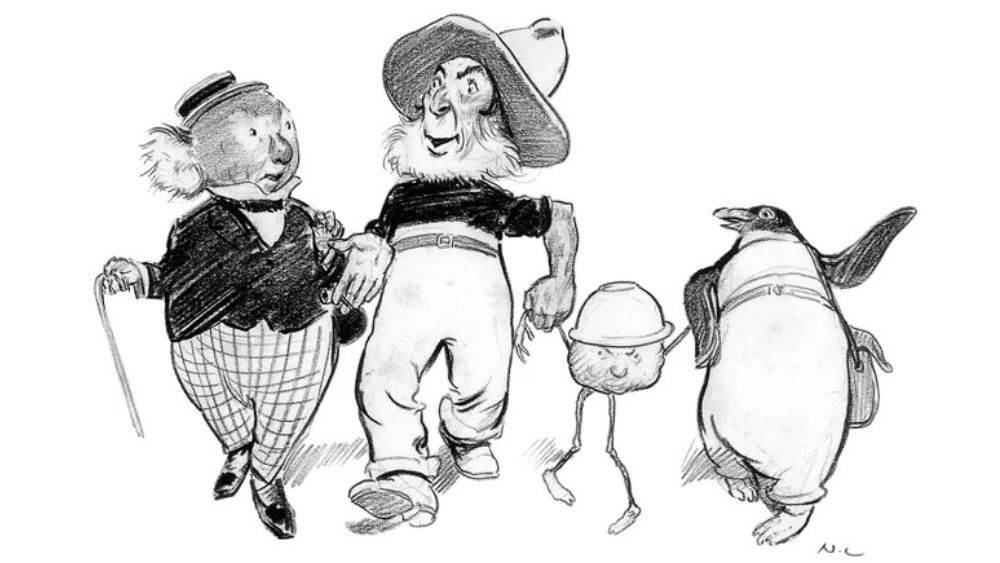
See Through’s third literary marketing hero is the eponymous hero of Norman Lindsay’s Australian children’s literature classic, The Magic Pudding (1918).
This picaresque romp, full title The Magic Pudding: Being The Adventures of Bunyip Bluegum and his friends Bill Barnacle and Sam Sawnoff, narrates the story – occasionally breaking into song – of a magic talking pudding named Albert.
No matter how often Albert is eaten, he reforms to be eaten again. Albert is ‘owned’ by three companions of dubious, but ultimately sound, character, who defend Albert against Pudding Thief rivals who try to assert their own ownership.
Lest Albert, an unco-operative type of pudding, mutters his secret advice to climate activists too quietly, permit us to amplify. We won’t burst into song, like Bunyip Bluegum, Bill Barnacle and Sam Sawnoff, but instead translate it into business guru jargon for the patient, baffled, non-literary types who are still with us.
If a particularly annoying Australian management consultant were to provide an exegesis to his unfortunate offspring when reading them The Magic Pudding as a bedtime story, he might explain that Bunyip Bluegum, Bill Barnacle and Sam Sawnoff were leveraging the virtuous cycle principle, or fiscal multiplier effect.
When See Through colleagues read their children bedtime stories, they trust Lindsay’s words and illustrations to do the job. Let the kids work it out for themselves.
In the same way, we’ll leave Albert there, and let you gentle readers discern the Magic Pudding’s similarities to the See Through ecosystem.
What use would an inexhaustible, unbeatable gift that grows with no fiscal ceiling created by a budget, funder or bank balance, be to scalable carbon drawdown?
And everyone lived happily ever after…NOT.
This is where See Through departs from the world of fiction.
Let us, literarture and business fans alike, returns to the depressing reality of our species. What can we do to deter those determined to chop down the last tree? How can we wean our fossil-fuel-addict fellows from their fantasy of infinite growth on a finite planet?
Not a happy ending, but just as the end of this article doesn’t kill the immortal Tom Sawyer, Mr. Merdle and Magic Pudding, our fossil fuel addiction need not be the death of human civilization.
All is not yet lost.
This is not The Hope Bit. We’ve already written about how to distinguish hope, false hope and despair.
It is, however, the bit where we emphasise the second part of the See Through Goal of Speeding Up Carbon Drawdown by Helping the Inactive Become Active. Not the objective science of the first four words, but the squishy, messy humanity of the final five words.
Effective climate activists must put sophisticated storytelling at the service of cold, hard facts. Funnelling facts alone makes it too easy for Big Oil’s storyteller – the PR experts, spin doctors and lobbyists. Now their employer’s vested interests in the status quo are yoked to our Silicon Valley Overlords’ data centre obsession, they have even more money, all the world’s social media, and much of the world’s old media brands, to tip the scales in their favour.
These advantages are in the hands of masterful storytellers. They know how to cultivate denial, and pivot immediately to despair. Effective climate activists like the See Through ecosystem seek to drive a wedge between denial and despair, and leverage it to induce ordinary people to match what they say they want, with actions that will actually make a difference.
The ‘good’ news is that climate activists have truth, science and real-world evidence of climate change on their side, instead of smoke and mirrors.
See Through may have a unique advantage in not having a bank account. There can only be one Best Story – or in management-speak, first-mover advantage in leveraging a unique reputational intangible asset.
The See Through ecosystem’s unique no-bank-account status is precisely what makes it unimaginably rich in the oldest and most valuable currency – stories.
Being uncontaminated by money, immune to wealth, untethered by the strings attached to funding, undistracted by fundraising, liberates See Through to be radically transparent.
Straplines like ‘if you can’t buy integrity, why should you be able to sell it?’ don’t come cheap.
See Through can demand payment in action, not cash. It can overtly trade its Best Story for individual and corporate time, goods, services, cash & eyeballs. As the business gurus probably wouldn’t say, ‘No Money = No Competition’.
Instead, the See Through ecosystem can turn to Tom Sawyer for inspiration.
Maybe other climate activists with payrolls, fundraising goals, sponsors to satisfy and bills to pay can find something useful in the See Through model.
The business gurus have a whole industry devoted to what they call the ‘Challenger® sales model’. Good luck to them for being able to monetise the idea of selling things by pretending not to sell them, but the fact that they’ve monetised it betrays the poverty of their ambition.
As the last fifty years have proved, carbon drawdown is way harder than making money.
It’s all in Chapter 2 of The Adventures of Tom Sawyer. Never ‘sell’, pitch, or solicit.
On the contrary, negotiate a high price for finding out What Happens Next.
No Money = No Dependency.
*examples of Going Full Tom
*
To speed up carbon drawdown by helping the Inactive become Active, you can click here if you promise not to tell the others.