
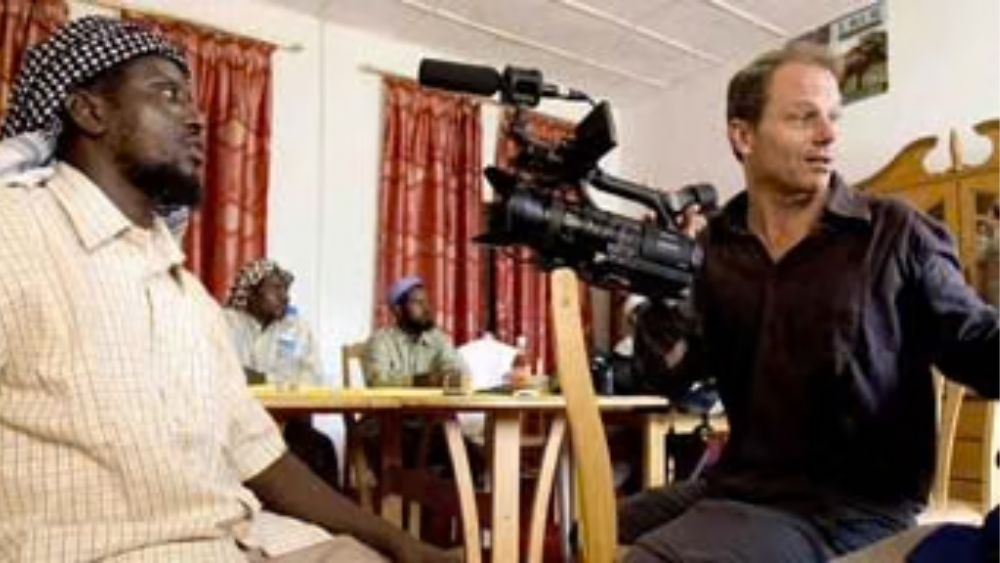
A Somali assassin who killed Martin Adler in 2006 helped found the See Through ecosystem. Twenty years after his murder, can Martin’s legacy trigger you to take climate action?
By Robert Stern, Founder, See Through Network.
A eulogy, without hindsight
This is the text of a previously-unpublished eulogy I gave to a roomful of grieving journalist colleagues twenty years ago, to honour Martin Adler’s extraordinary, curtailed, life, when I was still trying to smuggle climate stories past broadcasters.
Apart from adding some links, the text is unedited, as delivered at London’s Frontline Club in 2006.
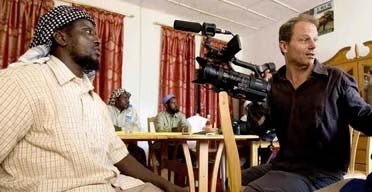
Martin Adler interviewing Sheik Sharif Sheik Ahmed, leader of the Islamic Courts Union. Photograph: Flemming Weiss Andersen
**
Martin Adler, 1958-2006
Many of you in this room knew or worked with Martin Adler, and will have your own memories of him.
But for those who didn’t know him, I’d like to give a brief account of his career, working methods and personality, and a couple of my own memories, before we start this discussion.
Name an armed conflict of the past 15 years and chances are Martin was there. Their variety and number bear repeating; El Salvador, Peru, Rwanda, Congo, Angola, Sierra Leone, Liberia, Chechnya, Bosnia, Afghanistan, Sri Lanka, Nigeria, Sudan, Eritrea, Indonesia, Iraq – and, many times, Somalia, where he was murdered filming a political rally on June 23rd.
Martin worked as a print journalist – mainly Aftonbladet of Sweden, where he lived – and also as a photojournalist – you can see some of his remarkable photographs here tonight – but internationally he was best known as a director/producer/shooter of television news features. Martin Adler was known as someone who would come back from the world’s most dangerous, chaotic and confusing places with stories distinguished by their courage, clarity and integrity.
Some of his stories won awards – an Amnesty International Media Award, a prize at the New York Film Festival, a Rory Peck Award. But just as significantly, some of Martin’s films were barely seen, or never broadcast.
Last year Martin disappeared to East Africa for a few weeks to do a story on the Oromo Liberation Front. As he would tell everyone, it was the story of how Africa’s 3rd -largest ethnic group has fought an armed independence war for more than 30 years, without anyone seeming to notice or care. The last foreign journalist to cover the war went years ago, and that was Martin. He funded the TV filming himself, but couldn’t find a broadcaster interested in getting a film made, so it never was.
Still, Martin approached this trip with exactly the same enthusiasm, commitment and preparation as he did for any of his award-winning stories, simply because he, at least, believed it was important.
The word ‘independent’ was made for Martin. He was as independent as they come, and in so many ways.
He was Professionally independent. Just in technical terms, he worked about as independently as is possible in what’s basically a collegial profession. He researched, produced, directed, filmed pictures and recorded sound on nearly all his own work, in some of the most difficult working conditions imaginable.
Martin was independent in the way he did Business: Not just in the usual sense of managing his own production, but also financially – he often funded his own trips – which gets to the heart of what we’re about to discuss. Martin did stories because he believed in them, not because they could get funded, and he didn’t want broadcasters’ funding to determine the stories he did.
Above all, Martin was independent by nature. He was relentlessly curious, questioning, challenging conventional wisdom by exposing the reality on the ground. His embed with ‘Charlie Company’ in Iraq in 2003, for which he won the Rory Peck Hard News award, exposed the truth of the US forces’ battle with the insurgents at a time when they were still thought to be winning hearts and minds.
I first met Martin, through Ron McCullagh, when we were both doing films for Insight 6 years ago. At the time Martin was in China shooting unofficially on a tourist visa, and having some problems. As I was living in Beijing, spoke the language, and had been doing news there for many years, Ron asked if I could give him a call and help him out.
I had a long phone conversation with Martin, during which I explained how doing journalism in China was different from everywhere else in the world, why he couldn’t expect to work in China as he usually did, the extent of the double handicap he suffered of neither looking nor speaking Chinese. Martin listened courteously, asked some focused questions…and then largely ignored my warnings to make the film, ‘Kidnapped Wives’, that won his Amnesty Award. The boldness of its conception, the resourcefulness of its execution, and the raw emotion of its impact, still astound China news specialists when they see it.
Despite my help on that story, Martin and I became friends, meeting to discuss our latest stories, the ways of the world and the business, hatching plans to work together one day. Last year we finally succeeded, when I brokered a deal for Martin to make a film for NHK from Iraq. It was the story of a Baghdad gym-owner’s obsession with Arnold Schwarzenneggar, and his quest to stage a body-building tournament in the midst of the growing sectarian carnage. Martin got the idea on a previous trip, when he drove by a hand-drawn billboard of Arnie. Impelled by his curiosity, he’d stopped by to find out more, and found an gem of a parable – Shi’ite, Sunni, Turkmen and Kurdish body-builders training bicep-to-bicep to pursue their shared dream of bigger muscles, their attempt to preserve their own normality as their country disintegrated around them.
He made a beautiful, typically Martin Adler film – inspired by his curiosity, driven by his determination, executed with courage and caution, crafted with originality and clarity of vision.
Martin’s death has left a gaping hole in the lives of all who knew him, none more so than for his widow and two young daughters, his parents and his brothers.
The lessons from Martin Adler’s life are clear, but what we’re now all struggling with is what we can learn from his death.
**
Martin’s legacy, with hindsight
Any temptation I had to film in war zones was terminated by Martin’s assassination.
We had daughters the same age. I’ve never been able to shake the image of his wife and children somehow getting through his funeral.
Whenever we spoke on the phone, or met, either in London, where he had a flat, or when he’d come to visit me and my family in Wiltshire, we’d always talk about our families first.
Of all the many things we’d discuss, our children, our fatherhood, and what we could do to prepare them for the world to come, was the most pressing and important to us.
Dad talk
Martin and I would also talk about our own parents, especially our fathers. We’d reflect on their influence on us, and how that informed our own efforts to influence our children.
Martin’s father was starting to show signs of dementia. My father was an eminent neurologist, and Martin would ask for my father’s thoughts on how best to care for his father.
The first time I met Martin’s father was when we shared a pew in front of Martin’s coffin, illuminated by sunbeams filtering through church windows.
I spoke to Martin’s father later at the wake, by a sparkling lake. Most of the attendees were family or fellow journalists.
We hacks, usually confident in most social situations, stood around, clutching wine glasses and nibbling canapés, torn between our impulse to network, swap war stories and socialise, and the bleak reality of Martin’s assassination.
Talking to Martin’s Dad made this already-surreal experience stranger still. He was an Anglophile, and I remember his enthusing about a London bespoke cobbler who many years before had made him a pair of shoes that ‘fit him like a glove’ (his English, like Martin’s, was impeccable).
This pleasant chit-chat was occasionally punctured by gut-punching realisations his son was dead. He’d then resume his memories of London, brow unfurrowed. Never has dementia seemed more of a blessing.
Funerals and the living
On the flight back to London I sat next to Ron McCullagh, colleague and mentor to both Martin and me, who’d introduced us a few years before.
Ron has won all the awards, and is a legend among news documentary makers, and a founder of the Frontline Club, set up to support independent journalists.
Ron is usually confident, wise, loquacious, articulate and omniscient. On that flight, however, he sat as stunned as me. Ron and I flipped between silence and incoherence, as we tried to process our loss.
I was 41, and Martin’s was the first funeral I’d attended. At the time I wondered whether my unfamiliarity with death, let alone assassination, might account for my confusion, but Ron had attended many more funerals than me.
As nature intends, I’ve been to more funerals over the past two decades, with increasing frequency. The more funerals, memorials and wakes I attend, the closer in age I am to those in the coffins, and the less odd that feels.
Repetition has not diminished the impact of Martin’s funeral.
I’ve tried to learn from burying my father. I’ve registered powers of attorney for my daughters to square things legally, and written guidance notes to reduce avoidable friction in the event of my incapacity, internment and their inheritance, for the non-legal bits.
But as I reassure my daughters, children burying parents, however upsetting, is the natural order of things. The alternative is far worse.
Seeing Martin’s father’s raw grief raw in the moments when his ongoing dementia didn’t spare him the pain, is not something I’d ever want to experience.
Just as hard was seeing Martin’s wife and daughters passing around the canapés, by the sparkling lake. The girls were young enough to find the party fun. Their mother was running on fumes, struggling to find the right platitudes to respond to our platitudes, as she faced life without Martin.
Reflecting on this now, I seek posthumous guidance from my greatest mentor and role model, my own father.
Martin’s assasination helped me see being alive at my father’s funeral as good fortune, not tragedy.
Legacy
My father when he was alive, like Martin after his assassination prepared me for coping with death.
Growing up, I eye-rolled at his ‘Dad-isms’, thinking them witty, rather than wise. Some favourites:
- ‘Life is a morbid condition with 100% mortality’. Takes on different meanings as we pass through youth, have kids ourselves, and test the outer limits of claiming to be ‘middle-age’ (I’m 61 now, and when asked my age stopped saying ‘I’m approaching early middle-age’ a few years ago).
- ‘Funerals are for the living, not the dead’. I never understood this until Martin’s funeral. Only after Dad’s own funeral did it strike me that as a neurologist specialising in neurodegenerative diseases, Dad’s day job required him to cope with patients and their families coping with creeping death.
- ‘I hope to die at the age of 100, stabbed in the back by a jealous lover’. It was a stroke just short of his 88th birthday, in the end, but I now see this gag as Dad’s way of reminding me that Death comes to us all, we know not when and how. We imagine it will come when we’re old and grey. No one expects to be randomly assassinated at work by a mystery gunman, in our prime.
These Dad-isms have become more pungent and profound with age.
As I attend more funerals, and shuffle closer to oblivion myself, I’m getting more comfortable with thinking about death, but also more focused on what happens beyond the grave, and a sense of urgency to do what I think important while I still can.
I’m not pondering any afterlife – why should an old person’s speculation on the unknowable be any more insightful than that of a young person? Rather, I’m thinking about what legacy I’ll leave among the living.
What Dad-isms will I bequeath my daughters? What trace of me will a Google search leave when I’m gone?
There’s nothing like a funeral to make you think of your own legacy. Delivering Martin’s eulogy triggered a review of my own ambitions. My urge to take action has grown as my remaining years tick away. The 20th anniversary has added a new urgency.
When others die, especially ‘too soon’, like Martin, the least we can do is reflect on what we choose to do with our remaining days.
- Are we squandering the years Martin never had?
- If we die today, will we have lived to the full the time we’ve had?
For many years after his assassination, the lesson I took from Martin was to try to be the best journalist I could, while still providing for my family. This has changed,
During my years as a documentary filmmaker, Martin was a role model in many different ways. I aspired to match his ethical standards, personal integrity, business acumen, entrepreneurial spirit, perseverance, determination, passion, craft, technical and storytelling multi-tasking, eye for a small story to tell a big story, and courage.
But as I’ve got older, I’m impelled less by Martin’s professional expertise, and more by his determination to live as meaningful a life as possible.
Martin’s whispers
When I quit making a living from journalism to set up the zero-revenue See Through Network in 2021, Martin had been dead for 15 years.
But he was still whispering in my ear when I decided to stop trying to scrape a living as a journalist, and devote my remaining years to being a climate activist.
The pulls of earning money to feed my family were gone; the pushes to spend my remaining years doing something meaningful were getting stronger.
My adult daughters were on their own career paths. Making a living as a journalist was requiring more effort, demanding more compromise, generating less money and almost zero satisfaction.
From dead horse flogging to gift horse distribution
By 2021, my successes in smuggling environmental greens beneath other more ‘engaging’ meaty topics, were fewer and further between.
The more CO2 we emitted, the more indifferent broadcasters appeared to be about its consequences. It felt like flogging the decaying skeleton of a dead horse.
The remaining commissioning editors, with their shrinking budgets, did not share my view that our climate crisis was the most important story to tell. They were too busy chasing the ‘eyeballs’ being snaffled up by our Silicon Valley Overlords.
If the mantra was to give the public what they wanted, there wasn’t much of a future for me trying to convince them to give the public what they needed. Climate didn’t cut it.
So five years ago I quit trying to make money, and started devoting myself to figuring out how to reduce carbon emissions instead.
This was a choice of conviction, not an appeal for sympathy, which was just as well. None of my family, and few of my friends, thought my career choice prudent. Some saw my switch to climate activism as a sign of mental illness, rather than as I did, as a sane response to a mad world. Some thought it was an ill-disguised mid-life crisis.
Martin,15 years in the grave, was not my only cheerleader, but was among the very few. This is a figure of speech, not a sudden conversion to spirituality. When I say Martin, I mean the legacy he’d left in me, and his whispers in my ear.
I was confident that Martin, an instinctive environmentalist and fellow-respector of science, would have applauded my decision. His encouraging whispers helped drown out all that sincere advice for me to be sensible, realistic or practical.
Voices telling me I was wasting my storytelling skills, production cunning, and remaining mojo on a wild goose chase were drowned out by legacy voices, like Martin’s and Dad’s.
They urged me to ignore the doubters, follow my passion, swim against the tide, and wished me luck on my quixotic climate mission.
Powerful things, legacies.
Who should I listen to?
Martin was cheerfully indifferent to age and status, but as he was six years my senior, it was natural for me to think of him as a mentor.
Weird to think I’m now thirteen years older than Martin was when he died. I still think of him as older and wiser.
Martin would have been the first to pooh-pooh such thoughts. For him, wisdom is in the eye of the beholder, uncorrelated with age.
We all know old idiots who spout idiocy into their dotage – Martin would have been the first to point out we even elect them to the highest office, had he lived to see the 2016 US Presidential election. For balance, Martin would also have repeated it with the elevation of every other idiocy-spouting idiot of any age. We’ve elected plenty of climate-deniers and climate-sceptics.
Martin would have pointed out that toddlers, unpolluted by guile and artifice, are natural truth-tellers. Ineffable wisdom is just as likely to come ‘from the mouths of babes’.
Age and wisdom
It might amuse Martin to know that I’ve found age matters less, the older I get.
I’m not yet at the stage where the downside of a knackered body kicks in too noticeably. I hope to have a few more years appreciating age’s benefits.
Experience has made me better at distinguishing authentic wisdom from cliché and cant, regardless of whether either comes from the toothless mouths of babes, or the toothless mouths of our elders.
Age has taught me to assume nothing, listen carefully, and judge people by their actions rather than their words.
Words are both important, and unimportant. Clichés are clichés because we recognise them to be true, even if we fail to live up to them.
On the other hand, reducing a life like Martin’s to clichés like ‘live life to the full’, ‘make the most of the present’, ‘no regrets’, and ‘never compromise your dreams’ does no justice to Martin’s attention to the meaning and impact of words.
If you’ve never had the good fortune to have known Martin Adler, or even to have heard of him, I’ve done my best to pass on what his life – and death – have taught me.
Martin Adler’s Lessons
So here’s what I’ve heard Martin tell me during the six years I knew him when he was alive, whisper to me in my head over the twenty years he’s been dead, especially now I’m struggling to address the bewildering polycrisis, with the climate at its heart.
Martin’s lessons aren’t neat, can’t be compacted into clichés. They’re the opposite.
Life is complex; its richness lies in nuance and the unexpected, not in simple answers. Just ask climate scientists.
Would Martin have thought following his passion, undeterred by compromise, expedience, convention or convenience, was worth dying for?
We did, of course, have such conversations. Even the most foolhardy war reporter reflects on the price they’re willing to pay to get to the truth, and Martin was one of the least foolhardy.
But he was wise enough not to spend too long thinking about it. Even alive, Martin knew when it comes to death, words are cheap.
Reckless war reporters who believe themselves invulnerable because they’ve dodged the bullets so far are not ‘wise’.
Functionally, they place a similar value on their life as suicide bombers who go into the same war zones determined to blow them up – or indeed a gunman instructed by his Somali warlord boss to kill a foreign journalist. There are many words to describe these kinds of people, but ‘wise’ is not among them.
Such existential questions are not the unique province of war reporters, suicide bombers and assassins.
We all face the same dilemma, because death is the one thing that awaits us all individually, and – unless we take urgent action on our self-induced climate crisis – our species.
Death and doing good
Martin made no grand claims about being willing to sacrifice his life for a higher cause because he’d interviewed enough young men waving guns saying the same thing.
War brings death, and death brings such questions into sharper focus, but we can all ask ourselves what the purpose of our lives are, at any point before our time is up.
Martin knew that a glib answer about the price he was prepared to pay for his life choices was no different from that given by any of those with less glamorous jobs.
Any young, fit, healthy person who blithely asserts they’d rather die than live in a wheelchair/on a ventilator/needing personal care/as a burden to our family is uttering similarly empty words. When you find yourself in that situation, you might give a very different answer.
Instead of futile pondering on an unanswerable question, why not ask more useful questions instead?
You now have an idea of Martin’s decisions and actions. You can make your own judgement about the consequences.
You can now weigh the complex, tragic, inspiring legacy Martin has left his family, friends and colleagues.
Here are the questions Martin Adler has helped me answer:
- Have you lived the best life you can?
- Will you live the best life you can for the rest of your life, however long it lasts?
I’m glad I didn’t say these things at Martin’s memorial twenty years ago. Martin valued sincerity, and these thoughts have only been granted to me by hindsight.
But now you know the legacy Martin left me, and how it influenced my aspirations for my own legacy, such as it is. I’d much rather die knowing I did my best to swim against the tide of climate indifference, than win any prizes for ‘raising awareness’, when it’s action that’s required.
So if any of it has chimed with you, what are you going to do about it, right now?
What Martin and I want you to do, right now
By all means read to the end of this article, so long as you end up doing one one of these four things:
Action 1: Record a Video for How To Live Without Plastic
Cost: $0, around an hour of your time & 100% transparency
Benefits: you contribute to an open-source repository of sustainable wisdom, & 100% transparency
Spend an hour or so to find someone old enough to remember life before plastic, record an interview with them, fill in a short form with their name, year of birth, etc., and send it to See Through Together’s How To Live Without Plastic project.
We’ll put the transcript (translated, if not in English) into its open-source database, due to soft-launch by 2027, and upload the video to the YouTube channel.
How To Live Without Plastic is ‘oral history for a sustainable future’, a global repository of human wisdom passed on by the diminishing cohort of humans who don’t have to imagine a plastic-free world, because they remember it.
We don’t guarantee it, but everyone who’s taken this action so far has found it a moving and meaningful experience, for both interviewer and interviewee.
Action 2: Get your business to sign up for an accurate, free, transparent carbon footprint report for the See Through Carbon Pilot.
Cost: $0, around an hour of your time, future-proofed carbon reporting compliance & 100% transparency
Benefits: accurate, free, transparent carbon footprint report & 100% transparency
Only available to businesses, but even if you don’t own one, or aren’t the decision-maker, you can get the credit for bringing this gift horse to their attention.
At the very least you’ll discover whether your employers are actually serious about carbon reduction, or happy to greenwash.
We don’t guarantee it, but everyone who’s taken this action so far has found it commercially beneficial, incontrovertible evidence of their genuine carbon drawdown commitment, and a differentiation from greenwashing competitors using discredited carbon credits, or paying for ludicrous ‘carbon neutral’ badges.
Action 3: Join the See Through Network.
Cost: $0, around 5min to fill in a form, & 100% transparency
Benefits: $0 from us, the chance to leverage See Through’s IP to get other people to pay you if you earn enough pro bono credit to become a trusted Partner & 100% transparency
Join our global network of pro bono contributors with the shared Goal of Speeding Up Carbon Drawdown by Helping the Inactive Become Active.
Click on the links at www.seethroughtogether.org, and you’ll see how you can help. There are roles for anyone with time to spare to contribute their time, skills and services, including IT support, web design, software development, filmmaking, music, podcasts, events, education, community outreach, carbon accounting, illustration, animation, marketing, writing, social media moderating, digital creation and administration.
We don’t guarantee it, but everyone who’s taken this action so far has found it a meaningful experience, gaining a share of the reputational gain of contributing to a climate action network with no bank account.
Action 4: Subscribe to the See Through Newsletter
Cost: $0, around 20 seconds of your time & 100% transparency
Benefits: weekly free newsletter with original, human-crafted articles, videos and podcasts, & 100% transparency
The See Through Newsletter has dropped into subscribers’ inboxes every Sunday since 2021. No data bought or sold. You can’t pay for it because we don’t have a bank account.
We don’t guarantee it, but readers have found See Through content original, entertaining, stimulating, and 100% impossible for any AI to have generated.
Shameless manipulation
If you’re looking for excuses for Inaction, or are feeling manipulated because I’ve baited you with the tragic assassination of a journalist hero two decades ago, just to manipulate you into taking climate action, you’ll have to come up with a better excuse.
For those quick to take offence on behalf of others, Martin’s brother Alan knows what I’m up to, and is fine with it.
I’m confident that Martin would not only approve of me ‘exploiting’ his assassination to manipulate you into taking climate action, but applaud it.
Storytellers’ craft secrets
Most of Martin and my conversations were not about the climate, wars, philosophising about broadcasters’ duty of care, or risk assessments, or even about the tradecraft and technology of one-man-band filmmaking.
We’d spend more time talking about our families, in particular the pleasures and challenges of being a father to two daughters.
But the topic that occupied us was even more mundane – the storytelling business, and how to make a living in a tough, competitive market.
Martin’s niche was hostile environments. Limited demand, but very little supply, meant it was possible for a smart operator to contrive a business model that allowed him to earn a living and feed his family.
My niche was leveraging my fluency in Chinese and Japanese to make a living in independent documentary filmmaking, and smuggling climate stories past climate-indifferent braodcasters whenever I could get away with it.
This was my strategy to act on my own growing climate concerns while still beating the odds in the huge-supply-tiny-demand world of indie docs, a structural imbalance that made it more of a ‘lifestyle choice’ than proper business. Yet I too contrived a business model that allowed me to earn a living and feed my family.
Martin and I discussed our respective business in great detail, looking for overlaps and common factors, sharing contacts and networks, swapping pitching tricks and storytelling craft.
We were two canny operators, twin entrepreneurs, brothers in ducking, diving and dodging, probing our unforgiving paymasters for unspotted vulnerabilities.
Swimming against the tide
Martin developed a habit of bringing a bottle of cranberry vodka whenever he visited, which we’d methodically drain as we brainstormed, after the kids had gone to bed.
Martin and I liked nothing better than spotting a new trick no one else had noticed, trying it out. If it worked for one of us, the other would try to adapt it in our own storytelling niche.
A few months before Martin was assassinated, we’d ducked and dived our way to scratching each others’ backs in dollar terms – or rather yen.
I brokered a deal with my main client, Japanese public broadcaster NHK, to make a bespoke edit for the Japanese market for a story Martin had filmed at a bodybuilding gym just outside the Green Zone in Baghdad.
All that brainstorming had navigated ourselves to a point where our realms overlapped, and we’d finally found a way to combine our unique skillsets to make money together.
Martin’s contributions to this joint venture were his courage, originality, eye for a story and filmmaking, Mine were my contacts, language, cultural, negotiating, and producing skills.
We both loved every second of making the Japanese version of Baghdad Bodybuilders, which he directed and I executive produced. Win-win-win, it seemed.
- NHK couldn’t believe their good fortune in getting such amazing storytelling without risking their own employees
- Martin had a new client
- I had another string to my bow of co-producing Martin’s films, as well as making my own.
We toasted our success with cranberry vodka. We’d conjured something from thin air. We’d engineered an outcome greater than the sum of its parts. Best of all, we’d added a new dimension to our 6-year-old friendship.
We were already planning several new projects, when a Somali assassin pulled his trigger in Mogadishu.
Twenty years on, I’m choosing not to mourn the loss, but to use my extraordinary fortune in knowing a fellow maverick pioneer for six years, twenty years ago, in the service of a project I know he would have loved. As a respecter of science, and a disciple of evidence, Martin was an instinctive climate activist. He too smuggled climate messages into his films whenever he could.
It’s easy to say ‘x would have loved y’, when x is dead. I know it’s not hard evidence, but Martin’s whispers are pretty loud on this matter.
He would have liked the See Through Network’s ingenuity, originality, no-bank-account integrity, its blend of serious purpose and sleight-of-hand execution, and the way it used the same metric as climate scientists, tonnes of CO2e, and not dollars, clicks, or subscribers.
All to do something new and different, mitigate human-induced climate damage, and improve the lives of our daughters.
I hope you’ve enjoyed the journey I’ve taken you on so far, starting with a eulogy for an assassinated war reporter, and ending in four invitations to take effective climate action to give our children a sustainable future.
If you, like Martin, find the nuts and bolts of storytelling interesting, it’s a textbook demonstration of See Through’s:
Engagement Journey process
Incremental C-Bomb rating (where C= ‘carbon’ or ‘climate’)
Target audience (you’re almost certainly Category 3, Unwilling Inactivist)
But the whole point of nuts and bolts is they’re invisible to people who just want to get from A to B, so feel free to ignore the conjuror revealing his tricks.
I hope you’ve found the journey interesting, moving, even entertaining, but making you interested, moved, and entertained is not my goal, nor that Goal of the See Through Network.
Unless you click on one of those links, I’ve failed, and Martin’s whispers were in vain.
Robert Stern
- Editor of See Through News
- Founder of the See Through Network
- Friend to Martin Adler, 1958-2006