
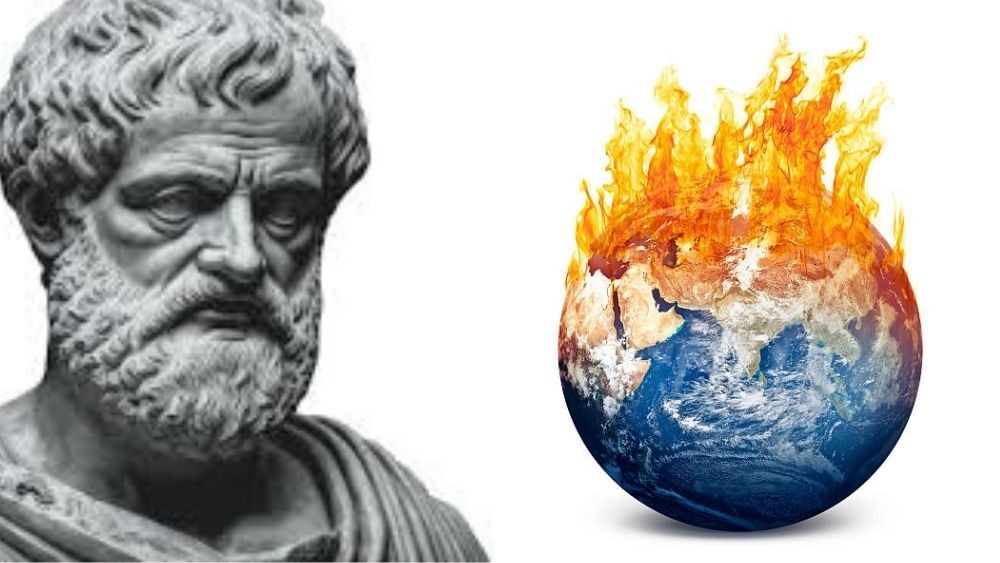
Aristotle reckoned humans are persuaded by reason, reputation and emotion, but money works too. Effective climate activists should exploit all four.
This article examines our fossil fuel addiction through an ancient Greek lens, questions whether money should be added to status, emotion and reason, and takes a view.
Persuasion
Animals survive by getting other animals to act in ways that benefit them.
Methods usually involve evolved physical tricks like:
- Force (big fish eats small fish)
- Deception (small fish fools big fish)
- Escape (small fish evades big fish)
Humans, when threatened in extremis by other animals and fellow-humans, still resort to violence, hiding and escape.
The evolution of language, however, has granted Homo sapiens a range of lower-risk alternatives.
Words, expertly deployed, can save us from the danger of violence, the cost of camouflage and the inconvenience of running away.
The silver-tongued don’t need to be stronger or faster, simply more persuasive. Language made it possible to persuade other humans to act to our advantage, simply by saying the right things to the right people at the right time.
This power has grown with time and technology. When we were tiny dots on a vast plain, persuasion was tougher. If we all knew each other and everyone saw each other every day, we could directly measure words against behaviour.
Civilization opened new possibilities to exploit the gaps between words and deeds.
As we gathered in larger and larger groups, we created more ‘strangers’.
The looser the bonds between humans, the more opportunities for the silver-tongued to thrive.
The Climate Crisis Persuasion-off
150,000-odd years after humans began talking, 10,000-odd years after we started farming and building cities, and 250-odd years after we started digging up coal, our ingenuity has landed us in a planetary-scale crisis.
At bus-stops, family dinner tables, offices, factories, bars, schools, in print, on TV, radio and online, we’re all engaged in the mother of all persuasion-offs.
It’s often described as a fight to ‘save the planet’. This shorthand betrays the hubris that got us into this mess in the first place, but can’t guide us towards a solution, as it’s not a meaningful goal.
The planet will be just fine. Five mass extinction events have left it unscathed, as will a sixth. The only remarkable thing about the current Holocene iteration is that one species is causing it, knows it, yet is not changing its behaviour.
Whether or not we’re bothered about all the frogs, birds, bugs, plants etc. we’re taking down with us, you’d imagine most of us might be bothered about our own species’ suicide.
The problem is, it’s not happening quickly enough, or locally enough, to move us to take action.
Our future may be at stake, but not quite now, and not exactly here. This creates plenty of space for the silver-tongued to exploit.
There are many orators, with many motivations, participating in this Persuasion-off, but for practical purposes they fall into two mutually exclusive camps:
- Team Keep Drilling: a tiny minority who profit from fossil fuels, armed with limitless funds, captured politicians, and the biggest megaphones, seeking to persuade us to keep marching towards the climate abyss. Their efforts tend to focus on another tiny minority – those holding the biggest levers of power.
- Team Stop Drilling: a tiny minority of human civilization fans, armed with science, verifiable facts and objective evidence, seeking to persuade us to divert to a sustainable path. They tend to focus on the vast majority with the weakest grasp on the levers of power.
An alien, or child, might wonder why we’re still debating between species suicide and survival.
Proximity to the crisis in time and space is a big issue, but not an insuperable one. As recently as the 1980s, we spotted a hole we’d made in the ozone layer, and quickly teamed up to fix it.
The greenhouse gas problem is far trickier because our brains are addled by addiction, and we’ve been on a 250-year-long bender.
How to kick addiction
Whether peddling oil or crack, drug dealers have the advantage when it comes to persuading addicts to keep using.
The odds favour the drug dealers over any friends, family or counsellors. A chance word from a stranger may trigger us to get clean before we hit rock bottom or die, but not often.
Those trying to help loved ones kick the habit usually face a long, hard journey, that might not get anywhere. Most addicts, most of the time, will choose one more hit, even though we know it’s lethal in the long run.
Consider the persuadee – the addict’s perspective shouldn’t be too hard to understand, as we’re all fossil fuel users to some degree or other.
The Keep Drilling drug dealer persuasion checklist is pretty straightforward:
Remind us of how flying is fun, food is cheap, and plastics are convenient
Bad-mouth our friends and family for wanting to deny us our pleasures
Smile while dangling another hit in front of our eyes
The Stop Drilling persuader checklist tends to follow the Keep Drilling agenda, but in reverse:
Lecture us that flying, cheap food and plastics are actually bad for us
Bad-mouth the drug dealers for profiting from our addiction
Frown as they confiscate the dangling hit and leave us to go cold turkey
The problem is that like all addicts, we’re self-obsessed. We think only of ourselves, and push away the impact our addiction has on those close to us, or our children. Arguments that indulge our selfishness are sweetly beguiling; arguments that confront it leave a bitter taste.
Smart fossil fuel addiction counsellors, like recovering former advertising executives, know how ineffective negative messaging can be.
They improve their odds of success by accentuating the positive. They describe the sunny uplands of being clean, not the gloomy abyss of addiction. They frame sustainability as a bright place of aspiration, not a dark pit of sacrifice.
But inertia requires less energy than momentum. Business as usual is easier than radical reform. No one ever got fired for buying IBM.
It’s time to consult the OG of rhetoric, the old Greek guy who literally wrote the book.
Aristotle’s Three Musketeers of Rhetoric
Say what you like about Aristotle, but learning from Plato and tutoring Alexander the Great, taught him a thing or two about the art of persuasion.
For the past couple of millennia, Aristotle’s treatise The Art of Rhetoric had been a primer for anyone serious about getting other people to do things that benefit you.
Politicians, hucksters, demagogues, priests and advertisers have come in different forms over the past couple of thousand years, but human nature hasn’t changed.
This ancient Greek philosopher boiled our main means of persuasion down to three categories.
Aristotle ’s Three Musketeers of Rhetoric were Ethos, Pathos and Logos, each playing its own Siren song:
- Persuasion via the speaker’s character (êthos)
- Persuasion via the hearer’s emotional state (pathos)
- Persuasion via the argument itself (logos)
The fact that modern persuaders are still using Ethos, Pathos and Logos is testimony to Aristotle’s deep insight into human nature, and how predictable evolution has made us.
Their English language derivatives (ethical, pathetic, logical) don’t exactly map onto their original Greek meaning, but are close enough to get the gist.
- Ethos: the go-to tool of the populist, influencer and celebrity. Anyone whose core message is ‘I’m great, so do what I tell you’, is playing the Ethos card. Donald Trump is an Ethos expert.
- Pathos: favoured by advertisers, brand promoters and marketers. Anyone whose core message is ‘This makes you feel good/bad, so do what I tell you’ is a purveyor of Pathos. By social media metrics, Christiano Ronaldo is the current top Pathos trader.
- Logos: the choice of scientists, academics and the educated. Anyone whose core message is ‘The facts speak for themselves, so do what reason dictates’ is a Logos lover. In climate activism, Greta Thunberg is a Logos legend.
The problem with Logos
The problem for, and with, persuaders who rely on Logos, is that they overestimate its potency.
Behavioural psychologists and economists are constantly proving it’s the force we rate highest in ourselves, lowest in our opponents, and is the weakest of the three in driving our actions.
Even if the speaker is a Logos-phile, who’s genuinely convinced by facts alone, and whose every action is driven by data, reason and logic, the same is unlikely to be true of the hearer.
Aristotle was very aware of this. His own keen analysis betrayed his personal preference for Logos, but he observed that when it came to persuading at scale, logos is always trumped by êthos and pathos.
A high-status hero, rabble-rouser or poet would prevail over a nerd, philosopher, or stat-merchant. For Aristotle and the ancient Greeks, with their petty and impulsive pantheon of Gods, this wasn’t ‘unfair’, just realistic.
Scientists and philosophers like Aristotle and his circle at the Lyceum were not dazzled blind by their own intellects.
They wanted their keen observation of the natural world, taking measurements, performing calculations, and presenting arguments for the robust interrogation of their peers, to advance human knowledge. They just didn’t expect their Logos would automatically move people from inaction to action.
More precisely, Aristotle recognised that when confronted by tribal status and emotion, reason was not a reliable ally.
A generation before him, after his Logos defence failed to move an Athenian court into dismissing charges of impiety and corrupting youth, Socrates had been sentenced to death by hemlock. Ethos 1, Logos 0.
Aristotle himself died from natural causes – let’s call it a draw, or a narrow victory for Logos. But within a generation Archimedes would die at the sword of a Roman soldier, unimpressed at being told not to distract the great thinker from the geometric calculations he was drawing in the sand. Pathos 1, Logos 0.
Not great stats for Greta-style climate activists.
The fourth musketeer – Dollaros?
What about money? Cold hard cash can be pretty persuasive.
When drawing up his list of persuasive tricks, Aristotle didn’t create a separate category for money. The Art of Rhetoric focused on what emerged from people’s mouths, not from their pocket.
But in his other great treatise on human interaction, Politics, Aristotle shows:
a) he had deeply considered money’s role in motivating people to action, or inaction
b) the denominations and numbers of zeros may have changed in two millennia, but the power of money has not
Aristotle observed that money’s taint accompanies most iniquity and immorality.
‘Men’s ambitions and their desire to make a profit are among the most frequent causes of deliberate acts of injustice’ may be the most quoted sentence in his Politics.
Aristotle probably demurred from adding Drachmos to his list of persuasive tricks because despite all its problems, he saw money as essentially neutral. Like swords, money was neither intrinsically good nor bad. The virtuous could use money to good effect, and the immoral to evil.
Today, we could update Aristotle’s ‘good or evil tools’ list with guns, drones, social media and AI, but his distinction about money being a neutral tool is still widely held.
We don’t tend to say ‘money doesn’t kill people, people kill people’ as often as the gun lobby makes the same point about guns, but that’s only because money’s role is so rarely questioned, and so frequently taken for granted.
Is Money Evil?
Timothy 6.10 provides one of the most misquoted Bible texts. More people probably say ‘money is the root of all evil’, than the correct ‘the love of money is the root of all evil’.
Priests, employed by hugely wealthy churches, admonish the ignorant by correcting the quote. They emphasize that the Bible was warning against the human sin of greed, not money itself.
But maybe we misquote it because it sounds more ‘right’. Money, after all, was invented by man, not God, at least a couple of millennia before the Apostle Paul wrote those oft-misquoted lines for his co-worker Timothy.
Debt was invented as a convenient alternative to barter and cowrie shells. Money was handy. It accelerated our transition from autonomous small dots on a vast plain to concentrated urban populations of strangers who needed governance to avoid chaos. It wasn’t on God’s Week One to-do list in Genesis.
Aristotle lived three centuries before Christ, but inhabited a similar world.
Christians might cite The Flood as a precedent, but Aristotle didn’t consider a species-level crisis. He neither knew, nor could he reasonably conceive of, a self-created threat that would supersede interpersonal argument, civil war and battles with other city-state tribes.
Aristotle couldn’t have reasonably foreseen our climate crisis, but he did foresee our folly.
Does our fossil fuel addiction mean we should see money not just as a potential solution, if re-allocated fairly, but as part of the problem?
Many climate activists are starting to see money itself, or the current capitalist model fuelled by money, as the root cause of our species suicide. Even if we wean ourselves off fossil fuels, they say, we’ll still over-extract something else that will promote our obsession with perpetual growth, and block our path to sustainability.
So long as we’re governed by an economic system that demands constant growth on a finite planet, and rewards the accumulation of capital with a greater share of available assets, they reason, sustainability is impossible.
From this perspective, money itself, in the guise of overt and covert, implicit and explicit bribery, is a persuasive force in itself, but one that will always favour the Keep Drilling drug dealers.
So, does our only sustainable future require the collapse of capitalism?
Or, is regulated capitalism flexible enough to replace the GDP growth metric with carbon neutrality?
Let’s not get bogged down
Practical climate activists, wanting to make a positive difference here and now, find this debate fascinating but futile.
It’s actually a perfect illustration of Aristotle’s three means of persuasion.
Such arguments usually start as logos academic debate, but rarely survive human intervention for long. Whether in a lecture hall, podcast, in person or online, it’s hard to keep the debate on the Logos tracks.
No matter how white the ivory towers, or how bespectacled the debaters, or how courteous the discourse, Logo’s more bumptious fellow-Musketeers will join the party.
Before long, Ethos will barge in, bristling with ad hominem weaponry:
- ‘Kate Raworth’s not a proper economist’
- ‘Piquetty has his head in the clouds’
- other ‘my economist is bigger than yours’ ding-dongs
Barrelling in behind comes Pathos, armed to the teeth with teeth-grinders and heartstring-tuggers:
- ‘You lot really yank my chain’
- ‘Communism has killed millions’
- ‘My mother told me on her death-bed to beware of your type’
Gunfight at the Last Chance Saloon
As Aristotle warned two thousand years ago, once Ethos and Pathos enter the room, Logos may as well leave.
So long as Logos is battling Logos, you have a chance, but once the other Musketeers enter the fray, Logos is left holding a knife at a gunfight.
If the Fourth Musketeer, Dollaros, joins in, Logos rarely stands a chance. Dollaros can dissolve most principles with the simple addition of one or two zeros to a bribe to do the contrary, even without Ethos and Pathos supplying their justifications.
So the prudent Effective Activist should re-assess the new bar-fight, reverting to the animal Force/Deception/Escape options. In this all-in, free-for-all, you’ll need all the allies you can muster, from animal instincts to Aristotle.
- Force: join in the new bar-fight on its own terms. If they deploy Pathos, counter with your own, even more emotional, Pathos. If they summon up Ethos, recruit more impressive influencers to your cause.
- Deception: Abandon Logos altogether, and ruthlessly exploit Pathos and Ethos. If you don’t, you can be sure that Team Keep Drilling will.
- Escape: Keep your powder dry. If you’re in a bar full of Willing Inactivists, you’re wasting your time, energy and resources.
And even if the debate keeps within civilised Logos guardrails, keep your eyes on the prize.
If none of the hot air will be captured in a balloon that will lift things, or compressed into a piston that will impel action, make your excuses.
Leave the ‘capitalism must fall for us to thrive’ camp and the ‘we can change the system from within’ brigade, to argue it out.
To make sure, you could retire to a corner, nurse your drink, and keep score:
- How many minds did this debate change?
- What changed as a result?
- How many tonnes of carbon dioxide equivalent did the debate reduce or sequester?
If the answer is zero, chalk it up as a win for the Team Keep Drilling incumbents, who benefit from inaction.
Effective Activists, keeping their eyes on the prize of Doing Something:
- move on to another bar to start another conversation
- keep Aristotle’s Three Musketeers on standby, deploying them as required
- maintain focus on outcomes, not motivations, which may mean not even mentioning ‘climate’
If you want to convert the climate inactive to become active, embrace Ethos and Pathos as allies.
Be wary of, but not distracted by, Dollaros.
Hold Logos close, but know you can’t count on the poor chap to do it alone.
**
See Through Together is part of the See Through ecosystem, with the Goal of Speeding Up Carbon Drawdown by Helping the Inactive Become Active.
Its Transparent Trojan Horse methodology deploys Pathos and Ethos, as well as Logos.