
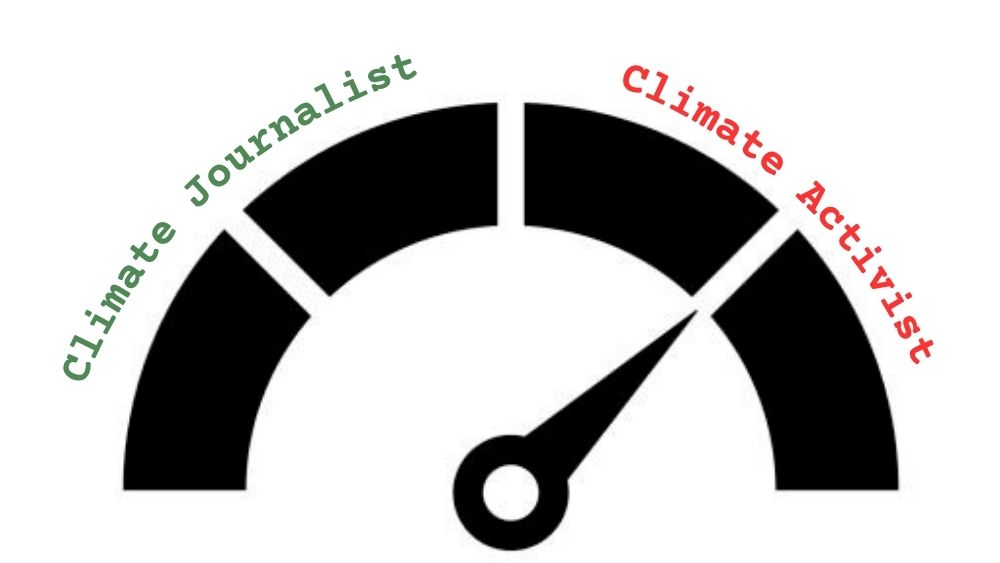
Climate journalism’s storytelling challenge is not adjusting the dial on the Reporter/Activist spectrum, but focusing on outcomes instead of motivations, and worrying about their audience, not themselves.
This article discusses the differences between a climate journalist and a climate campaigner, the stages in between, when to be what to whom, why it doesn’t really matter, and what does matter.
The article signposts its methodology en route.
Journalist/Activist Pop Quiz!
First, grab the reader with an eye-catching gimmick.
DON’T KNOW IF YOU’RE A JOURNALIST OR AN ACTIVIST? OUR POP QUIZ WILL REVEAL ALL!
You’re about to leave home, on your mission to make the world a better place:
1) Headwear: pausing at your front door, did you:
- adjust your trilby with a card marked ‘PRESS’ to a jaunty angle?
- strap on your papier-maché head-dress of a critically endangered newt?
2) Demeanour: glancing in the mirror before setting forth, did see:
- po-faced earnestness?
- pantomime gurning?
3) Resources: before locking the door behind you, did you check you’d:
- packed your notebook full of verifiable stats from credible sources?
- scribbled your slogan shortlist on the back of your hand?
Three a)s: you’re a Journalist
Three b)s: you’re an Activist.
Two a)s and one b): you’re a Journalist-Activist
Two b)s and one a): you’re an Activist-Journalist
Pros, Cons, Trade-offs & Risks
Quickly follow up with an unexpected plot twist, made more unexpected by spelling out its precise manipulation.
This questionnaire is, of course, bullshit.
But a pop quiz is a tried and tested tool to trick an audience attracted to polarized binaires into taking the first step along a path leading to detailed nuance.
Crude, obvious and crass? Yes. But if you’re still reading this, it’s worked so far.
To keep your interest, here’s another storytelling ruse. With luck, it will:
- Stop you clicking, scrolling, or swiping away (Job 1)
- Induce you to take the next step along this article’s engagement journey (Job 2)
Like the pop quiz, the box-tick uses lively, non-academic language, and a simple binary framing. Time to dangle some good ole’ bullet-point bait…
ARE YOU A JOURNALIST OR AN ACTIVIST? TICK THESE BOXES TO FIND OUT!
Tick all these boxes, and you’re a Climate Journalist:
Pro: I reckon that if I’m impartial, check the facts and follow the science, I’m a proper Journalist.
Con: I reckon my credibility, integrity and gravitas impress my audience. They reward me with clicks, likes and shares, but are slow to put their hands into their shallow pockets.
Trade-off: I earn credibility, but struggle to pay the bills.
Risk: I burnish my halo, but only in the company of other impoverished angels.
Tick all these boxes, and you’re a Climate Activist:
Pro: I reckon that if I rock punchy slogans, eye-catching antics and rabble-rousing rhetoric, I’m a proper Activist.
Cons: I reckon my activist credentials and badges impress my audience. They are quick to reward me with cheers and air-horns, but the decision-makers ignore both them and me.
Trade-off: I stoke authentic anger and righteous passion, but it usually dissipates into hot air.
Risk: I burnish my halo, but only in the company of other impassioned angels.
If only it were that simple
Drop the cheap teen-magazine tricks. Any readers still with us will now be impatient for a shift into a more subtle, persuasive, nuanced gear. For the next stage of the Engagement Journey, it’s time for some ‘proper’ journalism.
- The cartoonish Journalist and Activist depictions in the pop quiz and box-tick don’t reflect the reality of either tribe.
- Insisting on applying either label is unhelpful to anyone seeking a middle path.
This good sense is true for any scope of journalism/activism, from animal rights to climate denial, but it’s particularly pressing for ‘climate journalists’.
Climate journalists face a unique dilemma. Like theatre critics or sports reporters, it’s a struggle to make a living. It’s just much easier to pay the bills when your specialism doesn’t require you to bite, or bypass, the hand that feeds you.
We’ll address the issue of money in due course, but it’s first important to understand what makes climate journalism unique.
Why All News Is Climate News And How To Join The Dots goes into some detail, but the key takeaway is:
Climate Journalists’ should not exist, but it suits their bosses to pretend they do.
In a media world where humanity’s most urgent existential crisis is still siloed as a specialty, the ‘Environment’ is regarded as just another newsroom desk.
The Environment Desk is easily identified in a busy newsroom. It’s:
- the most short-staffed
- usually stuck in a corner by the toilets, or under the leaky ceiling
- the one with the wobbly leg and equally bockety stools rescued from a skip, with no budget to fix either.
A pragmatism of climate journalists
Keep the humour going, but use it as a bridge to the next stage in the engagement journey.
There’s no official collective noun for journalists. Some favour a ‘scoop’, less flattering options are a ‘gaggle’, ‘pack’, ‘gossip’, ‘hubbub’, ‘whinge’ or ‘sanctimony’.
When climate specialists gather, they tend to be more focused on what’s possible.
This was evident when a pragmatism of around a hundred climate journalists, editors, academics and PRs from around the world gathered at a ‘Climate Journalism Anti-Conference.
There was no abstract debate about what defines a Journalist and an Activist. No need for our pop quiz or box-tick questionnaires.
Instead, they talked turkey on the realities of working in the spectrum between these extremes. Practical questions included:
- How can I pitch a climate story to an editor or funder when ‘climate stories’ always get fewer hits?
- Even if I score a commission, how can I stop people switching off as soon as they realise it’s ‘climate news’?
- Anyone know anyone who funds proper climate journalism?
- How can we get our picture editor colleagues to stop using ‘fun in the sun’ images to illustrate articles about deadly heatwaves?
If you find this pragmatism surprising, the conventional binary framing we crudely illustrated at the start of this article may be the reason why.
Language matters
Now pivot to more demanding nuance to convey remaining readers to the next stage. Deploying a colloquial, rather than academic, register, might deter them from clicking/scrolling/swiping away to something less ‘heavy’.
- Why is it that ordinary people, the very audience that ‘climate journalists’ aspire to reach, are so bothered by the Journalist vs Activist binary?
- Why, when among fellow climate journalists, is this issue entirely neglected?
However annoying climate journalists may find being asked to declare their Journalist/Activist colours, this question deserves an answer.
Each journalist/activist must work out their own answer. There’s no one-size-fits all.
What’s critical is that climate journalists understand the language used to frame the question.
When words are your weapons, first assess your adversaries’ arsenal.
Campaigner vs activist
Is there a meaningful distinction between a campaigning journalist, and an activist-journalist?
Not really, but ‘campaigner’ helps soften the blow.
‘Campaigning journalism’ is a familiar term with a long and not entirely dishonourable history, It’s definitely more palatable than ‘crusading’, but also less threatening than ‘activist’.
Think of conventional campaigning journalism issues – immigration, poverty, preserving tradition in some form or other – and they’re actually climate topics in disguise, but hardly ever labelled as such.
If you’re ever in doubt, try inserting the word ‘climate’ in front of words like ‘refugees’, ‘poverty’ or anything else that media organisations fight to prevent or preserve.
Overt climate campaigning, on the other hand, is usually labelled ‘activism’.
Why? Because these functionally similar terms carry different emotive freight. ‘Campaign’ is positive, or at worst neutral. ‘Activism’ now carries a negative connotation.
This is no accident. Big Oil’s PR shills have systematically toxified the term ‘activist’. They’ve used the same well-thumbed playbook that worked so well for ‘woke’, ‘DEI’, ESG, and other terms coined in good faith, but have since been ju-jitsued by bad actors into terms of abuse.
Newspeak and doublethink
If you want to control the debate, the most effective way is to control the language of debate.
This is not a new idea, and it was well understood way before the investigation of the Internet and social media. George Orwell’s 1984, published in 1949 as the Cold War was chilling post-WWII optimism, gave us a whole new vocabulary for it.
Big Brother’s most powerful weapons for mind control of the masses were Newspeak and Doublethink. Fact-sticklers might be interested to note the novel never actually mentions ‘Doublespeak’, making it a rare example of a portmanteau derived from two portmanteaux.
As 1984’s doomed protagonist, Citizen Winston Smith, gruesomely discovers, thinking we know what these terms mean is no protection from their power.
Most are not even aware of linguistic manipulation. Therein lies its power. The terminological toxification of the word ‘activist’ by shadowy forces, conducted at the behest of a cabal of the rich and powerful, might sound like a conspiracy theory.
In truth, it’s not even a theory. It’s a well-documented strategy, costing billions and conducted globally over decades.
It has been forensically documented by media watchdogs like Drilled, their journalism (or is it activism?) based on disclosed legal documents and courageous whistleblowers (AKA ‘disgruntled ex-employees’).
We only mention it here because it’s not well known to the general public.
That’s how cunning those PR shills are, and what climate journalists are up against.
Twiddling The Reporter-Activist Dial
Nearly there. One last push. Bring it home with a recall to remind them where the journey started.
Remember our Journalist or Activist pop-quiz?
Armed with what we’ve learned since then, are the demands of being a responsible, credible journalist, and a campaigning, passion-driven activist, even compatible?
You can now imagine the convoluted, beard-stroking philosophising required for a sceptical questioner and a serious climate journalist to come to a mutually acceptable frequency on an imaginary reporter-to-activist dial.
Let’s say that after much debate, on-the-one-handing, consulting ethical guidelines and values statements, both questioner and the questioned manage to agree on some acceptable Journalist/Activist middle ground.
But even if both can shake hands, and stick a label on the dial at the exact boundary at which a Journalist becomes an Activist, the next questioner is sure to place it somewhere else.
The very notion that such a line exists is a fantasy, as useful in the real world as expecting Superman to solve our climate crisis.
We all knew the moment when the world’s most famous journalist/activist crossed the line: he popped into a phone booth, ditched his specs, and his underpants appeared outside his tights.
But Clark Kent/Superman is fictional.
100% of climate journalists who took part in this survey said they were incapable of turning back time by reversing the rotation of the planet.
Discussing the ethics of climate journalism is useful – that’s what this article has been doing so far.
Just don’t expect any meaningful answer, or for it to make much practical difference to the job of being a climate journalist.
Solutions, not problems. Outcomes, not motivations
We’ve arrived at the critical point of the engagement journey – the Call To Action. This plot twist reveals whether readers will stop just before the finish line, beyond which they will take action. Will they remain, still tantalisingly debating talking points while others cross it? Will they, like Unwilling Inactivists, choose this moment to lose interest and wander off to doomscroll, have a drink, or stare at the wall, frozen in despair?
For a climate journalist, a breath spent engaging with people asking where they lie on the Reporter-Activist spectrum is a breath wasted.
If they want to ‘make a difference’, they should use their reporter superpower to reframe the question in order that they can deploy their activist superpower.
Surely climate Journalist and climate Activist share the objective of helping the climate inactive become active. If you never move anyone to change their behaviour in a way that will speed up carbon drawdown, can you claim to be good at either job?
Look at it this way – is it possible to both understand a problem, and take action to fix it – without them being regarded as two entirely separate job descriptions?
Frame the question this way, and it becomes ridiculous that only journalists are held to this standard. Consider:
- No one talks about plumber-activists – how come they get off scot-free when they repair your gushing toilet?
- How come the high street laptop-reviver gets to replace your cracked screen without having their politics interrogated?
- Why don’t we expect the pest-control operative to justify their ethical position before we permit them to rid our kitchen of rats?
Are journalists really different?
Plumbers, gadget repairers and rat-catchers can all make a living without justifying their motivations.
If they say they do what they do in order to make the world a better place as well as turn a buck, we don’t dismiss them as hypocrites or con-artists.
The key difference then becomes not what you do, but whether it has any effect beyond paying the bills.
Does it leave the world a better place?
How to be a climate journalist
This is where it’s all been building. Good luck getting as many readers as you can over the line. Of hundreds you can get to start the journey, you’ll be lucky if a dozen end up crossing the line. Don’t despair, this is actually the job you’ve chosen.
IF YOU’RE WORRIED ABOUT BEING A JOURNALIST AND/OR CAMPAIGNER, HERE’S YOUR HANDY, CUT-OUT-AND-KEEP GUIDE!
- Think about where you lie on the reporter-activist dial until you’re comfortable with the answer. Now file it away somewhere safe, and start doing.
- If anyone asks you where you stand, briefly flash your prepared answer. Now use it as a starting point for steering the conversation away from your motivation, and towards their inactivity.
- Don’t shame, lecture, guilt-trip or waste time ‘raising awareness’ for its own sake – identify points of agreement. Now use them to speed your questioner along an engagement path that ends in them taking effective climate action.
- When your questioner is ready, offer them a suitable call to action. If you succeed in linking an action that will speed up carbon drawdown with making your audience the hero of their own new, better, narrative, you’ve made a difference. Well done.
A cheat-sheet to being an effective Journalist/Activist:
- Let others worry about your millinery. You’re under no obligation to pick a hat, especially when it’s only of interest to the eye of the beholder.
- The more interested anyone is in working out whether you’re wearing a newshound’s trilby or a protester’s newt-hat, the less likely they are to be interested in your message.
- Those obsessed with the messenger, rather than the message, tend to be externalising their own guilt at their inaction on you. The worse they portray your motivations, the better they feel about doing nothing themselves. It’s fine to point out their passive-aggressive projections, as they’re probably not even aware they’re doing it.
- Cold Hard Facts and Emotional Manipulation are not incompatible. A single step from the true path of objective journalism does not propel you on a slippery slope to ‘activism’.
- Don’t rise to the bait. Don’t let yourself be distracted. Be pragmatic. If they resist your first couple of attempts to switch the focus from your motivation to their inaction, bail out.
- The more your audience/readers query your motivations, the less amenable they are to taking any action themselves. If your goal is to take action, move on. There are plenty of other less sanctimonious fish in the sea.
- A climate journalist/activist’s true dilemma is to decide how much of your valuable time to invest in Unwilling Inctivists (i.e. those who accept the science and reality of human-induced climate change, but who feel powerless to do anything about it).
Money vs Carbon
The See Through ecosystem’s top FAQ is about how climate activism is possible without money. Pre-empt such questions thus.
The real-world issue facing most climate journalists is prosaic and bleak.
The easiest way to make a living from climate activism is to provoke an online ding-dong. Twitterspat, virtual pile-on. Outrage may be the enemy of rational debate, but it sure attracts eyeballs.
The modern media world is increasingly being driven by the attention economy, and it’s making your job harder.
Unless you’re lucky enough to be employed by a completely enlightened billionaire who pays your with no strings attached (phone number please!), have survived the latest round of redundancies at one of the rump publicly-funded broadcasters, work for an NGO that protects you from any funder bias, or are independently wealthy, this leaves you two ways to make a living:
- convert eyeballs directly into cash yourself (as a freelance journalist or independent influencer).
- use a middle-man (a news organisation, NGO, PR company or anyone else who pays you a salary).
You can then use that cash to pay your rent, put food on the table, educate your kids or address other levels of your hierarchy of needs.
But the planetary ecosystem that makes all this possible is based on carbon, not money. Something we’re made of, not something we made up.
Others may see your efforts to confront this reality as an eccentric hobby, a frippery, a lifestyle choice. Sceptics, normally insulated from climate change by wealth, will tell you climate activism is a luxury reserved for the rich, while ‘serious people’ (like them) deal with ‘real-world’ problems.
Pointing out that those problems were created by money, and so are unlikely to be solved by the same system, is unlikely to change their minds.
This is the real dilemma faced by climate journalists. Not how to justify themselves according to a framing designed by those who profit from inaction, but how to make meaningful change in a world designed for inertia, and corrupted by money.
Whether you’re running a business or an NGO, money usually trumps carbon, one way or another.
For businesses, it’s literally your job to deliver shareholder value. For NGOs, it’s more insidious, the drip-drip of incremental compromises, box-ticking and mission creep required to secure funding.
The See Through ecosystem does its best to evade the Money’s pernicious corrosion by not having a bank account, and relying on pro bono contributions, no-strings donations and barter instead.
Not having a bank account can’t entirely insulate its contributors and operations from the ‘real’ world where money talks, usually drowning out anyone trying to shout about the risks to our long-term health, wealth and habitat.
But reducing carbon without money, is surprisingly liberating and efficient. So if you have a spare hour or two in your busy lives, why not give it a try.
**
If you’d like to find out how the See Through ecosystem works, or if its Goal of Speeding Up Carbon Drawdown by Helping the Inactive Become Active appeals to you, visit www.seethroughtogether.org.