
Demagogues, populists, tech bros and Big Oil are bent on ripping up the rule book. What hope – and opportunity – does the regulatory battle hold for those hoping carbon taxes could help address our climate crisis?
Liberty vs Equality, Round Gazillion
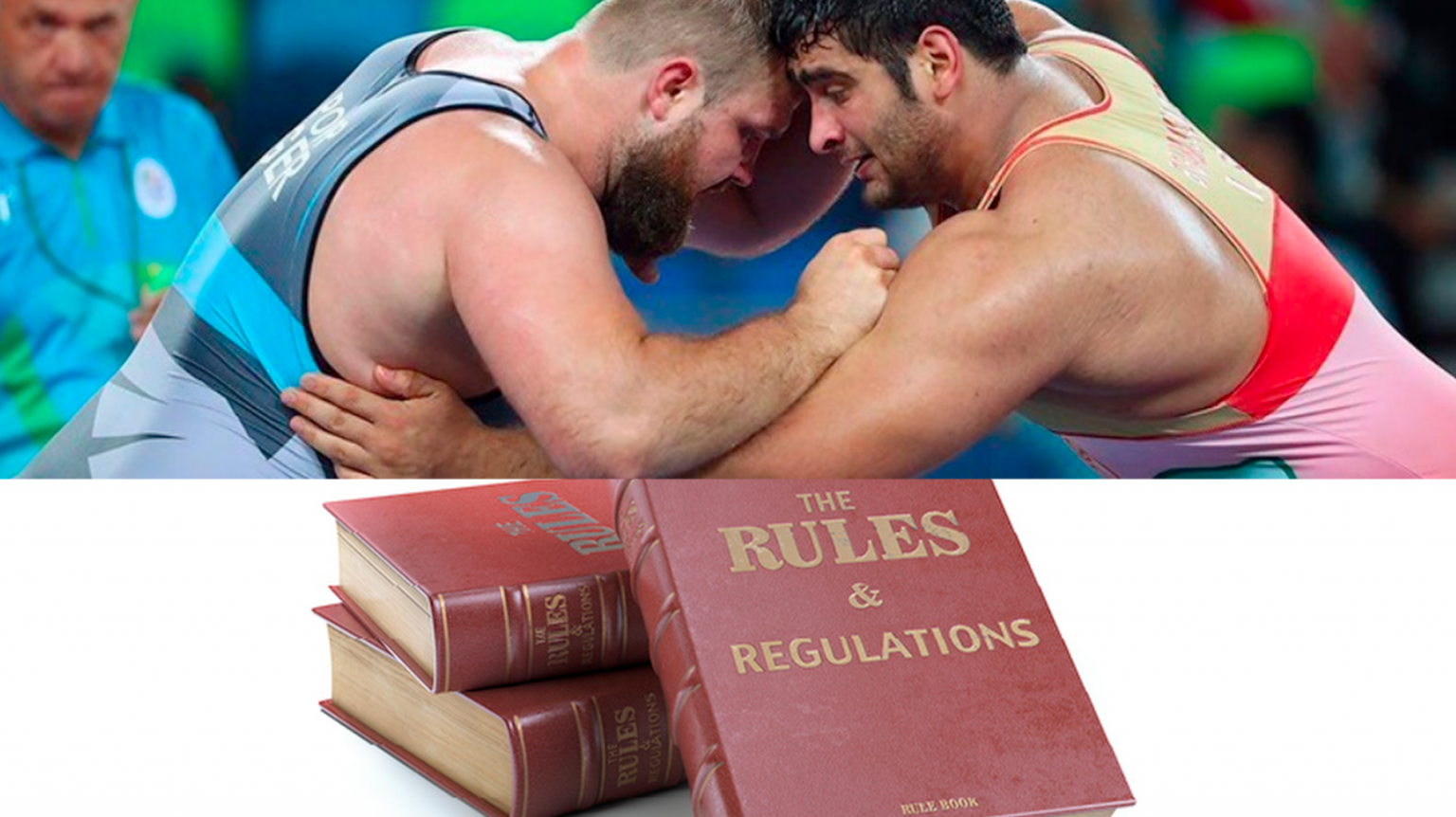
Liberty vs Equality is a no-holds-barred wrestling match, apparently without end.
It’s been going at least since humans started gathering in groups.
At any moment, either might appear to be on the verge of victory, yet is doomed never to finish off their opponent.
The more violent the assault, the sooner the attackers exhaust themselves. As they lose their grip, their battered opponent gathers strength. regains the initiative, and another round begins.
The grapple can include long periods of stasis. From a distance, it can seem the two fighters are locked in a mutually supportive embrace.
Look closely, however, and you can see their sinews straining and the sweat beading. The balance is never stable. Each adversary is constantly applying force, waiting for a moment of weakness to wrestle back the initiative.
Equality and Liberty go by names that cast themselves as heroes. Each declines to call their opponent by their chosen name, but uses villainous ones instead.
Team Liberty
In the blue corner, Liberty, brave defender of our rights to go about our lives unimpeded.
Liberty goes by many names, including Conservative and Traditional. Liberty likes to brand its opponent with negative tags: ‘Socialist’, ‘Militant’, ‘Marxist’. And ‘Oppressor’.
The more these terms are bandied about, the less meaning they carry, and the more confusing they become. Fans are happy to cheer on Liberty, less so ‘Dictator’.
Team Liberty self-identifies with certain phrases, which Equality is unlikely to use:
- Keep government small
- Unshackle entrepreneurs
- Slash red tape
- We need strong leaders
Other giveaways are phrases Liberty reserves for Equality:
- Nanny state
- Do-gooders
- Ideologues
- Naive
Liberty’s positive message has a long and honourable pedigree, full of heroes and great leaders. They prioritise individual rights. They fight for our right to live the lives we choose.
Liberty encourages us to see ourselves as tiny dots on a vast plain, picking and choosing the terms on which we engage with other dots to promote our own interests.
Team Equality
In the red corner, Equality, proud defender of the many against the tyranny of the few.
Equality goes by many names, including Progressive and Liberal. It too likes to brand its opponent with less flattering names: ‘Fascist’, ‘Tyrant’, ‘Dictator’,‘Autocrat’. And ‘Opressor’.
The more these terms are bandied about, the less meaning they carry, and the more confusing they become. Fans are happy to cheer on Equality, less so ‘Bolshevik’.
Team Equality self-identifies with certain phrases, which Liberty is unlikely to use:
- State support
- Protect the vulnerable
- Common purpose
- For the greater good
Other giveaways are the phrases Equality reserves for Liberty:
- Arch-capitalists
- Corporate vultures
- Profiteers
- Oligarchs
Team Equality’s positive message has a long and honourable pedigree, full of heroes and great leaders. They prioritise collective rights. They fight for our right to live the lives we deserve.
Team Liberty encourages us to see ourselves as tiny dots interacting with all the other dots, on equal terms and in our shared interest.
Law & Order
Look closer, and Liberty and Equality are not fighting each other, but vying for control of the Rule Book.
(If you’re starting to find the binary Liberty vs Equality wrestling metaphor overly simplistic, you’re right of course. In truth there’s a massive scrum of wrestlers of different statures and skills.
Other metaphors assign different power taxonomies, like the Three-Headed Beasts of Business, Government and Media, united below the neck by power, snapping and bickering to keep the rest of us from the deepest pools of the Money Mire.)
But even this wrestling match between two rivals is a much more subtle contest than it might first appear.
Depending on which chapter they’re wrestling over in any given round, you might flip affiliations. Sometimes you might not care either way. Other times you’re happy to let them get on with it, and go with whoever emerges victorious this time.
Still, in general, Equality appears bent on adding more and more chapters to the Rule Book. Liberty is generally determined to rip the whole thing up.
The Rule Book matters, because no group of humans can survive without a shared set of rules.
Liberty and Equality agree on many of them. Legislation and enforcement can’t work without rules, and many are based on our shared human nature. Liberty and Equality can both agree we shouldn’t go about killing each other without good reason, or grabbing each other’s property willy-nilly.
Stability requires order. Order requires rules. Rules need laws.
Every now and then Anarchy might jump in the ring, but is usually booed off.
The fight, then, is not over whether to have a Rule Book, but about who writes the rules:
- Are some chapters sacrosanct, never to be touched, like religious texts or founding constitutions?
- Are other chapters obsolete, quaint relics of a glorious but distant past?
- Do some chapters need to be edited, with updated dogma, revelations or amendments?
- When does the march of progress require entirely new chapters, rather than re-writing old ones?
This wrestling match moves with the times. As circumstances change, the battle ground constantly shifts.
Regulation ruck taxonomy
Nearly all rule book rucks, across recorded human history, fall into one of the following four categories:
- Decaying: fights subject to irreversible linear forces that steadily diminish in intensity over time. Science chips away at religion’s authority. Old battles – slavery or women voting – are abandoned. Ethnic disputes are resolved by annihilation or assimilation. Hatchets are buried.
- Ratchet: the inverse of decaying fights, as new linear forces increase in intensity until they can’t be ignored. New norms require new rules. As you tear up your rules for human sacrifice or public execution, you need new ones for prisons, courts, education, housing, health or whatever emerges in their place.
- Cyclical: always in play, but subject to forces that resist equilibrium. After every banking crisis, Equality beefs up the financial regulation chapter to ensure stability: before every banking crisis, Liberty removes them, in the interests of promoting economic growth. When growth is strong and jobs are plentiful, immigration rules are relaxed, only to tighten when economies dip. When crime is low, rehabilitation creeps in. When crime soars, incarceration returns to favour.
- Novel: new realities, brought about by war or technology, require new chapters. The League of Nations, the United Nations, nuclear non-proliferation treaties and pandemic lockdowns were inconceivable until they became essential.
This last category, designed to regulate new challenges, is the hardest to address.
The shock of the new
Regulating novel challenges presents particular problems.
The obvious challenge is that anything new demands new information and thinking. The consequences of agriculture, the printing press, the Black Death and Darwinism all had profound social impacts. Societies need time – sometimes generations – to agree on what the new rules should be.
As technological innovation accelerates, and their impact on our societies hits harder, deeper and faster, rapid adaptation becomes tougher.
Regulation necessarily lags behind adaptation, which in turn lags behind innovation. By the time we’ve all agreed on the rule book for AI, for example, it may be too late.
But there’s another even bigger existential crisis that’s now the subject of the Liberty vs Equality rule book wrestling match.
It’s not emerging quite as fast as AI, but its impact is not only incalculably bigger and more widespread, it’s more immediate.
Even worse, our usual wrestling attrition method to re-write the rule book is failing, comprehensively.
This particular crisis, it seems, is too overwhelmingly large for us to contemplate agreeing on a shared set of rules to adapt to it.
It’s easier for us to treat it as if it were too pifflingly small for us to waste energy wrestling over.
It is, of course, the climate crisis induced by our fossil fuel addiction.
Climate crisis rulebook
Scientists first warned the Greenhouse Effect was not just a theory, but a reality, in the 1970s.
That’s given us two generations for Liberty vs Equality to come up with a new Climate Crisis chapter for our rule book.
What have half a century of increasingly conclusive scientific modeling, decades of real-world data and dozens of COP meetings achieved?
- Rising greenhouse gas emissions
- Rising consumption of fossil fuels
- A trillion-dollar carbon trading industry
A comprehensive failure, by any reckoning.
Optimists might point to some instances of the new climate chapter of the rule book bringing positive results, after prolonged rounds of wrestling:
- a surge in renewable energy generation
- rapid transitions to electric vehicles
- a few countries eating less meat
- a breakaway COP for countries that take emissions reduction seriously
The best that can be said for such developments is that they offer hope. The worst is that they’re sticking plasters on a gaping wound.
In reality, they’re nowhere near enough.
We need urgent, concerted, radical global action, and nothing we’ve done so far suggests we’re going to write a new rule book in time.
Carbon trading – greenwash or green shoot?
Since the world’s first carbon credit was issued in 1988, one set of rules we’ve added has been the ‘carbon trading’ one.
The thinking behind it was – and remains – superficially attractive. If we price the environmental costs of burning carbon, we can leave market forces to work their magic.
If businesses had to pay carbon taxes in the same way they pay any other taxes, the logic went, we could transition to a sustainable future with minimal sacrifice to our globalised economic system, and minimal impact on the rising living standards we’ve grown to expect.
In theory, this could have worked, or at least been a significant contributor to a sustainable future.
In reality, it’s just created another way for some of us – mainly a tiny number of white men in sharp suits – to get richer, while having negligible impact on our rocketing emissions.
Little of this money makes its way to the Global South countries that carbon credits are supposed to reward for their restraint. Meanwhile, Global North countries continue business as usual.
The notion of a carbon tax could yet work, but we’ve barely begun to require companies to report their emissions at all, let alone treat carbon as seriously as money. The only effort to do so is still at the Pilot stage.
Instead, Liberty and Equality spend their energy vigorously wrestling over rule book Cyclical classics, like the chapter on the minutiae of financial taxes. This struggle is as old as the Egyptians who objected to Pharaohs taking a 20% cut of their harvests.
Or Liberty and Equality sweat and grapple over relatively minor Novel issues, like gender, drugs, sexuality, abortion and other Culture War tussles.
We expend much less energy wrestling over the climate crisis. The rules on money are as thick as a phone book. The rules on carbon tax barely fill a couple of pages.
Carbon reporting regulations are being treated as another geopolitical weapon:
- America isn’t even in the ring. Washington has entirely ripped up its first draft of carbon tax rules, and is also tearing out pages in the regulations restricting oil drilling.
- Europe is bickering internally about how to impose their rules. Brussels is wrestling with itself, with big business grabbing bureaucrats’ hands as they try to rubber stamp their ambitious Green Deal.
- China has written its own set of rules. Beijing sees Europe’s Green Deal as just another non-tariff trade barrier. They’re not wrong, but then again so is theirs.
Is there any way out of this mess?
Take a different seat
Maybe we’re seeing it wrong.
The problem is not so much the wording of the rules, the existence of the chapter, or even the rule book itself.
It’s the wrestlers.
The old Liberty vs Equality wrestling tussle, has managed to cover all of our preoccupations since recorded history, in some form or other.
It’s a very durable format, but in the climate crisis it’s now encountered a problem it cannot resolve.
Not because it’s insuperable. It’s just unwrestleable.
So long as we keep framing every attempt at change through the lens of individual liberty versus communal equality, there’s no prospect of taking the kind of collective action we need to preserve our individual liberty.
Think of this next time you see a ‘green initiative’ framed as a Liberty vs Equality tussle, like:
- Government cuts unpopular ‘green energy’ surcharge from household bills
- Outrage at ‘nanny state’ food labelling proposals
- Relaxed oil sanctions reduce risk of cancelled flights
Look up from the wrestling ring.
Start shouting to everyone about the tidal wave on the horizon, but rapidly approaching. Explain it will wipe out the wrestlers, the ring, and the entire audience unless we do something dramatic, together, fast, now.
Not every crisis can be resolved as a No Rules vs. Regulate Everything contest.
It just suits both sides to behave as if it is, until the show’s over.
***
To join those showing them how, sign up here.